Photography by Finnegan Travers
Bass, the low-frequency sounds that we feel in the pits of our stomachs, the depths of our guts, travels further than the snappy hi-hats that pierce our attention. During its travels, the sound of bass changes, it transforms, and asks us to do the same.
DJ and producer Batu’s label, Timedance, is a testament to bass-driven transformation in dance music. Since 2015, the label has been a harbinger of the future of left-field electronic music. Ten years later, Timedance has fostered a community of industry veterans, rising producers, and deep listeners collectively interested in pushing the seams of the genre with resonating bass and innovative sound design.
Timedance rests on the transformative power of dance music, its micro and macro impacts within communities. Albeit its roots in Bristol, the label is an international force that isn’t slowing down. Timedance celebrates a beautiful sonic decade by taking over the Aura Stage at Draaimolen Festival, gracing foliage and tree bark with soundscapes meant to melt time and space into a potion of hedonism, attention, and perspective. TD10, the label’s honorary compilation album, out on the 10th of October, pays homage to the values of Timedance and compels listeners to accompany them for another decade.
We had a conversation with prolific musician and label founder Batu encompassing the story of Timedance, his personal artistic inspirations, TD10, and much more. Read further to sink deep into a portal of sound and time – maybe it’s a dream, or maybe you’re floating in a subwoofer sensory deprivation tank.
Hi, lovely to talk to you today.How has the festival season been? You played at Dekmantel very recently.
Yeah, I played a lot of things in the Netherlands, actually. I mean, I played at Dekmantel, Lowlands, and then Dekmantel Selectors, obviously, in Croatia. And then it’s Draaimolen next weekend. Yeah, it’s been intense. But I really like it. At the same time, I really focus on my time, which revolves around DJing, and it pushes me to play well and be very engaged with that. I balance a lot of things, but these months have really been about DJing and trying to do that as well as I can.
Timedance is starting its anniversary celebrations by taking over Draaimolen’s Aura stage next weekend. How does it feel to be celebrating 10 years of the label?
It’s really crazy. It makes me think about when the label started and who I was when it started. I was 21, so there was a lot of very childish enthusiasm and innocence. I didn’t know what I was trying to do. There wasn’t a plan. There wasn’t a sense of trying to make a label that would be around for 10 years. It really was just a reaction to where I was. I had some music myself, which I wanted to release, and I had some friends around who were making good tracks. So, to think about everything we’ve all been through together and now at this new point, it’s quite crazy to think about, but I’m very proud of it all and happy things turned out this way. It’s a nice moment to think about all of the great memories of the last 10 years, for sure.
That’s lovely. Apart from the enthusiasm of wanting to release music, what pushed you to start the label? What space were you in that it represented that beginning?
Well, I think it was really the environment of the university. Where I met some friends, and we all shared a lot of musical values. I guess we felt somewhat outside of things. We didn’t live in London or a big city. We were in a small city called Bath. We all shared this passion to make a mark on the industry. I felt that a lot of what we were making didn’t really feel like there was a home for it. There wasn’t a clear space or direction where this music would sit. There were a few like-minded people who wanted to work together. Timedance just became a home for those people initially. A lot has changed now, but the start of it really was this very simple idea.
Obviously, the label is based in Bristol, and Bristol has a huge legacy in electronic music, ranging from trip-hop to bass-heavy experimentation. How do you think Bristol’s legacy shaped the unnameable corner of club music that Timedance occupies?
I think for me personally, sound system culture and sound system music is a big part of my DNA in electronic music. That’s something which Bristol really shares. That always had to be a big part of what I did. My interest in Bristol, before I ever went to the city, was with Dubstep. Artists like Pinch and Peverellist had this very open idea, I think, of what sound system culture could be. They pushed Dubstep into some interesting places, not-so-formulaic sounds, and incorporated influences from other sounds, like techno. That kind of mentality and principle of sound system music being this open format, where as long as you have certain things, like the physicality of the bass, you can really experiment and try different things. There’s a real sense of openness in the city musically. I think Timedance definitely tapped into that.
It’s interesting that the official celebration of the anniversary of the label starts in the Netherlands. What do you think this represents for the position of the label in the global experimental club music scene and its ethos?
Well, I think a big change the labels have had over the last 10 years is that the industry has moved from a very localised, small nucleus of music and producers, into something which is much more global and outward-looking. Paul and I, who is the label manager, both feel a lot of inspiration through scenes and music outside of Bristol and Europe. I think the label generally feels like a much more international thing now. I find inspiration in stuff that feels quite global to me. Although Draaimolen is a festival in the Netherlands, I see this shared interest in things that are pushing things forward, in looking deeper. We really share that kind of interest. So it felt very natural to collaborate with Draaimolen.
You’ve mentioned your values in musical creation, in representation, and distribution. Can you give me some insights into those values?
For me, I think clubbing culture makes room for interesting ideas. We have this space with dance music where, in subtle ways, you can hit upon ideas which feel unconventional, outside of the box, or tell us something interesting about the world that we haven’t thought about. I guess all art does that, but I think the functionality of club music can transport us into places. You’re on a dance floor, you’re hearing some music which may feel familiar to you. Before you know it, you’re in this different space which feels unfamiliar to you. Maybe you learn something, and there’s something to be curious about. I think there’s a real power in that. Because you’re a unified crew, you’re experiencing something together, dancing together. In terms of these ideas about non-Eurocentric clubbing culture, I think it’s an interesting way to broaden people’s perspectives within Eurocentric areas. We can use dance music as a vessel for empathy and broadening perspectives.
All of the Timedance’s releases are incredibly varied. The first release, your debut, Cardinal/Domino Theory, it’s incredible and feels like a dance in time in itself. It plays a lot with latency. How do you feel looking back at this debut and its role in your own artistic journey, as well as the labels?
I think that a few of these moments, especially at the beginning of the label, were points where I knew the music I was releasing was going to feel different. I think sometimes you can feel worried that people aren’t going to think the release is good. People won’t understand or they won’t like it. I think the first release kind of showed me that, actually, there’s more room for ideas outside of normal frameworks. And actually, people were really receptive. It gave me a lot of confidence that the label could do these things. I didn’t know exactly what that was yet, but I felt empowered that there was space for this left-field club music that my friends and I were making. That it could work. Now, being a little bit older, I actually trust more in the potential and risk we’re taking. Sometimes, when you don’t have certainty of how things are going to be received, it’s a good sign.
Do you have these moments often? Now more often than then, perhaps?
No, I think with time you feel more sure of yourself. But, they still happen for sure. I think if they stopped happening, that would be a good sign.
I was doing some research, and I read your previous interview where you opened up about where the name Timedance came from the persistence of bass through time. But obviously, ten years have passed since then. Has the meaning of the name shifted or deepened for you within this period?
I can’t remember what I said. But I would say that I think a lot about this idea that when you have very physical music on a sound system, those spaces, those environments, those rooms with lots of bass on a late night. There’s a point where you’re potentially quite sleep-deprived. Because it’s a very intense sound, I think it can play with our perception of time quite a lot. I think that’s interesting. I’m definitely looking for music that can have that effect on people. I think that sound systems are almost a form of psychedelic therapy or something very powerful within that.
How did you get into sound system culture?
I didn’t really grow up around it, but my heritage is Afro-Caribbean. So it was something I definitely knew about. There was a lot of music from my father from dub culture. This lineage really stayed with me. There are a lot of DIY-independent kinds of principles from sound system culture. The physical sound side of it was very clear to me from quite a young age. When I got a bit older, I got really into dubstep through my uncle, who was a dubstep teacher. This became kind of my church; I learned so much from that music. That’s what got me interested in producing myself. I still think the set of principles from sound system culture is really important to what I do and the way I think about music. So it all comes from my childhood really
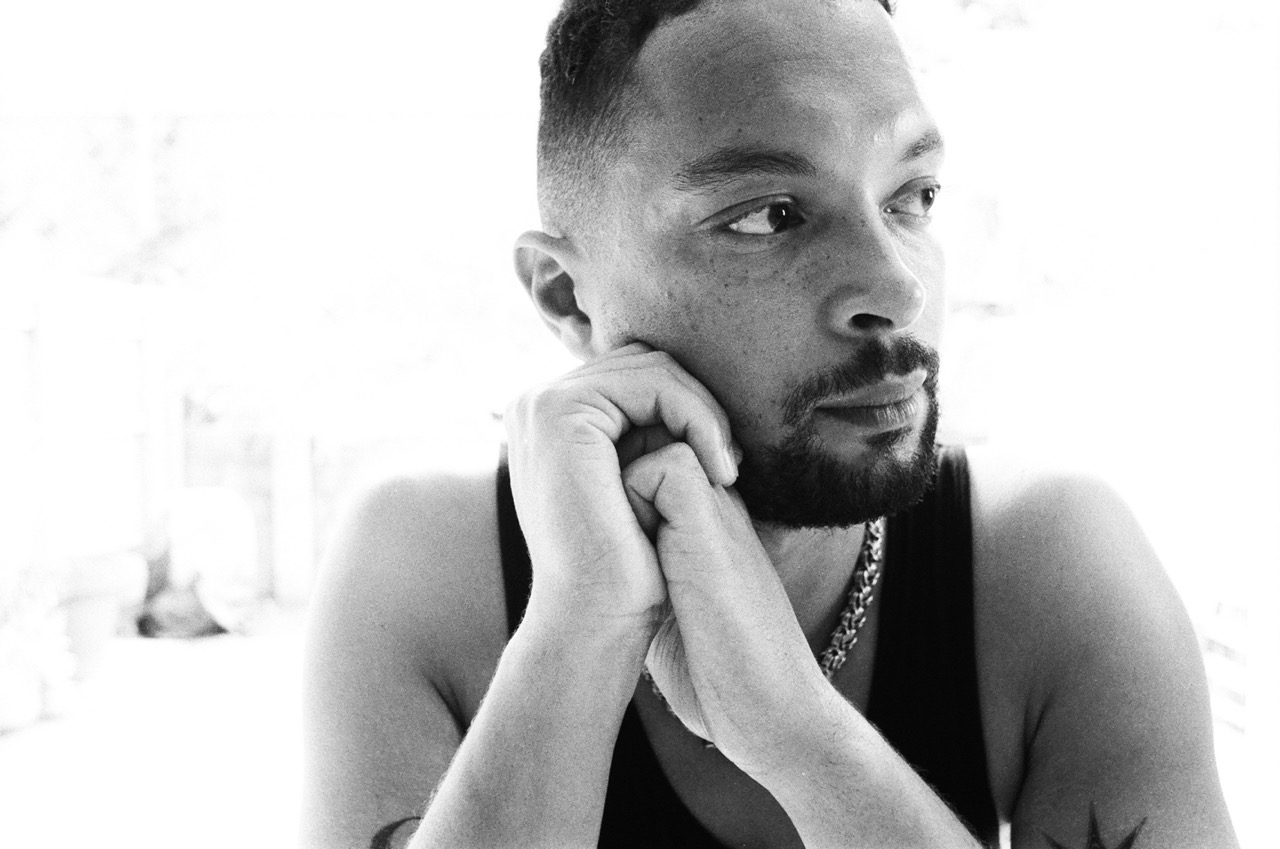
Photography by Finnegan Travers
Especially in your NTS show, A Long Strange Dream, and also your 2023 EP, For Spirits, there also seems to be a recurring theme of dreams and the subconscious within your work. Can you expand on how those ideas of dreams, memory, and the subconscious weave into your music?
I find a lot of the psychoanalyst Carl Jung’s ideas really interesting. Whether we’re talking about nightclubs or dance music. I find it fascinating how reality can feel a lot less tethered when you experience something special, something powerful artistically. I think obviously dance music feels very linked anthropologically to the ritual culture we have in indigenous communities. This idea of music, going on for long periods through the night, sleep deprivation, altered states of consciousness.To me, those kinds of environments feel a lot closer to dreams than they do to reality. I think a lot about that when I’m making music. I just find it fascinating this kind of area of thought within human research.
Have you had a weird dream lately? Or encountered a non-sonic object that made you feel like you were occupying a strange dream?
I watched a really good film recently called Certified Copy. It’s from an Iranian director whose name I forgot, although it’s in English and Italian mostly.. It’s a really good, dream-like kind of film.I think a really good piece of art often puts me more into this space. It’s not necessarily about dreams within our sleep; it’s more about how reality can be like a dream and vice versa.
To come back to Timedance, TD10 is set to come out on October 10th – what was the curation process like?
Well, I think initially it was Paul and myself, who run the label, were thinking about a few different strands of artists that we work with or we wanted to work with. Artists like Pearson Sound and Bambounou. Then we also wanted to work with some new producers or slightly less established producers who we felt could maybe be a big part of the next chapter of the label. There’s some Mexican producers, like a producer called Koi. There are a couple of younger artists from Bristol, like Yushhh, Jurango. So it’s kind of these three different groups, and then it just becomes about finding a way to make a story that attracts. Like, thinking about what fits and how it can fit together as good as possible.
The running thread in the project seems to be a very encompassing sound design. What do you think, specifically, about immersive sound design adds to club culture, to dancing bodies?
I think it’s always underpinned by a kind of physicality from the sound system culture. You know, if you need groove and you need bass, essentially, it’s like the main elements, that’s what makes the music work. On top of that, I think there’s room for experimentation. There are interesting ways to do that. If you think about dub music, there’s definitely this sense of the producer being a kind of mad scientist, like an experiment. To me, that idea should always be retained. As the tools change, as we move into new places technologically, I want to release and support music that represents this moment. There’s nothing wrong with old music. And learning about old music is really important to me. But at the same time, I think, we should use and embrace new technology We live in this age of amazing sound design tools; they’re actually very accessible. And that’s really fun for artists to play with. A lot of the identity of individual producers on the label comes from their sound design. That’s like their sonic language. So yeah, I think it’s really fun and interesting to play with this and for producers to make modern music based on this moment.
What do you see in the next chapter, in the next 10 years?
I don’t know entirely. I think someone described running a record label to me as this: you start off with your face against the painting, and every time you release the music, you start taking a step back and you see more of the painting. You don’t know what you’re looking for, what the direction is, but you’re just building a bigger and bigger picture every time. I think the philosophy of the label hasn’t changed really. We’re looking for interesting pockets of music, which are physical and based in sound system culture, but we are also looking to play with our form and to give people new experiences and new perspectives on what dance music can be. Maybe the way we look for it is different and more detailed now. 10 years ago, the label wasn’t looking in such a broad way. Now we have an increasing interest in music from all over the globe, which fits into this vision of what techno or dance music can be. I want to be there with new producers and be curious and support that, whatever that might be.
That sounds amazing. I hope to see that happen.
Words by Yağmur (Yago) Sağlam
Images by Finnegan Travers