“Some days it feels like the world is collapsing and making art seems completely irrelevant. Other days it feels like the only sensible response.”

Image by Jessie Connell
Mirjam Vreeswijk builds dreamlike universes that feel seductive but unsettling. Her paintings are glossy, alienesque, liquid, and feminine, like a poisonous flower, they’re as alluring as they are eerie. The dreamscapes she builds are like portals pulling you in the way that sirens do at sea: you know you shouldn’t get too close, but it’s too tempting to resist. So you let yourself drift in anyway, against better judgment. Once inside, you find yourself in a space you can linger in without ever quite knowing where it leads, an uncanny environment where something always seems to pulse just beneath the surface, a supernatural, emotional holding zone of sorts.
Her duo show opens today at Galerie Fleur & Wouter, following a period of loss and recalibration. We spoke to Vreeswijk about where she finds herself now, mentally, creatively, and inside the worlds she’s been building.
How are you at the moment, what’s been on your mind & where do you feel you’re “residing” mentally or creatively right now?
It was a heavy year for me on a personal level, and it inevitably shifted the way I work. While making this new series, I was reminded of what I love most about the making process: starting somewhere without knowing where you’ll end up and allowing curiosity to lead the way. I noticed that in the period before that, if you spend long enough alone in the studio, you can quietly slide into working from control. You start inventing rules for what a “good” painting should be; less driven by desire and more by checking boxes; whether the image had enough tension, wasn’t too sweet, not too dark, not too explicit. Realising this felt like reclaiming my authorship.
There’s a strong sense of uncanny in your work, combined with gloss, glamour, theatrical lighting, and femininity, but it often feels slightly unsettling. What draws you to that tension between beauty and repulsion?
I’m drawn to moments where something is just about to tip. When something is beautiful, but too smooth, too still, or too perfect to fully feel safe. Glamour and femininity don’t function in a singular way in my work; they are seductive, but also distant or artificial. It’s within that excessive perfection that a subtle sense of friction emerges. The uncanny often doesn’t come from what is explicitly visible, but from what seems to linger just beneath the surface.

Image by Jonathan de Waart, Courtesy of Galerie Fleur & Wouter
Are there artists, films, or visual languages that have shaped your sense of atmosphere?
David Lynch, of course, that’s almost an automatic answer. I was surprised to realise that I felt genuine grief over the death of a ‘celebrity’. His entire approach to filmmaking has strongly shaped my sense of atmosphere. He doesn’t think in terms of scenes or images that need to mean something, but starts from creating situations, combinations, and worlds that already carry tension or something elusive within them. That way of thinking, where experience and mood come first, is something I strongly recognise in my own work.
Musically, I’m drawn to artists like John Maus, Michelle Gurevich and Anika. What they share for me is that their music feels like a world in itself. It’s romantic, but always with a darker undertone, slightly dramatic. The music doesn’t function as a background, but as a space. I often play it in my studio to find the right tone while working.
In terms of visual language, I’ve long been fascinated by 80s floral design. I collect a lot of books on it. The way natural elements like leaves and flowers are presented in an almost artificial way, bent, manipulated, and made nearly sculptural, really intrigues me. In that tension between the organic and the constructed, I recognise much of what continues to attract me visually. And, in a way, I also find it quite funny.
I get what you mean! There’s also a sense of ‘kitch’, something very recognisable, that then gets extra tense when distorted, in both Lynch’s work and 80s floral design. To move to the work you’ll be showing at the exhibition, this series was made during a period of change and loss. How did that experience shape or change the worlds you were building?
Losing my dad came with a loss of control. Building my own worlds became a way to take some of that control back. I think that’s when the worlds I was making shifted from landscapes to decors. It sharpened my focus on construction and staging, became more conscious of the act of building and assembling them myself, and of the grip that comes with that. Rather than suggesting a space to look at from a distance, I wanted to create settings to be inside. Spaces where you can stay for a while without knowing where they lead.
Seems dreamlike, and comforting yet at the same time scary. In Press Continue, you and your dog move through an unclear, swampy landscape that feels like a paused digital game. When you were making it, did this space connect to feelings of grief or suspension for you? And if so, where do you feel you are now: still in that in-between space, or somewhere else entirely?
The dog in Press Continue is my father’s dog, Puck. After my father passed away, I started taking care of her. In that sense, she feels like an inheritance, not in a material way, but as something living that continues.
While making the painting, the space felt closely connected to a state of pause, or in-between time. The landscape became a kind of game environment. I’m not sure if I was trying to depict grief itself, but rather the act of continuing while something fundamental has shifted. Or maybe that is grief, I still don’t really know. Moving through that space together with Puck made it more powerful. She became a kind of companion or ally within that uncertain terrain.
I don’t think I’m fully inside that paused state anymore, but I also don’t think you ever completely leave it. I guess the game continues, just in another phase.

Image by Jonathan de Waart, Courtesy of Galerie Fleur & Wouter
It’s new, that you’ve started placing yourself in your paintings. As a sort of temporary space to reside in, you said, is it to escape this realm perhaps? How do you imagine the world in your paintings, and what does it offer you?
That’s true. I think the world in my paintings is not completely different, but rather as a shifted version of this world. By building it myself, it becomes a place to stay in, where time and direction feel a bit looser. In that sense, it does offer me a form of peace and safety. I’m not sure if I see it as an escape; it’s more a way of staying, but under slightly different conditions, haha.
How did you decide to add yourself in your paintings for the first time? Was there a moment you figured out this might be helpful for you?
About a year ago, it would have been unthinkable for me to include a face in my work, let alone my own. I had a very fixed idea about it, that had something to do with the directness of it I think. Maybe this was also one of those rules I had set for myself, which I mentioned earlier, and eventually let go of. When the duo show with Koos de Vries was planned, who is known for his self-portraits and the courage that comes with them, it made me reconsider. His paintings feel very honest, and that made me wonder if it could be interesting to place myself inside the worlds I was already building. It felt logical in a way, especially at a moment when I felt like I had lost myself a little.
Your older work contains a lot of heels, bows, sunglasses, clouds, plastic, water, gloss – how do you choose your (often glamorous, shiny) subjects and what draws you to these objects and this style?
The objects I return to, carry multiple layers for me. On a very simple level, it feels almost illicit that I can surround myself with shiny, glamorous things I might not be able to own in real life, but can paint and let exist around me. More importantly, I think I’m drawn to glossy, seemingly non-essential objects because of a deeply ingrained, almost Calvinist urge to always be productive within a system that values speed and efficiency above all else. Painting allows me to position myself as ‘productive,’ while simultaneously resisting that logic by depicting objects that exist outside of utility. It’s a subtle form of resistance: embracing things that don’t need to justify themselves through function.
I love that. You also told me once that you’re very drawn to theater curtains. What’s your favourite thing about them, and is there a specific moment you experienced this first?
For me, painting is very much about what you choose to reveal and what you withhold. Theatre curtains embody that perfectly. They mark a threshold. They conceal something, while at the same time promising that something is about to happen. That’s the kind of situation I want my paintings to exist in as well: the feeling that you’ve just stepped into a world where something has either just happened, or is on the verge of unfolding. I like that suspended tension.
When I was a child, my aunt once took me to a small puppet theatre near Amersfoort, hidden in the forest. It felt incredibly magical, but I also remember being genuinely scared of what might be hiding behind the curtain. That combination of enchantment and fear is something I still recognise in my attraction to moments of anticipation.

Courtesy of Plan X Gallery

Courtesy of Plan X Gallery
Funny that that’s become such a theme in your work, both enchantment, fear, anticipation. Is there anything you are currently low-key obsessed with, visually?
I’d say I’m currently low-key obsessed with the snow. Everything outside here is covered in a thick layer, as if a soft blanket has been draped over the world. It turns everything sculptural. Forms simplify, surfaces smooth out and everything feels softened.
It makes everything look kinda like a cartoon to me! In an era of constant digital images, how do you see painting, something especially slow and physical, speaking back to that system?
I don’t think painting is the opposite of digital imagery. I consume a lot of images, often unconsciously, and painting helps me process that visually. I love the craftsmanship of building an image layer by layer. You have to pause, take a step back, look again, and choose your next move. I feel it’s less a reaction to the digital, and more a way of staying connected to making.
Do you ever struggle with comparison, especially now that artwork is consumed so quickly online? How do you navigate that?
For me, comparison is more about the pace of the art world. I’m still figuring that out. Sometimes visibility, shows, fairs, and sales are made to feel very important, while they can feel quite removed from the magic and sincerity of what happens in the studio. I tell myself that if you keep returning to the core of making, to the fun of it, and never compromise your own ideas or sensibility, things tend to fall into place on their own, whatever that may end up meaning.
A lot of the art world is a bit of a blown up bubble that’s more focused on consuming bubbles and hors d’oeuvres than the actual art itself. Is there something you’re actively trying to unlearn in your practice right now?
I’m trying to unlearn how quickly I jump into narrowing things down. I usually start by collecting ideas that are still very vague and dream-like, more like loose atmospheres or half-formed images. They’re slippery and hard to define, and that’s actually my favourite part of the process, when everything still feels open and possible. At some point I tend to take a side path and start filtering. I zoom in on one idea, get a bit tunnel-visioned, and suddenly days have passed because I wanted to follow that one thought all the way to the end. I’ve realized lately that it can be more interesting to delay that filtering moment, just to stay a little longer in that messy phase where nothing is fixed.


What does success look like to you at this moment? Has that definition shifted recently?
Ever since I graduated from art school, I’ve felt like I’ve been trying to solve the same puzzle: balancing time to paint with a part-time job, a place to live, a studio, and some actual free time. Solving that puzzle feels like success at this point.
How are you currently feeling/reflecting on the state of the world right now and is there anything giving you a sense of hope?
Some days it feels like the world is collapsing and making art seems completely irrelevant. Other days it feels like the only sensible response.
I feel like that might be the only correct answer. What are you most curious about exploring next?
Right now, I’m very curious about a possible new temporary studio. Nothing is certain yet, it might not even happen, but there’s the option of working in an abandoned little house. It looks haunted, with old white lace curtains still hanging in the windows. I can’t help but fantasise about that place, and about how the atmosphere of the house itself might start to seep into my new work.
Fingers crossed that comes through! And see you at the opening tonight <3
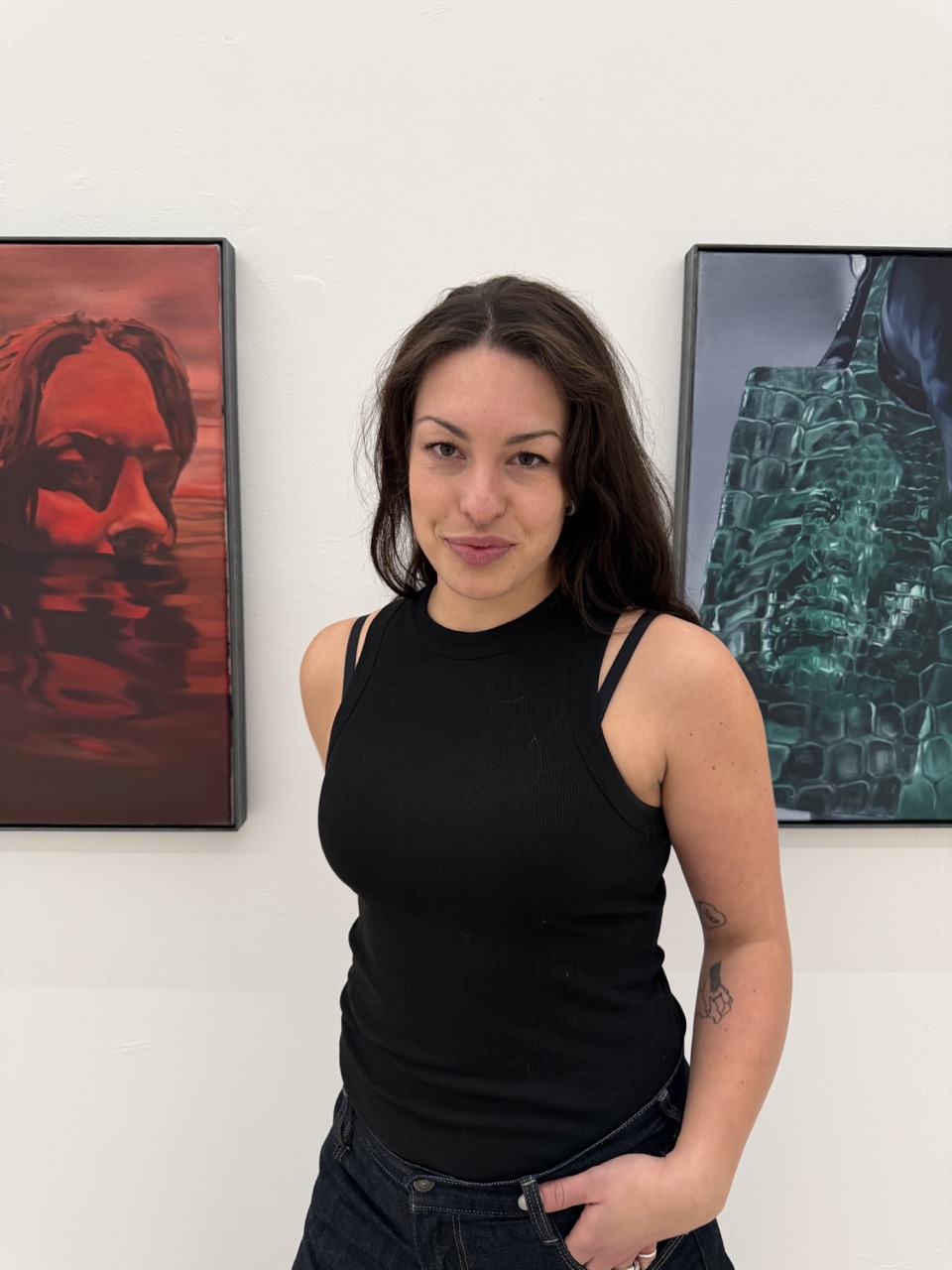
Image by Hamza Al Aqiqi
Words by Pykel van Latum
Visit Mirjam Vreeswijk’s duo show Yours Truly
from January 9 – February 15
at Galerie Fleur en Wouter