Where ASICS are reimagined
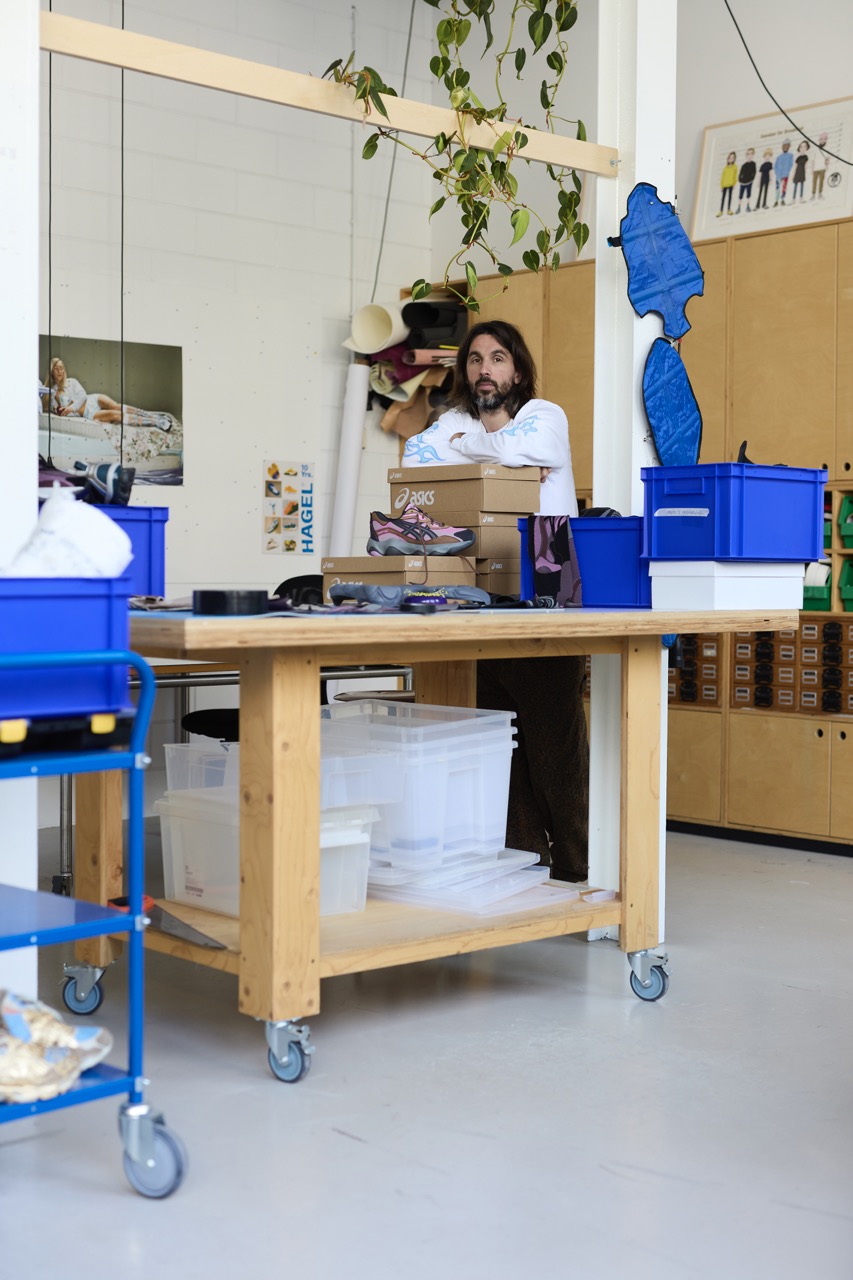
Mathieu Hagelaars greets us in a Turnstile T-shirt, a thin chain around his neck carrying a tiny golden shoe charm. We’re in the light-filled studio he’s built as his laboratory slash living room. The back wall is a “wall of fame” of past creations, filled with spiked pairs, flocked ones, shoes petrified in epoxy or stripped back to fragile lace skeletons – cleverly obscuring the less photogenic storage behind it.
Traces of home sneak in. Part of his father’s old filing cabinet stands in the corner, still bearing small stickers in his handwriting (one simply reads “party,”a drawer for the disco ball remote). Bright colours punctuate the industrial mood: neon threads fed through a heavy-duty shoemaking machine, handkerchiefs in pastel colourways, his daughter’s scribbly drawing taped next to his inspiration board.
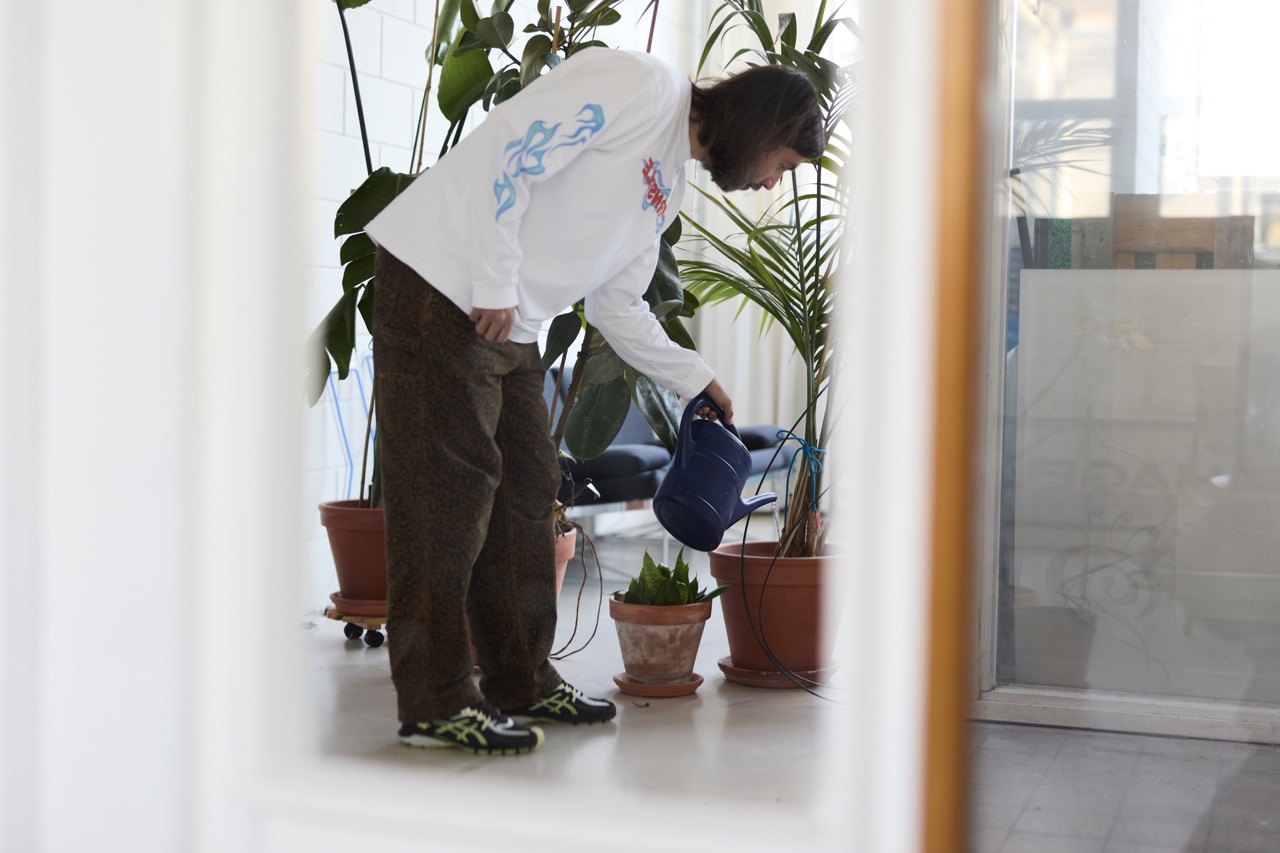
He has a lot of plants, and an ingenious pulley system crisscrossing the ceiling — that lets him water the higher greenery like a committed, if occasionally failing, plant dad. But failure is where the magic happens at HAGEL.
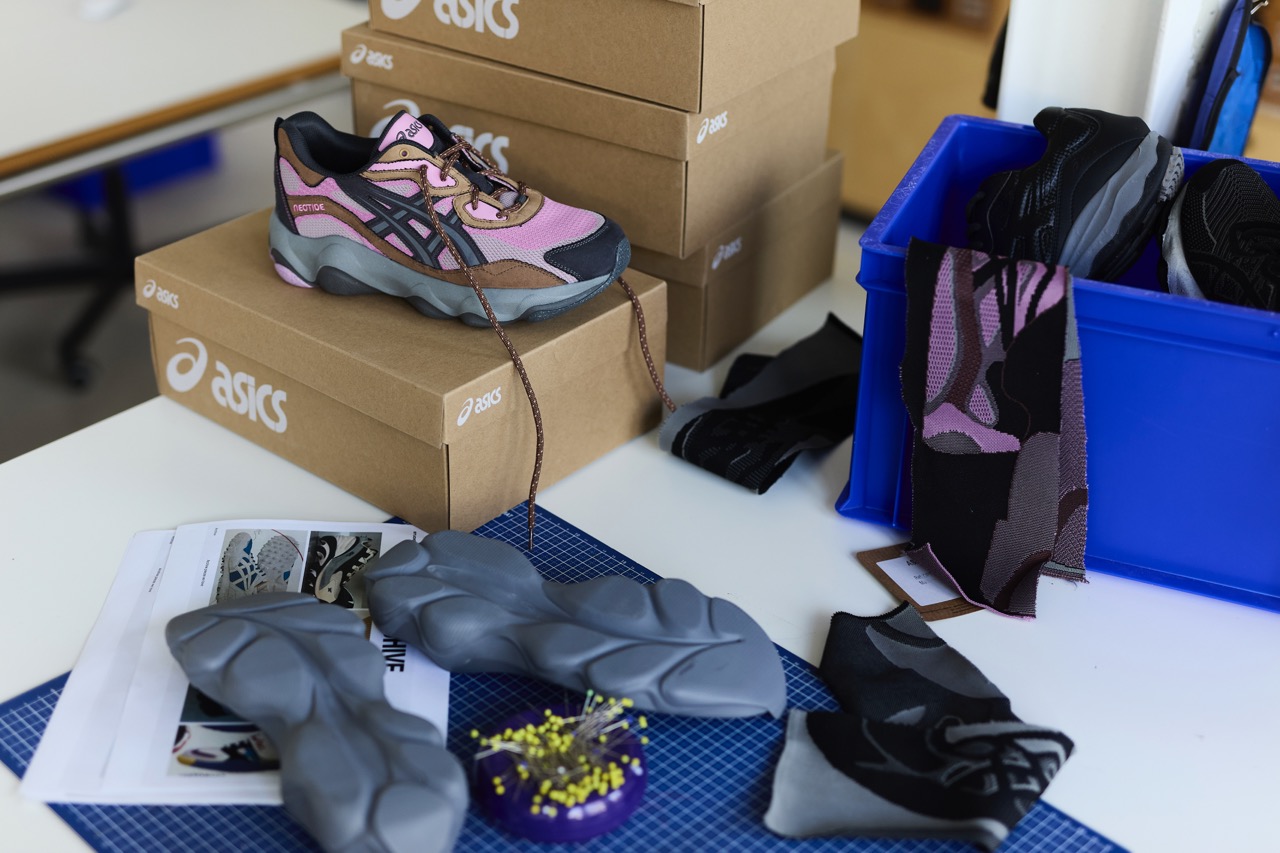
Point anywhere and Mathieu will excavate something: an old sole, a forgotten prototype, a fluffy material that looks vaguely Gremlin-adjacent. ASICS SportStyle are everywhere: whole, halved, skinned, waiting. Pairs, ready to be ground down and reincarnated. Running up to the release of the NEOTIDE™ with ASICS SportStyle, on March 6th, Mathieu leads us through his process.
It’s a nice sunny day! Tell me about your studio. How did you get here?
We’ve had this studio for a couple of weeks before the Covid lockdown. It was really a blessing at that moment. Noone was allowed to do anything or be around colleagues, and it was just me with this big space. I could really create the space I wanted, at a slow pace.
What I envisioned was something flexible: a space where I could easily create a photo shoot, but also, at one point, turn the whole studio into a small factory where we could even produce runway shoes.
I wanted a space where, when you come over, you instantly feel a nice vibe. Like something is happening here, something you want to see more of. Something that sparks creativity. I think I achieved that.
Definitely. When you’re in here, you walk in, and you see all these other artists in the hallway already… You already get into a creative mood before you step in. What’s important in a studio space for you to make it inspiring?
For me, a studio has to have all kinds of materials. You need to feel like you can get your hands dirty. That’s how we work: hands-on. You need machinery, shoes, materials, all ready so you can start creating instantly. But there’s a lot that you can do without having a 3D printer or without having a very advanced kind of system.
Then there’s our wall of creations showing what we’ve already done. And that’s maybe only a fourth or a fifth of everything we have; the rest is in the back, in crates. For our 10th anniversary exhibition, we showed 160 pieces, but we still had more — somewhere between 200 and 250 creations in total.
Wow. And these are the ones that are inspiring you the most now, or the most recent ones?
A bit of both of them. the most recent ones and the ones that inspired me the most.

Where in the studio would you say the magic happens?
The actual magic happens at the table in the middle. That’s where everything comes together, though ideas can spark anywhere — outside the studio, walking through a DIY shop, or even at an exhibition. You see a material or an art piece and think, “How can we apply that to footwear?”
Is that your favourite corner of the studio too?
I guess the table in the middle is also my favourite corner, but I really like the couch area too. I also like the ping pong table just outside the corner. That helps too.
Sometimes the best ideas come when youre not in “thinking mode.” What does this place look like on a bad day?
Oh yeah, it explodes sometimes. We cleaned up before you came, but on a bad day, when we’re really hands-on, it’s just one big mess — sewing machines, parts everywhere, floors dirty, scraps left around. You’re focused on what you’re making; the rest isn’t important in that moment.
At the end of the day, I’m totally cool leaving it like that. Eventually, though, you get fed up and clean everything, and start from a clean slate. Even though the work can get messy, we’re quite structured. I really like structured systems. When it’s done, we move to the next phase. And within those phases, you can mess around.

So, can you tell me a little bit about this project with ASICS SportStyle?
ASICS told us they wanted to start something completely new within ASICS SportStyle, mainly around circularity, with production in Portugal. I got total creative freedom to make something that stands out. We learned a lot from the NEOCURVE, the first model we did.
The challenge was that we started designing without really knowing what the new production could do. ASICS SportStyle usually has long relationships with factories in Asia, but this was a new country, a new factory, a new way of producing. Factories always say, “Yeah, we can do that,” but along the way you find out how things actually work… and ASICS SportStyle has really high standards.
So there was a lot of testing, failing, and trying again. In the end we arrived at the product as it is now. From those learnings, we started the next model, the Neotide. That’s where the idea of simplification came in: looking at how nature simplifies its surroundings.
Tell me about how nature can simplify?
For instance, with a heavy snowfall, everything blends out: the hard corners of a house, the edges of a rock… but you can still recognise what it is. Sandstorms can do the same thing; they even create new shapes.
That became our starting point: simplifying while still keeping something recognisable. So we thought, what if we take an icon from ASICS SportStyle and simplify it?
We looked at a really recognisable model (the GEL-NYC) and started defining its most defining elements: the lines, the patterns, and the key features of the shoe. From there, we could simplify the design and translate that approach into the new production in Portugal.
So you stripped it to the essentials.
Yes, we stripped it down and took out a lot of the detailing. Even the outsole originally had a lot of detail, so we simplified it and made it more wobbly, staying close to the snowfall idea.
So for this one, you also worked with deadstock.
Yes. ASICS partnered with a company called Fast Feet Grinded in Heerhugowaard. Recycling shoes is normally difficult because they’re made from many glued-together parts, but they developed a machine that grinds the shoes and separates the materials.
So the different components come apart (for example, the midsole, which is EVA, lighter than rubber) and those materials can be reused again in the process. Mesh or laces can be turned into a kind of fluff, which becomes the base material to create new rubber, EVA, or even fibres again.
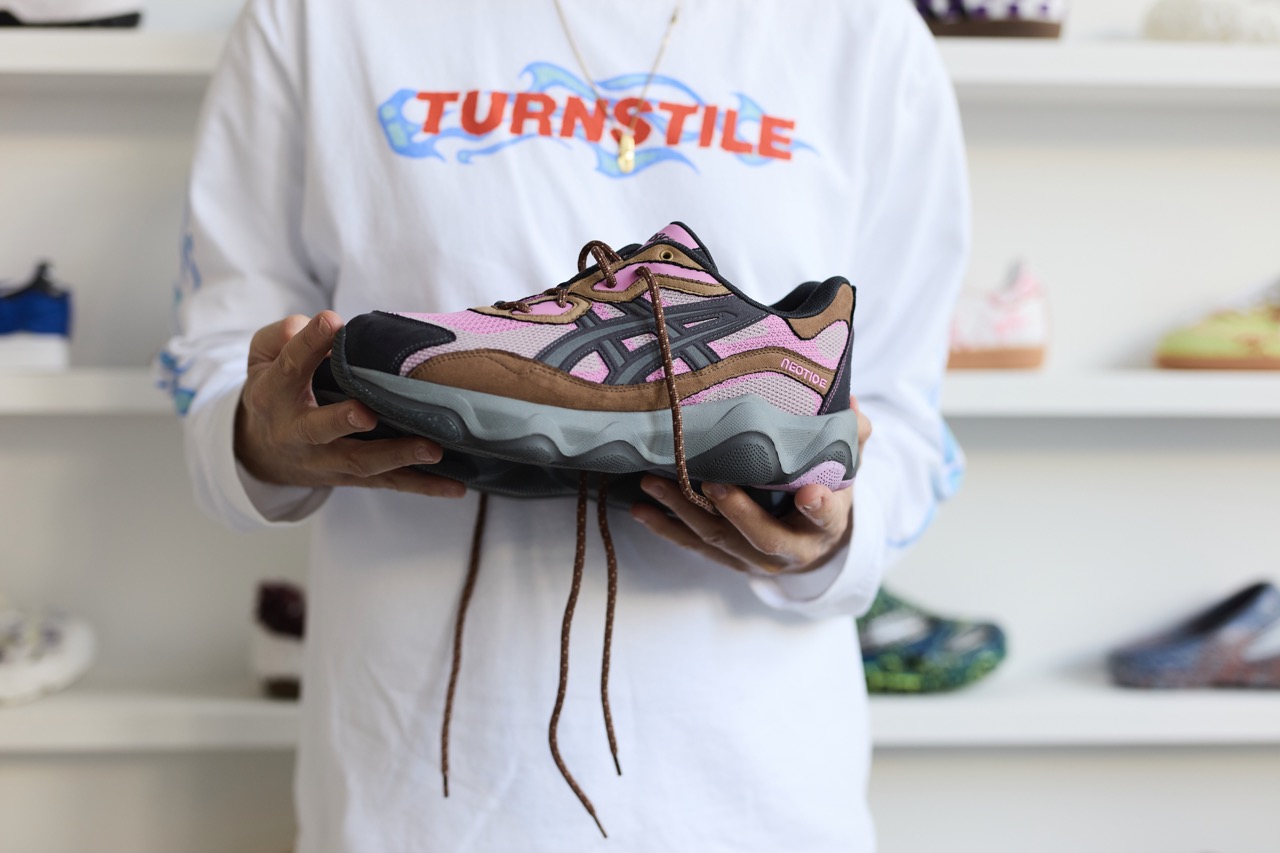
In this shoe you can still see little speckles in the rubber. That’s the recycled material. What’s unique is that it’s only ASICS SportStyle deadstock, not just any shoe. In total, about 39.4% of the shoe is recycled. Most of the recycled material you don’t even see.
It doesn’t look very… Recycled.
I’m not a big fan of putting, say, a green leaf on a shoe so people buy it just because it’s recycled. The design should still be the main thing.
It’s like in a museum: you stop because something looks beautiful, not because of the text explaining the idea behind it. But once you like it and start reading about it, you appreciate it even more. So, for me, the main goal is that it needs to look amazing first.

I agree with that a lot. What’s the point of an eco-friendly shoe that no one wants?
If it’s an ugly shoe, but very, very sustainable, it’s still going to stay on the shelf because it’s not selling.
And then it’s not sustainable anymore either.
Exactly.
Plus, it’s a bad look for sustainability. What was the most fun part about this collab?
The most fun part was working with the ASICS SportStyle team. I worked closely with the Japanese team, and they have a level of quality I’ve never seen before. During the NEOCURVE project, we visited the factory in Portugal together. They asked for a bunch of random shoes and started cutting them open. They were literally checking things like how many millimetres the glue touched under the edge, deciding what was acceptable and what wasn’t. That level of detail was really impressive.
And what was the hardest part?
The hardest part was working with a completely new factory. Normally, with a trusted factory, you know what to expect, but here every step was a surprise. Not unreliable, just different. Especially on the first attempts, like with the NEOCURVE.
You also need to reach the level of quality that a brand like ASICS SportStyle demands. When we saw the first sample, we were like, oh fuck. You always start with a monster.
Of course. And then you panic, and then you have to fix. And how did you come up with the colourways? Was there a specific inspiration? Because the first sample you just showed was completely black and sort of shiny.
Yeah, we have a, here we have a beige version, and we have a pink version.
The beige version was based on the inspiration pictures we had of sand dunes, roads covered by sand, and a house covered in volcanic ash. These images helped tell the story and guided the palette.
I love the pink little socks in the mud.
We also love quirky details. On one of these images, you see patterns formed on a backyard table by snowfall, and rocks covered in moss. Even if someone sees it as random, we see potential inspiration for a shoe. It’s not made to be beautiful. It just forms itself. Overall, it’s all about how nature can take over shapes and colours while keeping the concept cohesive.


Nice. I love that you hung up this reminder on your inspiration wall. “Hagel loves accidental design shaped by nature.”
You know, that’s like the core of what we do.
It’s cute that your daughter’s drawing is also here.
Yeah. Very expressionist. Every time she starts with a drawing, she’s also frustrated like, I can’t draw, I can’t draw. She always ends up answering “What are you making?” “An art piece.” It’s always an art piece.
That’s the way. She knows. It’s the opposite end of art critics who say, my four-year-old can do that.
We’re just saying, you’re already making art. The interesting thing about this is that children actually have more pathways.
Their creativity is unbounded. What’s your favourite part of design processes in general?
Starting points. The starting and the dreaming thing. It’s like, hey, what if? And then, and then also the visualisation, that’s the most important, and the most fun part. So you come up with an idea, in this case, the concept of nature overtaking a design, overtaking a shape. That’s the part where I clearly can see something. That’s amazing.
That’s maybe 20% of the work.
Yeah. And 80% is like… difficult.
Do you stick to the concept very closely throughout the process or does it evolve over time?
We always put a lot of effort and time into the concept. In the first phase, you probably won’t even see a shoe. Just ideas, shapes, the vision. It takes time, but in the end, it helps, because you can always rely on the story.
Where did your love for sneakers start, actually?
I was never really a sneakerhead; I didn’t collect them or anything. I was born in ’84, so during those elementary school years, anything from America was cool. You’d go to Foot Locker, and then there was the gabber scene… There were just two things I thought were cool to buy, shoes and pants. And then, through an internship, I got into shoes for real.
And what’s a mistake you made early on in your career that shaped your artistic vision?
I’m not sure if you’d call it a mistake, because in hindsight it was the best decision. I think it was learning not to take things too seriously. In the design world, everything feels very serious, and when I started my studio, I was trying to profile myself as a business. I was worried about how people would see me on Instagram, the wall, everything.
Then one day I just said, “Fuck it, I’m going to do whatever I want.” That’s when I felt a bit more freedom. That’s also when I started making some, well, kind of idiotic shoes. But that’s exactly when I got traction — and when I started to stand out in the footwear world.
Because what was holding you back? Were you worried about seeming professional?
Well, yeah. When I wanted to get into design, people told me, “You don’t have a design degree, you don’t have any experience.” I had zero formal shoe-design background. I could draw, but no art school, no design training. My parents are artistic, so maybe it’s in my DNA. Still, the traditional footwear industry basically said, “You can’t do it.” That’s why I couldn’t get a job, so I just started my own studio.

Maybe design schools are also pushing you into this traditional trajectory and you’re also not burdened with it. Maybe it was your blessing because you can think outside of those boxes.
I guess if it hadn’t worked out the way it did, maybe I’d call it a mistake. But now, working with amazing brands and having the studio known internationally, I don’t see it as a mistake — it’s the best decision I’ve ever made.
And do you feel like hard work beats talent or talent beats hard work?
I think hard work beats talent. I think. Cause I’m not sure if I have talent.
But at least you work hard.
I think hard work beats talent. I’m not even sure I have talent, but at least I work hard — or smart. Everyone has their own set of skills. For me, my sales experience and knowledge of the footwear industry, combined with whatever little talent I have, helped. There are way better designers out there, but I stayed focused and worked really hard to get to that point.
And so if this studio were on fire, what’s the first thing that you would save?
I would say myself.
Besides yourself. You can grab one thing.
Okay. One thing. Oh my God. What I would take. I would try to take as much use as I could. The creations that I made, those are irreplaceable.
ASICS SportStyle’s and HAGEL’s project, the NEOTIDE™ Sneaker is available from March 6 onwards.
Words by Pykel van Latum
Images by Jaane Jain