Naaz discusses it all: from overcoming evil butterflies and imposter syndrome, differences in songwriting in English and Kurdish, to favourite artists and best thrift finds.
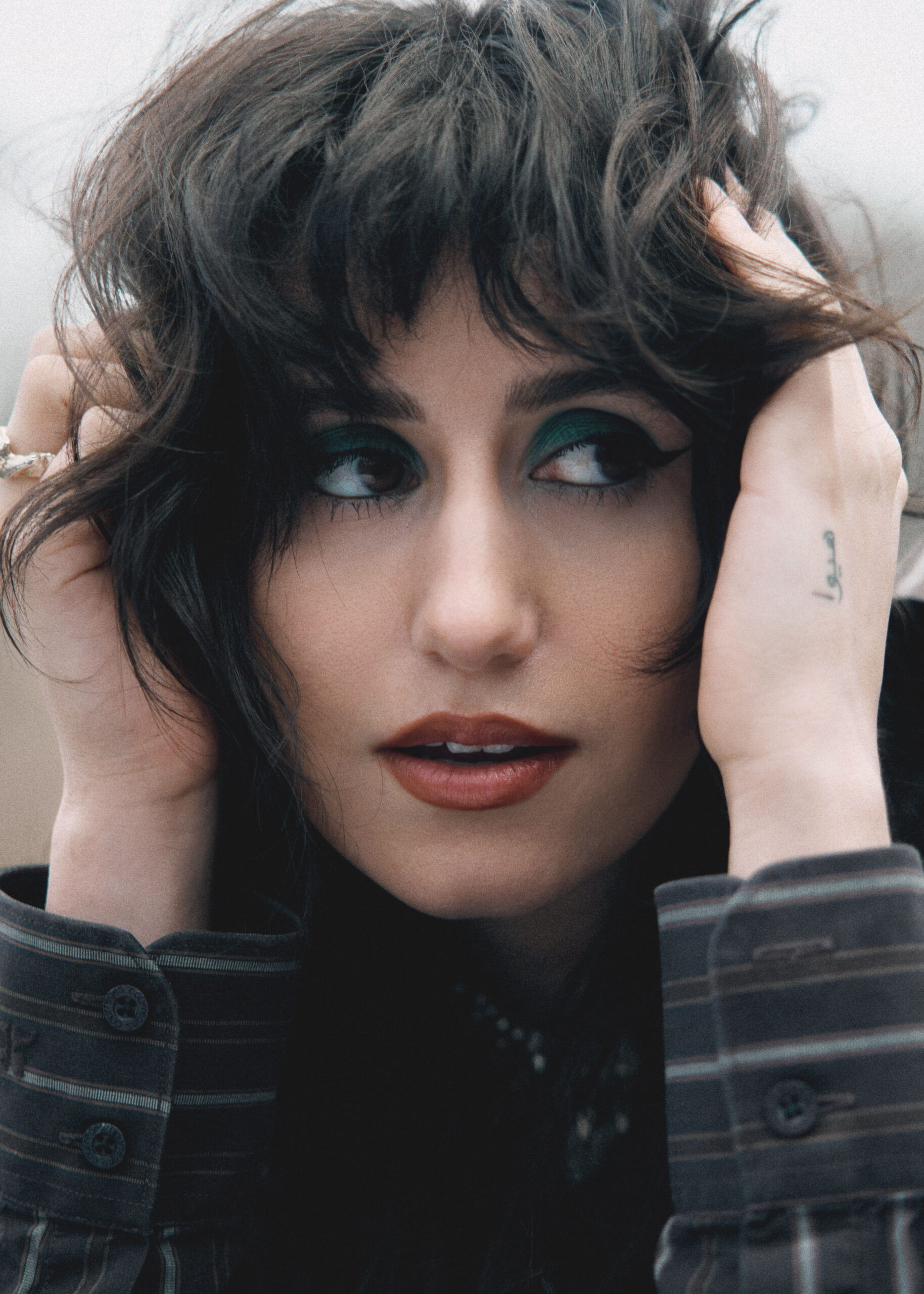
Sometimes the answers we’re looking for aren’t exactly where we’d expect. Through exploration, attentive listening to your body, and measured risk-taking, finding a sense of belonging can provide its own illumination. Which is exactly what Kurdish-Dutch artist Naaz does with her freshly released tender yet confident album,‘The Sky Knows I Exist’.
Hailing from Rotterdam, Naaz co-produced the project with Jasper Ras over just five months. Teaching herself how to play the guitar, she gracefully strings her fingers across the chords, and pulls her lyrics from her notebooks, creating a radiant pop-folk record. Over ten tracks drenched in the confessional and in shared wisdom, Naaz whispers dedication, drawing the listener into her world, head-butting doubts and learning to trust her own instincts.
Naaz’s tracks delve into these head-spinning both existential and extremely concrete thoughts around the theme of belonging. The opening song, ‘Bark,’ raises the desire of understanding and learning to trust your instincts – not unlike dogs (spoiler in the title). ‘Pure’ hits mid-album with its higher temp, and drum heavy pattern translating into strength and self-assurance. Ending on the title track, Naaz beautifully closes this chapter with all-encompassing guitar riffs carrying her veiled, distant vocals.
We caught up with her to discuss the production process behind ‘The Sky’, her (many) impressive ventures and the uncomfortableness of confronting your feelings, but the ultimate satisfaction of doing so. Read on to pick Naaz’s brain, learn something and leave even wiser.
Hi Naaz! <3 Where do these questions find you?
I am currently sitting on my couch, surrounded by both my cats and my dog. It is the day after my album release, and I am feeling content and grateful.
Congrats on the release of “The Sky Knows I Exist”! The message behind is beautiful; delving into the project must have been so cathartic. With your opening track “Bark,” you evoke the desire to lean into your instincts (akin to dogs). Any advice on trusting your instinct more today?
When I was a kid, I would describe feelings of intuition as evil butterflies. I would call it the opposite of feeling in love, as if little flutters were rather gnawing on you rather than lifting you up. Nowadays, I know this is what anxiety can be, but also intuition. When your body tells you no, you may trust it.
I’ve read you’re an extremely fast songwriter. What was the process like for ‘The Sky’? Any particularly challenging songs to finish?
The entire album was made in just five months, mostly stemming from me writing pretty lines and poems in a little notebook and turning them into songs. The hardest song to write was ‘Something Good’, but it is also my favorite. Usually, as I’m a very intuitive writer, the songwriting is often done within the hour. I record myself improvising, and often the song is already in the voice memo, and I just have to bring the pieces together. But with this song, I was feeling particularly distraught that day and just couldn’t get myself to write a song. Therefore, it’s so wordy. I think I just wanted to talk about it, the subject matter, and made it into a long but very hopeful rant. It’s therefore my favorite song. I just love the way it keeps building. And the chorus line soothes me a lot, something good must happen, somewhere to someone.
You have openly spoken about this lingering feeling of imposter syndrome in the music industry. How have you learnt to deal with it?
To be honest, the only way I’ve been able to let go of it was by confronting the feeling. By doing the things I thought I could not do and collecting little and big receipts of my own ability. I composed a score for theatre group Orkater, which is the most prestigious music theatre group in the Netherlands. Funnily enough, the play was also called ‘The Imposter’. I knew I could do it, as I had composed and produced most of my music up until that point. But because those were always my own projects, it did not feel as valid. This time, I worked for the cause of an entire group. I knew that if I did well on this, it wouldn’t be fair to doubt myself anymore, because it’s one thing to do well for your own project, it’s another to function and serve the greater cause of a group effort. What also really helped is buying a guitar and learning to play. We didn’t have instruments growing up, so all of my musicality is self taught and vocal, lyric, and melody based. The guitar brought me theory, which gave me a new language to speak in a world where I often felt a bit excluded, not by others but by myself through imposter syndrome.
Teaching yourself to play the guitar must have been such a freeing experience. How has adding this new instrument changed your production process?
It’s completely changed how I write my songs! I used to write almost exclusively a cappella and only add chords and instrumentation afterwards through my computer by producing the music. I hardly reach for my laptop these days, writing the songs mostly on this physical instrument and only producing them later on in the process. It feels nice to me, after a life of using my computer as an instrument, to not be dependent on it anymore. I like that I can write songs anywhere and anytime now, and I find myself writing completely different melodies and subject matters with this instrument.
You’ll be starting your tour very soon. You must be so excited to meet all the new crowds. What else do you love about touring?
I absolutely love the feeling in my body as I can completely surrender myself to the music. To me, it feels like going clubbing, except that I never really go clubbing, and therefore this is my substitute. I can sing, dance, play guitar, and express myself fully. It is the greatest privilege in the world to be a performing artist, and I crave being out of breath by the end of the set.
You also sing in your mother tongue, Kurdish. How does the songwriting process differ from English?
In Kurdish, I am very melody driven, in comparison to English where I often start from lyrics. My melodies in Kurdish songs, even when the compositions are Western, are often in the Hijaz scale, which is the common West Asian and North African scale used in traditional songs. I think it’s cool how my body automatically, intuitively goes there when the language changes. The lyrics are often more poetic, but this is also because as a diaspora my Kurdish is not as good as my Dutch or English, and so I tend to write simpler, but still very symbolic lyrics. The melodies give it the most meaning, and I notice I sing more emotionally as well.
I know most people around me don’t know the first thing about Kurdish music, but after hearing you might wanna dig deeper. Any musical tips for people who don’t know where to start?
I love Aynur Doğan, she is a Kurdish singer who was very revolutionary releasing a song called ‘Keçe Kurdan’ whilst living in Turkey in a time where the Kurds were heavily oppressed and it was even forbidden to speak the Kurdish language. The song became a hit, and I genuinely believe she played a huge role in fighting racism against Kurds. I actually got to sing with her last year during her concert in Concertgebouw, I was so honored to stand beside this courageous legend!
And besides Kurdish music, what are some of your other musical inspirations?
I’ve learned my songwriting mostly from artists such as Frank Ocean, who has always had very interesting timings and placements of his words, but also lots of Radiohead as I love their compositions, Billy Joel for the storytelling, and Tove Lo was the reason I decided to produce my own music when I was sixteen years old.
You have a beautifully delicate yet strong visual language. What influences your creative world outside of music?
Thank you so much! I make all of the visuals with Mike Jurriën, who is a photographer, graphic designer, and art director. I would say he is my biggest influence, as he shows me parts of myself that I could highlight that I wasn’t even aware of. It is very inspiring to work with people who have such a tasteful visual eye, who see color in different shades than you do. I have always been a very visually driven person, I get most of my inspiration from the natural patterns on animals’ fur. I find that animals are the most beautiful artworks the world has, and it’s so cool that they all look different even from the same species. Their fur patterns can really mesmerize me.
A birdy told me you’ve also started writing a novel? Tell me more!
I love that bird! Yes, I am writing a novel, it is an English language fiction novel about two sisters who become orphans as their conservative parents pass, and how they will deal with the abundance of freedom they suddenly have, and how shame eventually drives them apart. I’ve been working on it for two years now and have already finished two drafts. My agent is currently reading the second one!
When you’re not working on music, what’s your go-to thing to get your mind off?
I love to read literature, it completely slows me down and can bring me into a meditative state. Also when I read a book from the first person’s perspective of a character, it can feel like for a moment, I really am this person that I’m reading about, and no longer myself. This is a nice escapism, I think a healthy one.
You seem to have a knack for fabulous vintage finds. What’s your ultimate best thrift find?
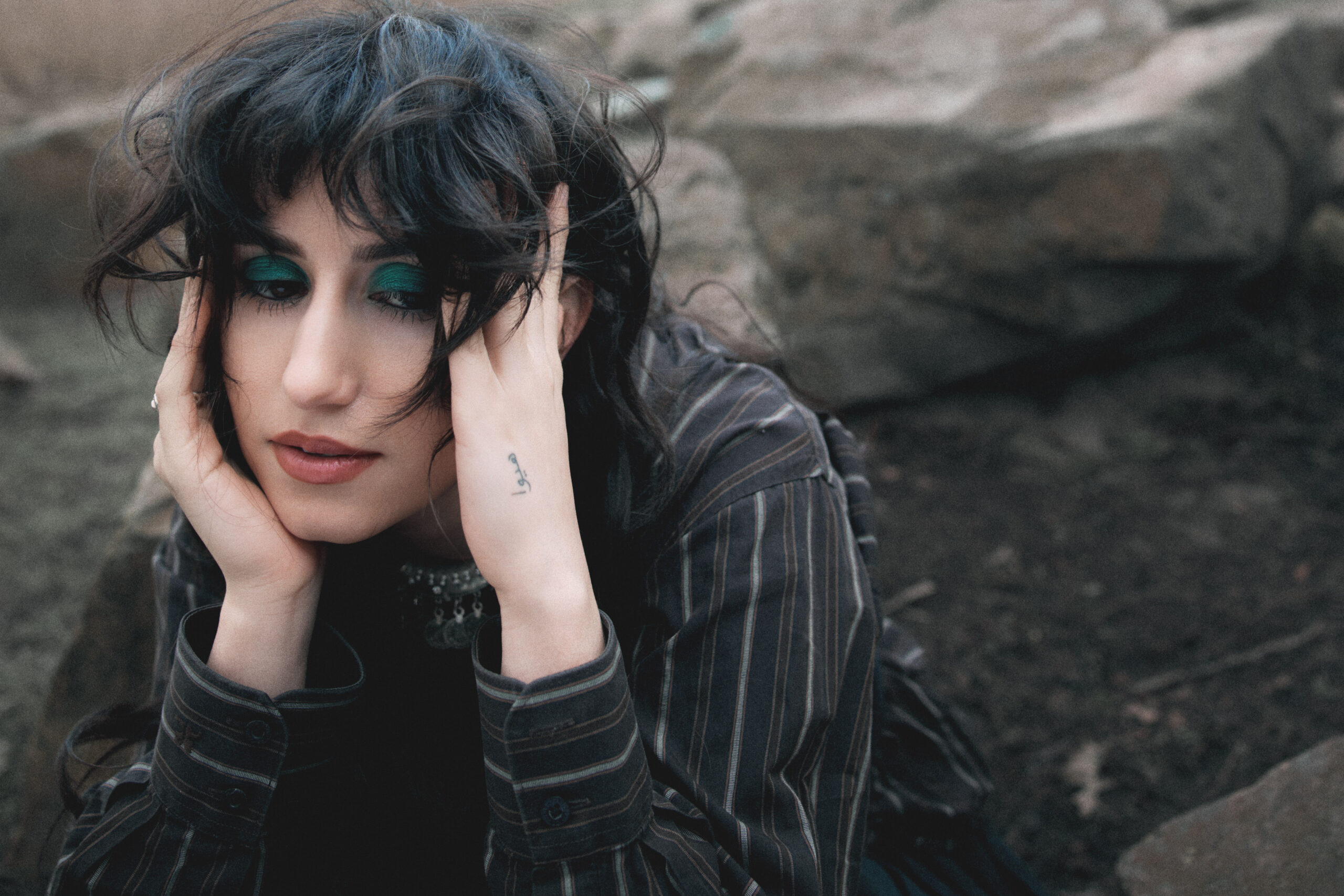
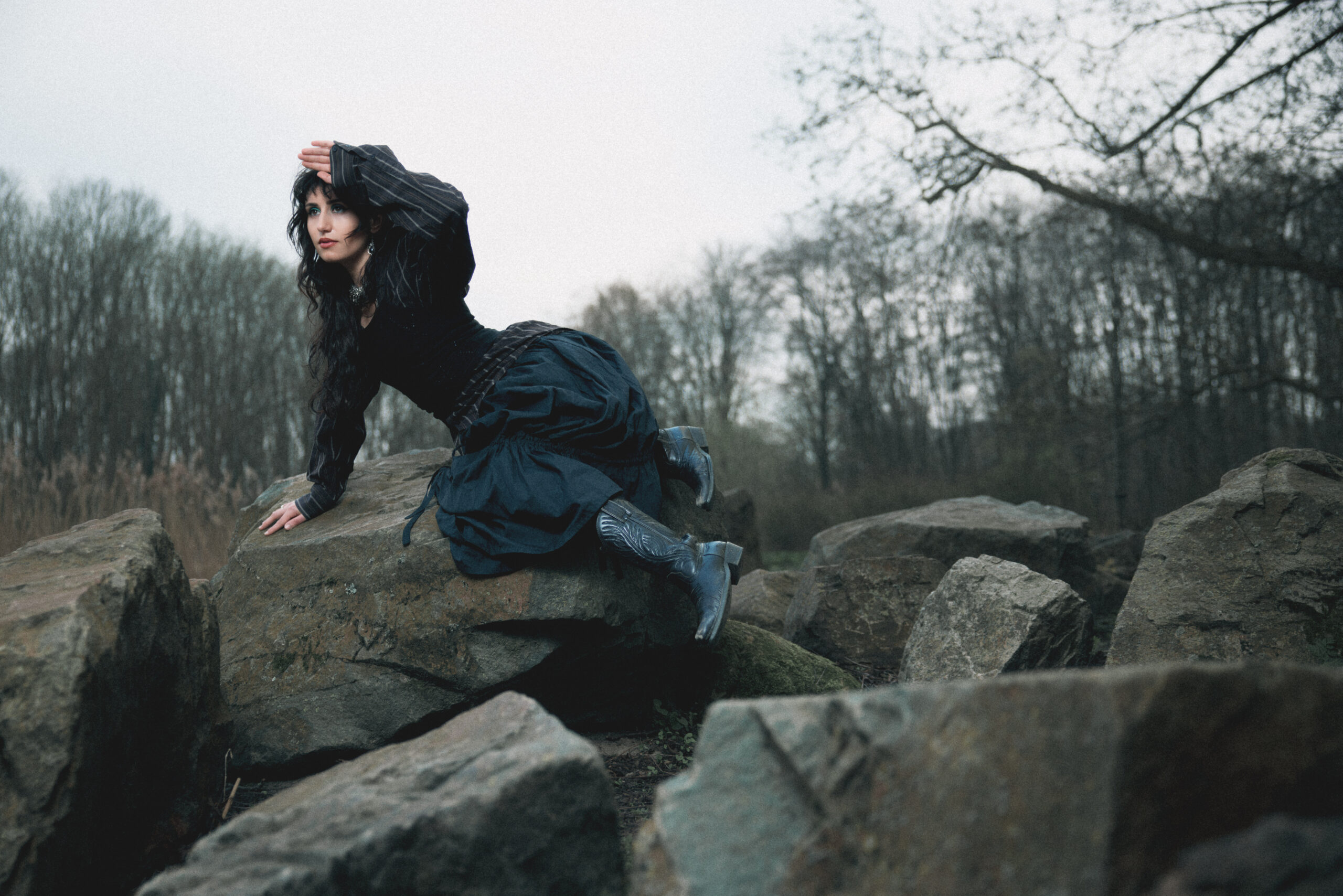
I got a vintage Dolce & Gabbana dress, I am wearing it as a skirt in these photos. I also found a vintage red coat last year that completely decided the trajectory of my album cycle visuals. As I was wearing the red coat in all of my pictures, it became the ‘red line’ of the album, and we decided to get a red dress custom made by designer Vanihila that matched the exact colour of my vintage coat, to wear on the album cover. The impact it had! In these pictures, I am wearing a thrifted Courrèges blouse, a thrifted tank top, thrifted Dolce & Gabbana dress and thrifted cowboy boots hehe.
Finally, what makes you feel like you truly exist?
What a beautiful question! I feel like I exist when I’m in conversation with someone and I can sense they are really looking at me, and caring about what they’re telling me and what I have to say. It makes me feel like I matter, they matter, and it matters to be alive and to be alive together.
Words by Lora Lolev
Photography by Mike Jurriën