“It is about looking with a certain sensitivity, where fleeting and ordinary moments gain importance precisely because we give less attention to the everyday.”
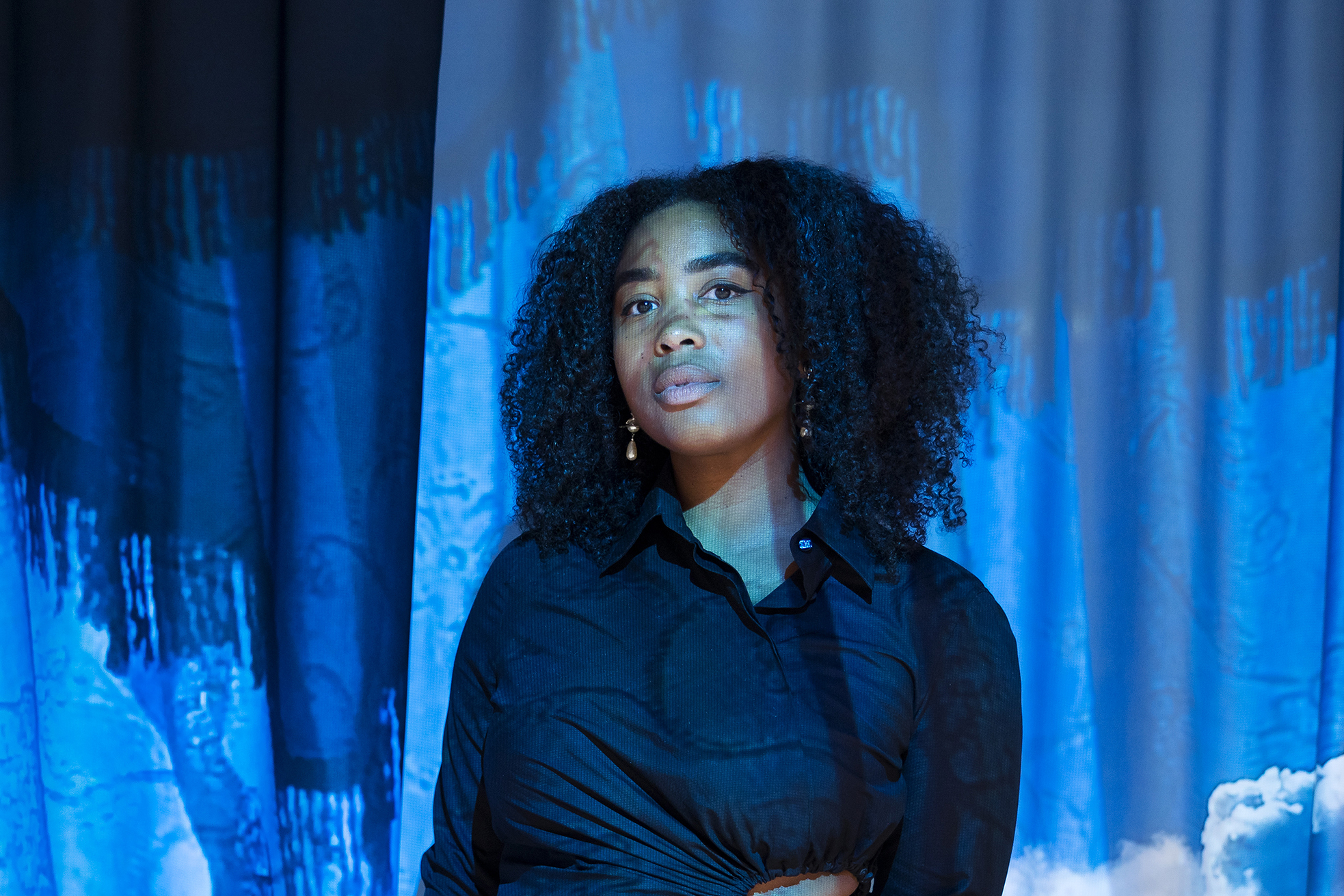
Image by Aad Hoogendoorn
Oftentimes, the most vital currency is the most overlooked. Air: clear, clean, essential for our survival, yet fatal the moment it’s cut off. Then there is the sky: ever-present, separating us from each other while binding us together at the same time. This acute focus on these omnipresent elements is exactly what multimedia artist Mandy Franca delves into for her new solo exhibition, I Breathe an Endless Universe in Me, which just opened at Stedelijk Museum Schiedam. Showcased in the museum’s attic showroom, Franca began her process by simply experiencing the space — feeling it, and understanding how to occupy it. The result is a show where nothing new is added, but an altered attention to the everyday provides a much deeper perceptual shift.
With I Breathe an Endless Universe in Me, Franca is interested in this exact shift in attention. By using the sky and air as a common denominator, she explores their lack of fixation and enhances their duration. Something that gives us life can also take it away; the sky connects just as easily as it separates.
Opening with the warm hues of a typically awe-inducing sunset, the exhibition begins in a state of serenity. From there, familiar mid-tone sky blues burst from the walls through photographs, paintings, and a textile installation reminiscent of the curtains in her grandmother’s house. Clouds populate the space, adding a distinct softness and inviting visitors to pause, sit down, and contemplate the elements we so often overlook.
Glamcult spoke with Franca to dive into her gripping exhibition at Stedelijk Museum Schiedam. Through discussions around the non-linearity of time, the consciousness of breath, and the importance of fleeting, ordinary moments, we left the conversation with a newfound wisdom. And we’re certain you will too.
Congrats on the opening of I Breathe an Endless Universe in Me! Can you tell us more about the process of putting the exhibition together at the Stedelijk Museum Schiedam? The process started with visiting the space in the museum, which is located in the attic. It’s a remarkable space that exists outside the traditional conventional white cube. I found the architecture of the space intriguing; it contains small corners and hidden areas that gradually reveal themselves as you move through it. My process for exhibitions always begins with ‘experiencing’ the space first, and/or requesting the floor plan with its dimensions. I try to understand what the possibilities are for navigating the space, how my work will function in it and what kinds of potential the space offers in return.
The curator of the exhibition is researcher, educator and writer Delany Boutkan, with whom I have worked very closely. We first met more than ten years ago during our bachelor’s studies, and I have always admired her research subjects and her way of writing. As well as with filmmaker Katarina Jazbec who created a video portrait of me for the exhibition. Her films explore how relationships emerge between people, bodies and their surroundings but also examine the influence that social and ecological systems have on these relationships.
Being able to work with people with an interest in similar subjects matters and deeply understands your practice, who sometimes notice things in your practice that you are not always consciously aware of, brought a deepening and expansion to how the presentation came into being.
Ultimately the exhibition is the result of multiple forms of research: material research, theoretical research, personal archives, but also ongoing conversations with others such as the curator, filmmaker, and family members, and thinking of my own personal experiences.
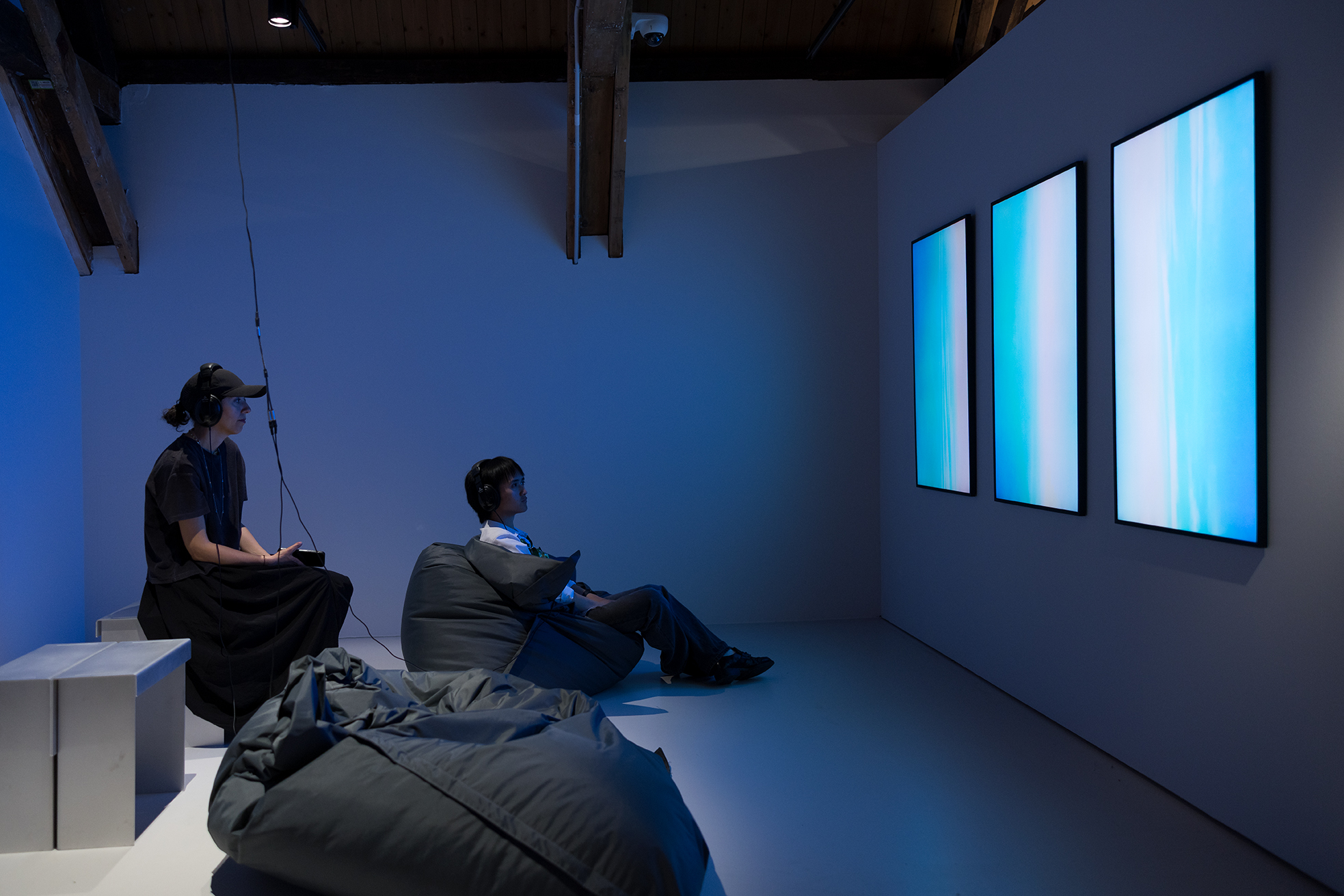
Solace, Video installation 16’30”, 2020, Image courtesy of the artist.
In the exhibition, new works arrive in your ongoing series On Being Light and Liquid, exploring ideas of time. Sometimes we wish to hold onto a set moment, and forget that every single second is ever-changing. There’s something about air that mirrors that idea — constant yet always in flux. Does working with it shift your relationship to time, or to ideas of mortality?
It certainly does. Working with air as a material makes time feel less linear and more expansive. Becoming more aware of air seems to expand perception itself. Air and the sky resists being fixed in a single moment and instead emphasizes their own duration.
In 2023, due to illness, I was isolated at home for almost a year and would stare at the sky everyday outside of my window. This is when I became more interested in the experience of time and how it depends on the context in which a person finds themselves. At the same time I also started to become more interested in the breath through working with a Cesar therapist who’s also specialized in breathwork and experienced the effect ‘good’ breathing can have on the brain and body. Simultaneously, air; both the air we breathe in and the air we see began to take on a more prominent role in my daily life.
Besides my own personal experiences, I started reflecting on political and global events since 2020 and how these are connected to the meaning of the air we see and the air we breathe, and to the ways in which these experiences are shaped by the places and individual situations in which one finds oneself. It is a privilege to experience air in freedom, and to be able to breathe safely without having to think about health concerns such as COVID-19 or pollution. At the same time, this also raises other questions: who has access to the sky? The sky does not represent freedom for everyone. For some, it is associated with confinement or danger, people like myself who were bound to the house and experienced freedom only through a window, or people looking at the sky from confinement. It also extends to questions of air quality and environmental inequality: who has access to clean air, and who does not?
My experience of time also shifts depending on context; watching clouds change and move, the surface of water forming a certain rhythm, the wind gently moving leaves on a tree, or even taking a nap on a summer’s day, but also my experience of being isolated at home. Time and air feel deeply dependent on the person and the situation they are in.
After a long period of not being able to make work I started working on the series MARK. This series was first presented in On Being Light and Liquid (2024). In the exhibition at Stedelijk Museum Schiedam new works out of this series are also presented. The marking of a single line with oil pastel on textile in a repetitive pattern and rhythm reminiscent of tally lines to mark time, became a way of making my existence present. To make a mark, to breathe, means you exist in the world.
The presentation On Being Light and Liquid (2024) derives its title from a chapter in Zygmunt Bauman’s Liquid Modernity. In the book he draws comparisons between solidity and liquidity in relation to society, and the way everything seems to be in a constant state of flux in our contemporary world and I became fascinated by these parallels. Clouds appear to follow their own pace, while the world around you moves at an ever increasing speed.
I loved reading the exhibition text and the attention brought to the omnipresence of air, which is often taken for granted although essential. It feels like we don’t really think about it that much. How does that tension — between the essential and the overlooked — shape your work?
It’s a huge part of my work but also of looking at the world. It raises a broader question: what do we actually understand as essential in our daily lives?
This tension shapes my work very directly in the way I look at images. I am interested in how attention can be shifted toward what is already present but often overlooked. It is less about adding something new, and more about changing perception and adding value through looking.
I think of poetry not only as written language, but as something that exists in the everyday around us. It is about looking with a certain sensitivity, where fleeting and ordinary moments gain importance precisely because we give less attention to the everyday. There is also something in the fact that we often only recognise their importance once they have passed.
In my large works on paper, I sometimes block out certain areas within the image while leaving others visible, directing the viewer’s gaze toward specific fragments of everyday life. This gesture of blocking and revealing is directly connected to that tension between what might not feel essential can be shifted through highlighting them through this technique.
That’s a beautiful reminder to pause and reflect on what’s right in front of us. What has that perception shift been like personally for you?
This shift is closely connected to how I look at the world in general. I have become more aware of how meaning often sits in the most ordinary and fleeting moments, and how quickly they can pass. There is something poetic in that. It has also changed my relationship to time and presence. Slowness and conscious attention has become a way of resisting the constant acceleration of everyday life, which is deeply tied to capitalist structures and the pressure of productivity and speed. In that sense, slowing down becomes a form of resistance.
On a personal level, this shift has changed the way I relate to looking. It has become a way of being in the world rather than observing it from a distance. It has made me more attentive to what is already there and to how attention itself shapes our experience of time, presence, and intimacy.
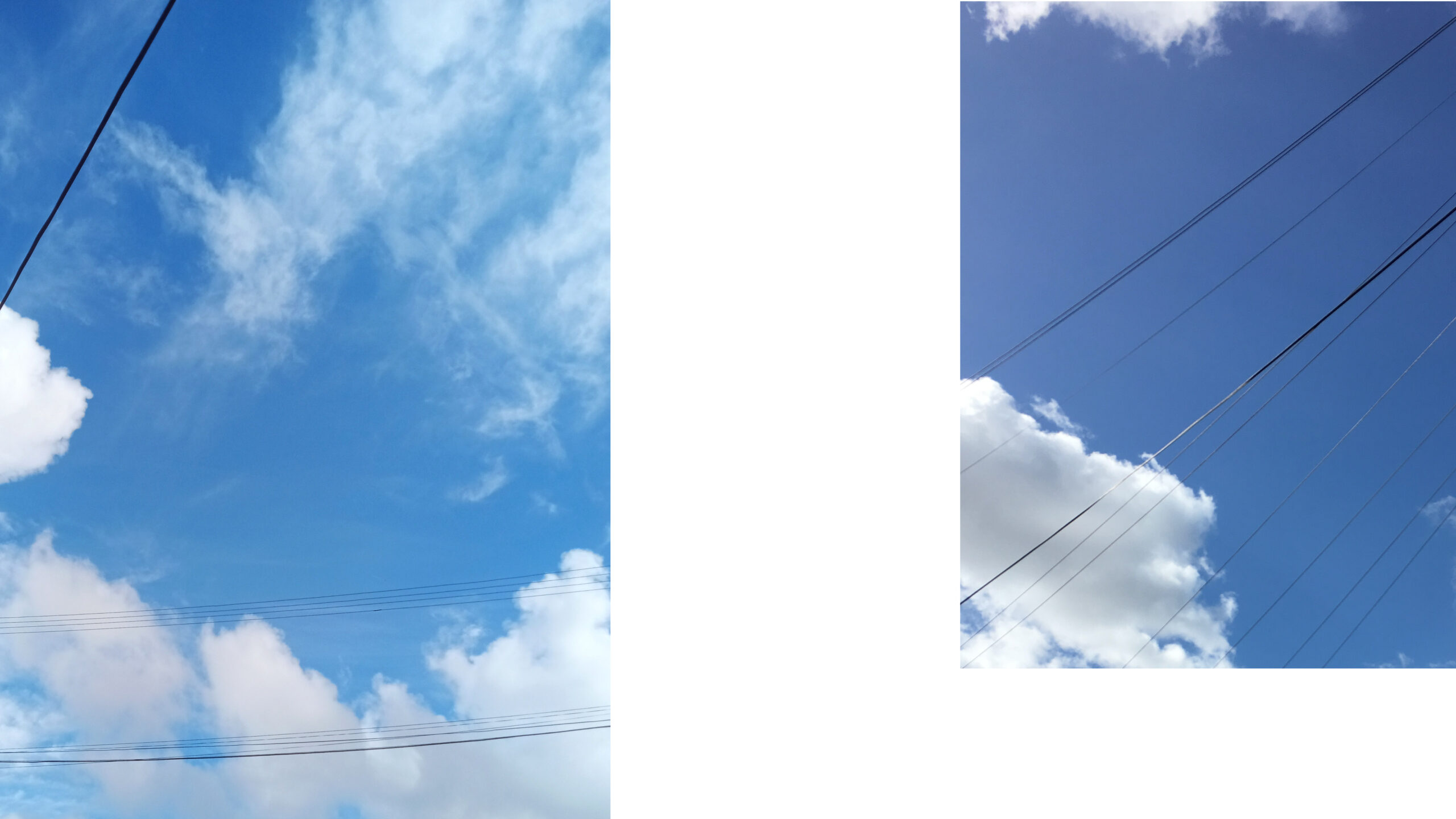
Phone pictures were taken by both you and friends and family, making the work collaborative in nature. Can you tell us more about this collaboration?
For this series, I asked my parents to take photographs with their phones of the sky every morning when they woke up from wherever they were staying in Curaçao. I then had conversations with them about their experience of making these images, and I found that the stories behind them were just as important as the photographs themselves.
My father described how he would have moments when he would look at the sky and think, “I need to take a picture for Mandy.” Or how, during a car ride, he would ask a cousin to quickly take a photograph of the sunset for me because he was driving and saw how beautiful the sky looked. He also spoke about seeing a single star in the night sky and wanting to capture it specifically for me and for my archive. My mother described how the process made her more aware of shifts in the sky and in the weather, and how storms and changing conditions revealed the ever changing nature of the clouds and the sky. She mentioned that before this she rarely paid attention to the sky in this way. She felt mesmerized and experienced a sense of wonder due to consciously shifting her attention upwards.
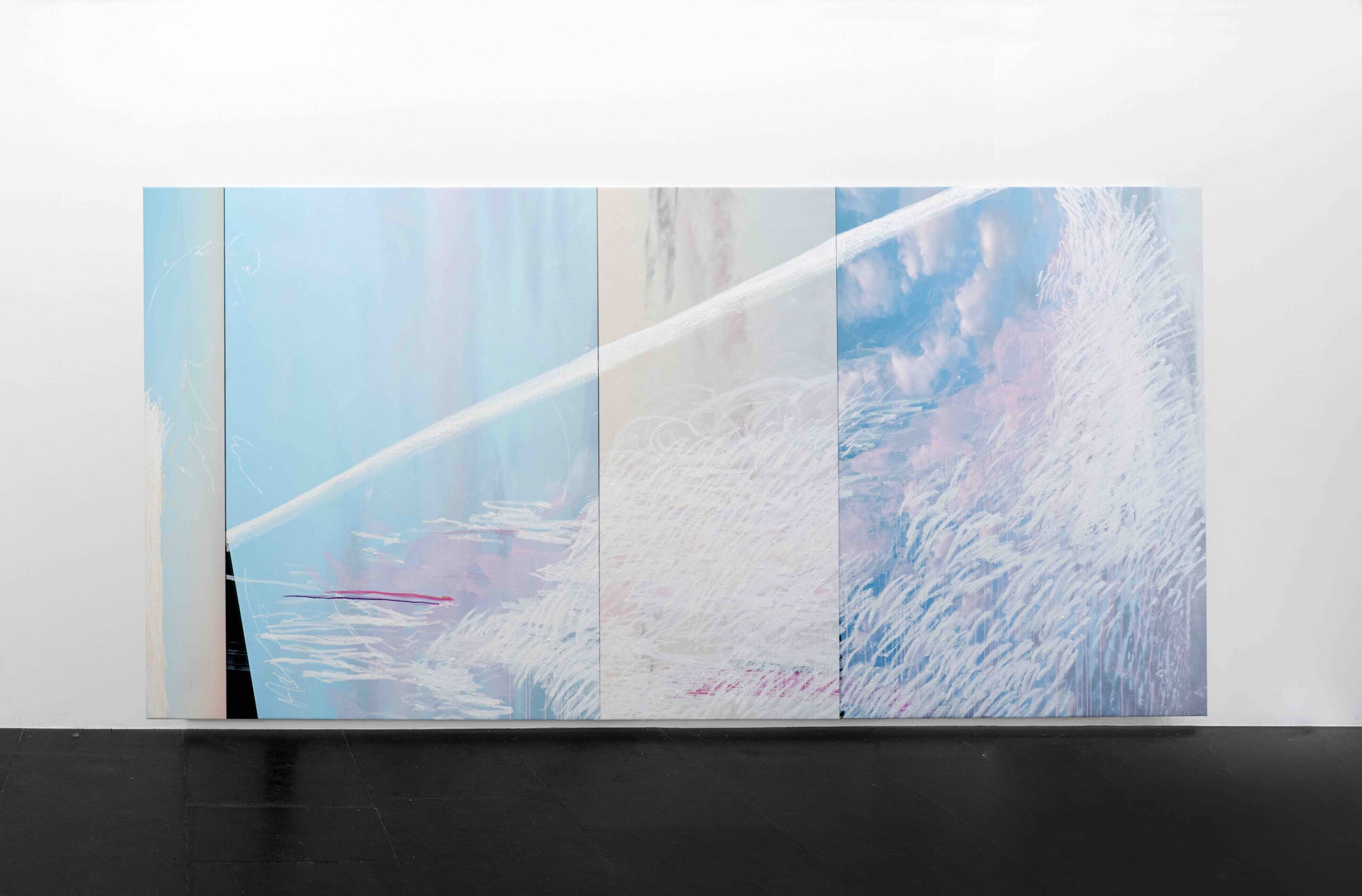
Why Do I Stare at the Sky and Long for the Clouds, Inkjet, acrylic, oil pastel, oil stick, paint stick, china marker on canvas Image courtesy of Night Café, London, Image credits: photograph by Vinx, 2025
It’s so interesting to think about the personal affects of collaborating, I love how your parents have that extra layer of thought around the act of taking the photography. Are there other ‘digital’ sky representations in the exhibition?
Alongside these phone images, I also presented digitally constructed skies generated within a simulation. Within this system I can reconstruct a specific sky by selecting the date, time, and coordinates based on the information attached to the photographs taken by one of my parents. Using historical weather data such as temperature, wind, and radiation levels to simulate what the sky might have looked like at the moment one of the photographs was taken. Bringing these real and reconstructed skies together creates a dialogue between lived experience and computational reconstruction. By placing them next to each other, I try to relate to moments in which I was not physically present. Moments that did not occur simultaneously begin to overlap, if only briefly, and presence becomes something more distributed and layered. Digital clouds sit alongside real ones, where the photograph taken by my parents is subtly ‘touched’ by its simulated counterpart through this overlap in time, place, and image.
These different ways of looking reveal multiple perspectives within a shared context, where different experiences and circumstances briefly meet and what is more relatable than the sky and breathing?
It is interesting to realize that most people see the sky every day, it is above us at all times, yet we rarely consciously turn our gaze upward. We spend so much of our time looking down at screens, and so little noticing what is happening in the landscape and the beauty in our immediate environment.
Yes, looking down has become the default mode, unfortunately. But also, the use of the personal phone feels significant here — it’s a device that has made us globally connected yet also deepened a sense of isolation. Was that tension something you were conscious of, and did it shape your choice to work with phone images specifically?
I have always had a strong interest in images since childhood. As a child of the 90s, growing up with a desktop computer at home I was constantly surrounded by images and as a teenager, I collected international magazines.
At the same time, during my bachelor’s, I never really enjoyed photography classes. The process often felt too technical and structured, especially within studio settings, which made me realise later on that my interest lies more in fleeting everyday moments that quickly disappear or shift and are faster and easier to capture with a mobile phone than with a professional camera. During my master’s, I also realised that my interest lies more in image archives and the circulation of images than in photography itself. I also do not attach much value to image quality, which allows photographs taken across different years and technologies to simultaneously function next to one another in my work, while also revealing a passage of time through technological change.
My interest is less in the analogue versus digital distinction and more in the relation between the material and the immaterial. Photography is not an end in itself for me, but a means of proposing different ways of seeing and of bringing attention to overlooked places, objects and moments in time.
This is also why the phone became important to me. There is something very democratic about it; almost everyone carries a phone and can become a maker. At the same time, I was very conscious of the tension between connection and isolation that comes with phone imagery. Phones allow us to remain connected across distances, but they also mediate how we experience the world and each other. Especially during periods of illness and isolation, images shared through phones became a way of maintaining closeness, sharing what is happening around the world while simultaneously emphasizing distance.
As a teenager, the internet and being online were also spaces where I could meet like-minded people from all over the world and find a sense of community. In recent years, especially with the rise of social media, there has also been a growing sense of isolation caused by constant online presence and the decline of physical connection, particularly among younger generations. At the same time, in my personal experience as an artist, a child of migration, and through experiences of isolation and distance from loved ones, technology has also made it possible to remain connected across distances.
I am wondering about the predominance of rather mid-tone blues and warmer sunset-associated colours – not quite light nor navy, or greyer tones of a gloomy sky. What draws you to this particular idea of the ‘blue sky’ or of the sunset?
The blue sky and sunsets have a specific position in both art history and our everyday visual culture. When entering the exhibition space, you first encounter images with more orange and pinkish tones; sunsets or sunrises, moments of transition. There are also very small images of curtains dancing in the wind, offering brief glimpses of what lies behind.
I am drawn to mid-tone blues because they sit in between those moments of transition. They reflect a more constant state of looking, where the sky is not an event but an ongoing presence. This blue becomes a kind of a space of observation rather than a spectacle where time does not peak but continues, and where subtle shifts can be registered over time.
The various blues I use in my work are also connected to the colour historically used in many cultures as a spiritual tool for protection like Blauwsel in amongst others Curaçaoan and Surinamese cultures or to ward off ‘the evil eye’. At the same time, I often work with more intense colours in general. Blue also carries a bodily dimension: To me it feels breathing and calm. It is also the colour of the Caribbean sea, where sky and water meet and merge.
Now if we go back in time a little bit, how did you first find your way into the art world?
Like many artists, I spent a lot of time drawing and expressing myself visually as a child. I eventually completed my bachelor’s in fashion, and before that studied media design, but I always felt the need to break away from the limitations of working solely through a screen or on the body. Even while working within these design disciplines, there were already elements of abstraction, poetry and visual art in my work that extended beyond the screen or the body itself. I therefore decided to pursue a master’s in Fine Art at the Royal College of Art in London, where all the knowledge and experiences from my previous studies could come together and express themselves more freely. It allowed me to think through material, abstraction, and installation in a more open way.
During my master’s it was the first time I truly felt that I had found my place by being surrounded by people who were also influenced by multiple disciplines and ways of working, and in a city that at the time was already very open towards overlapping media and broader interpretations of forms of art.
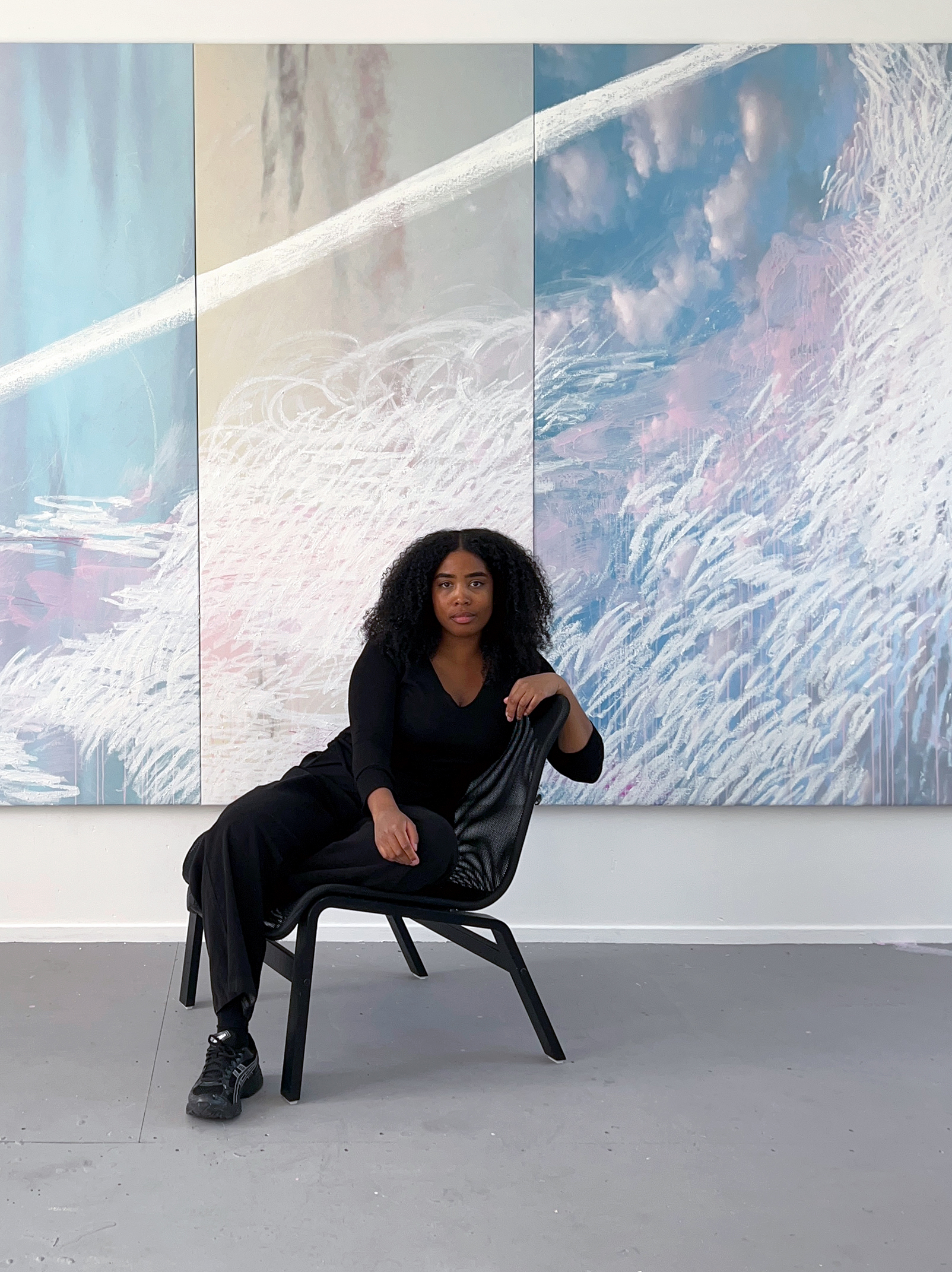
Self portrait, studio in Rotterdam, 2025, Image courtesy of the artist.
You work across various formats — painting, film, photography, and sound. What is your working process usually like? How does it begin?
My process often starts with encountering a sentence, a word, a thought, an experience, an essay or a book. From there I return to my existing archive of images on my phone but also my notes and begin to see connections between images, stories, thoughts and fragments.
Writing is also part of my process, although it does not always become a visible or central element in the final presentation. In the exhibition at Stedelijk Museum Schiedam, it appeared in the space through my voice as an audio piece.
For me, working with different materials such as oils, textile, video, sound, and (printed)images as well as techniques like; painting, photography and digital processes is a form of language. These mediums come together within a presentation to articulate certain ideas or ways of thinking. I see this as a way of working through multiple languages in relation to subjects or ideas I want to explore.
I’m curious about your research process too! Could you walk us through it?
My research process is very much intertwined with my working process. I don’t really separate the two. They happen simultaneously and allow me to enter and approach my work through different forms and layers. This way of working allows me to think through ideas in parallel, rather than in sequence.
Materiality, texture, composition and colour play an important role in my research process. I am also interested in how images and videos from my phone age when placed next to more recent ones, creating a subtle sense of time passing through material and technological shifts.
During the process of the exhibition I Breathe an Endless Universe in Me(2026) at the Stedelijk Museum Schiedam I read different books that relate to weather, time and the breath. Jamieson Webster’s On Breathing describes a clear moment at the birth of her daughter, taking her first breath and the realization that she will continue doing so until the end of her life. I also thought about my grandmother, who passed away earlier this year, and her last breath. And Roni Horn’s Island Zombie, which deals with isolation and weather in Iceland in a diary-like form.
When do you know when a piece is done?
This is based on Intuition! The piece will ‘tell’ me so.
What are you looking forward to in the future?
I am looking forward to continuing to explore different working and presentation methods across various contexts, and to see how knowledge from my previous studies continue to inform and enrich my practice!
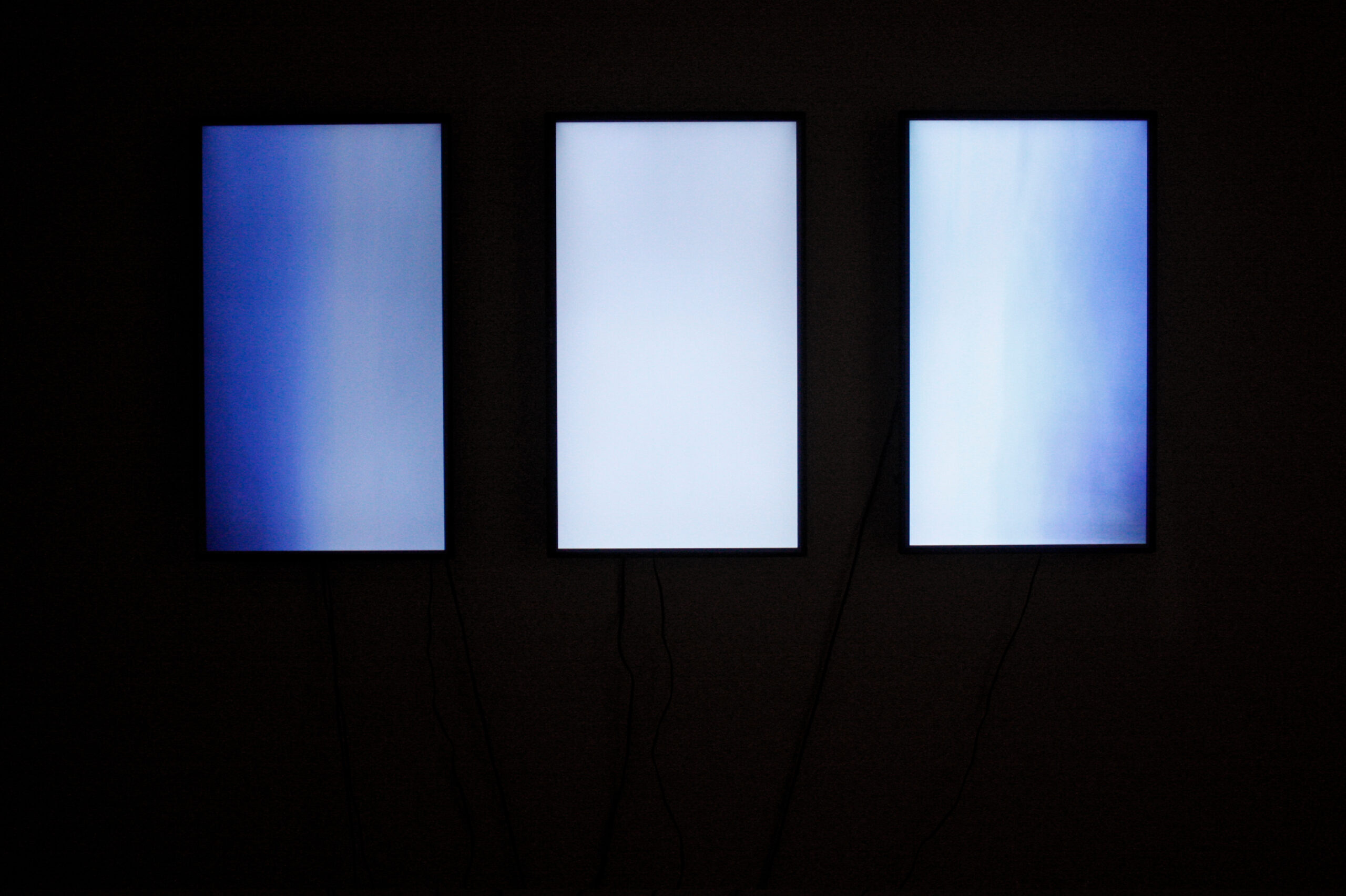
Detail: The Air in Between, 2026, Image courtesy of the artist
‘I Breathe an Endless Universe in Me’ runs until October 4 at Stedelijk Museum Schiedam.
More information here.
Words by Lora Lolev
Images by Aad Hoogendoorn