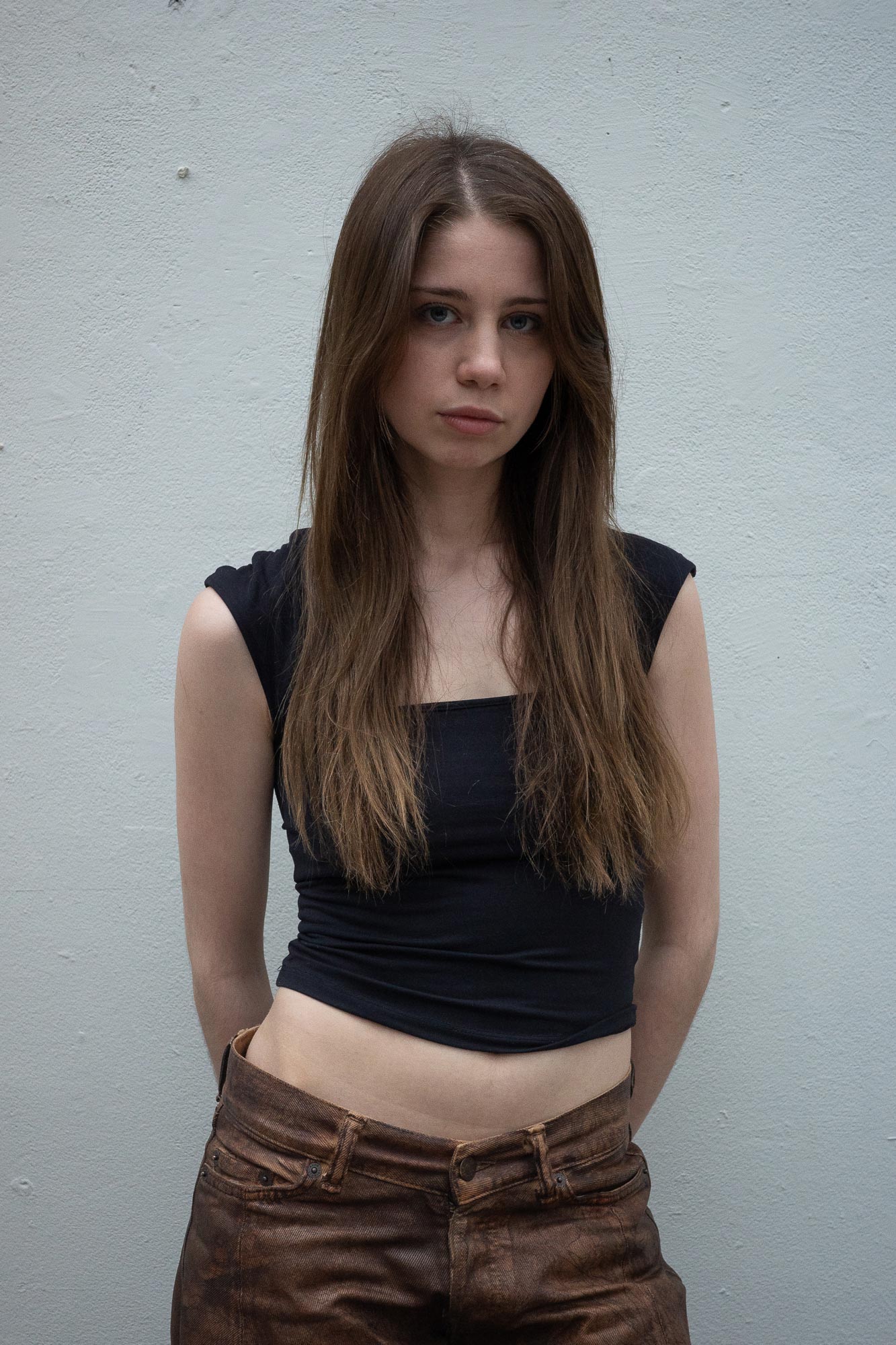
Our presence within the halls of the KABK first introduced us to this year’s uber-talented fashion graduates. With the classroom turned runway, what better way to meet the names we won’t forget than right in the heart of their ateliers? Glamcult sat down with two graduates for a chat. First up: the solar Mina Calori.
Born in the South of France and raised in Paris, Mina’s childhood memories constantly pull her back to the city of Nice. It’s a landscape of contrasts with the sharp saltiness of the sea standing against perched mountains, and her grandparents’ local hotel, where memories of imitation leather armchairs and heavy tapestries still flood her imagination. For her graduate collection, titled The soaring of the Simorgh, Mina weaves these intimate nostalgia-trips around her Iranian heritage — roots she admits to overlooking when she was younger.
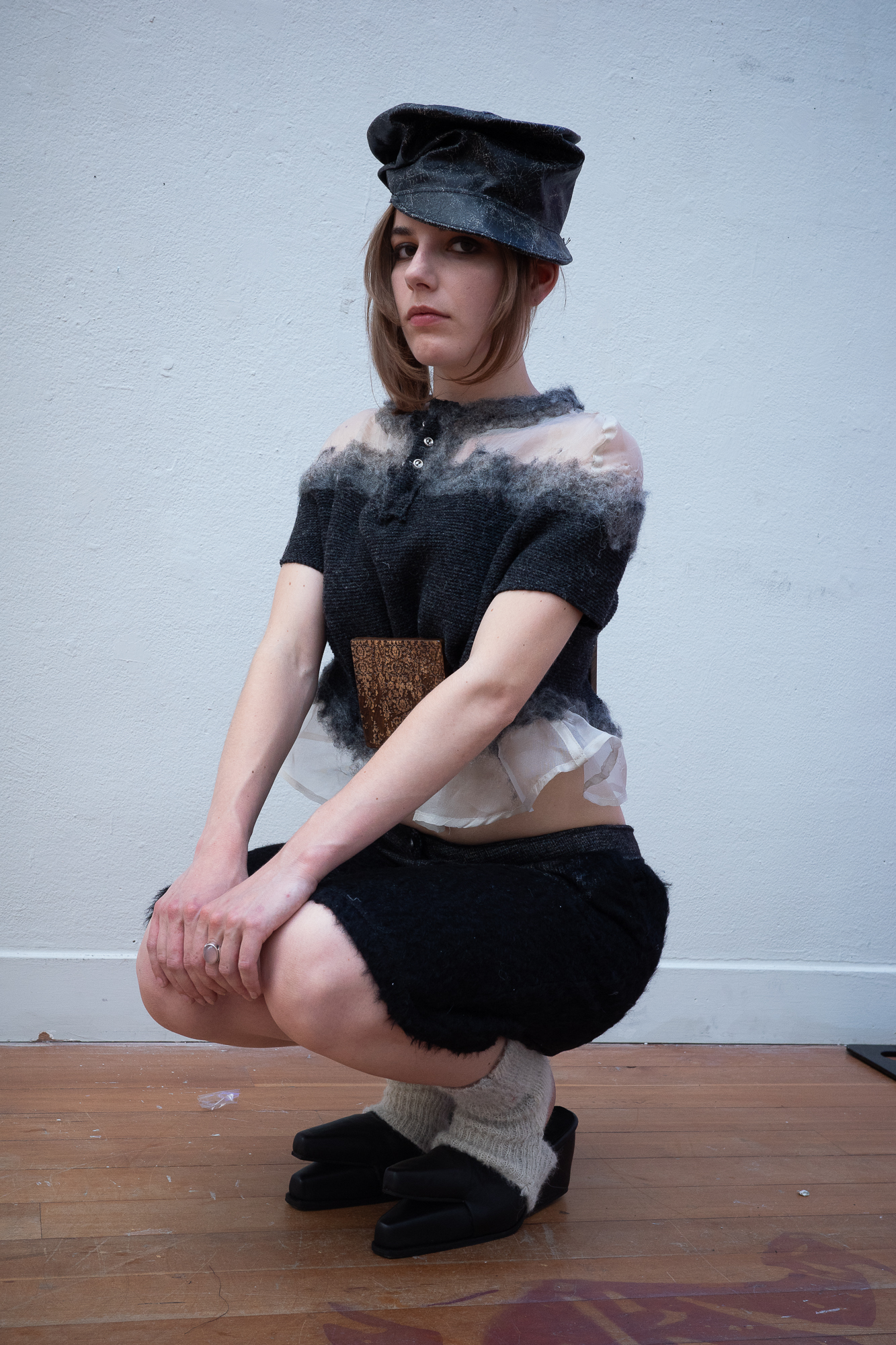
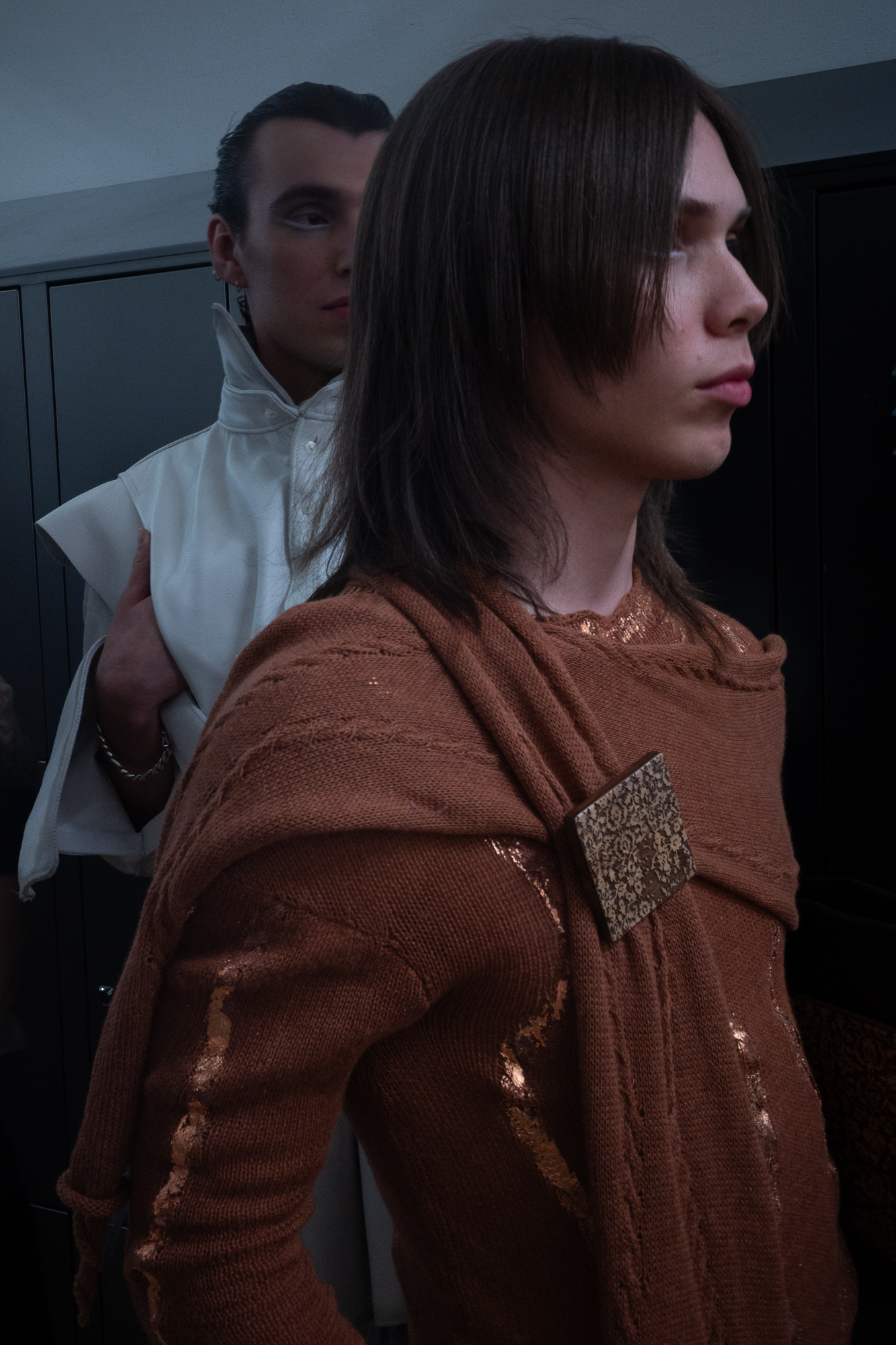
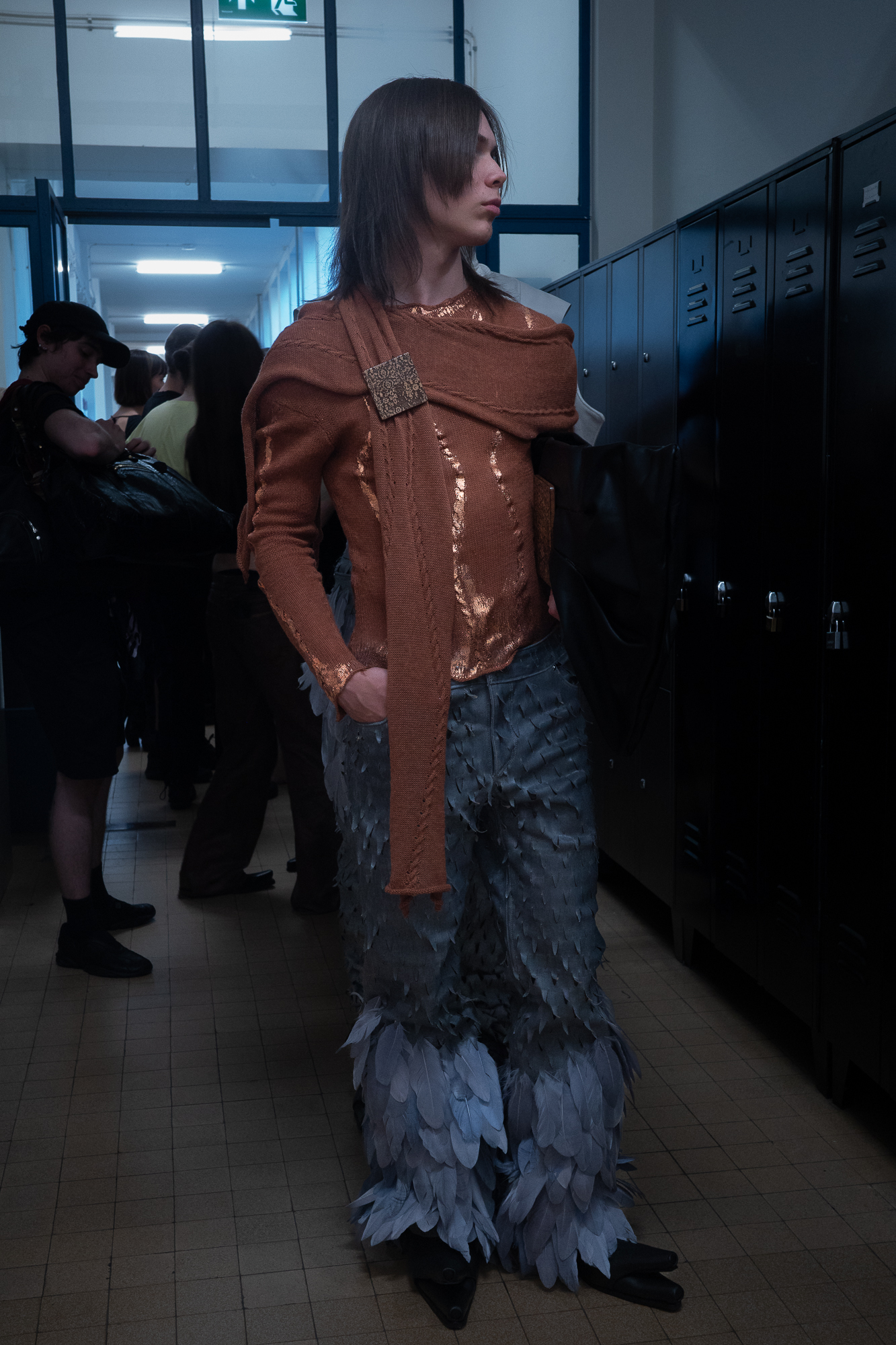
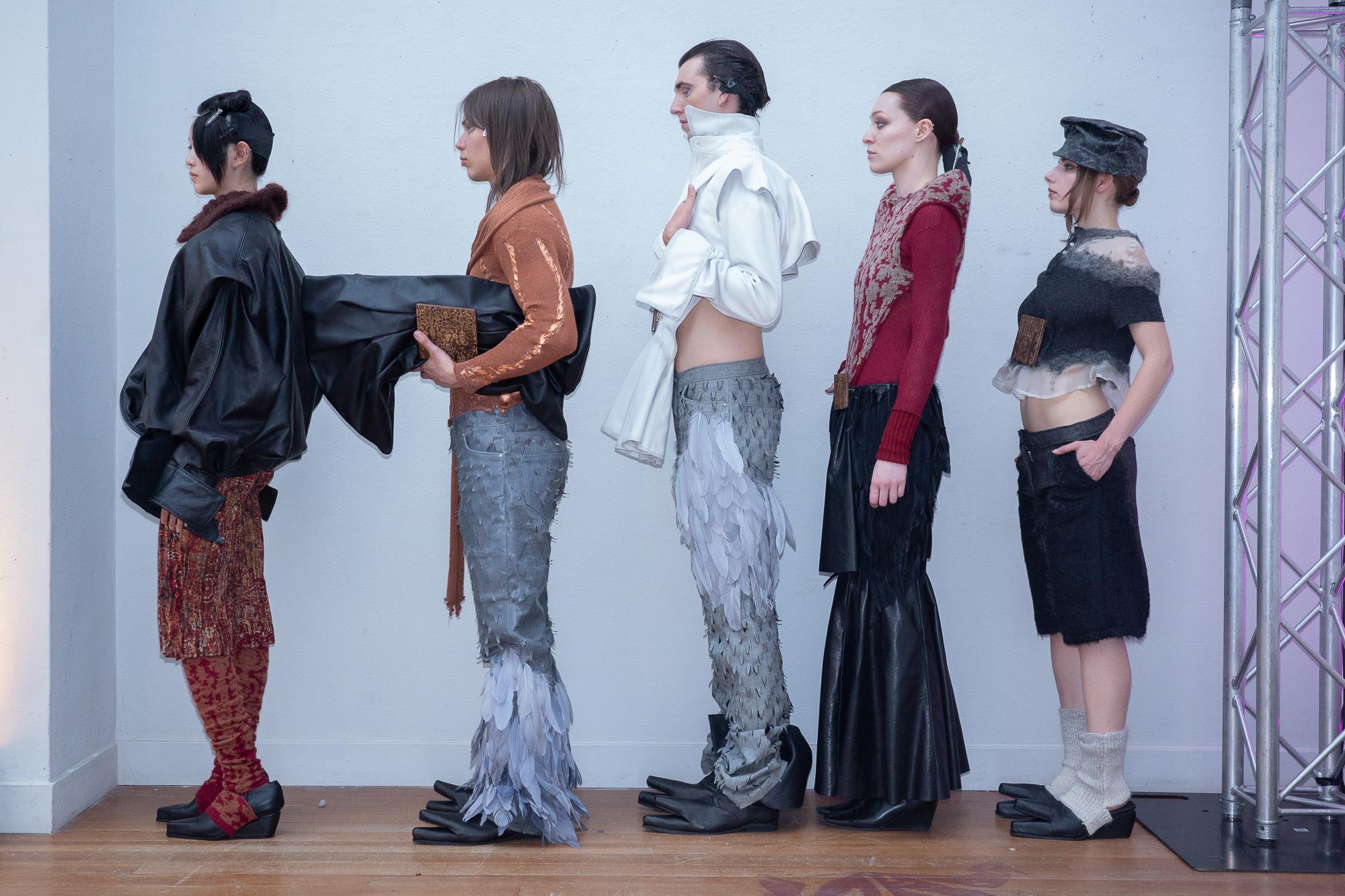
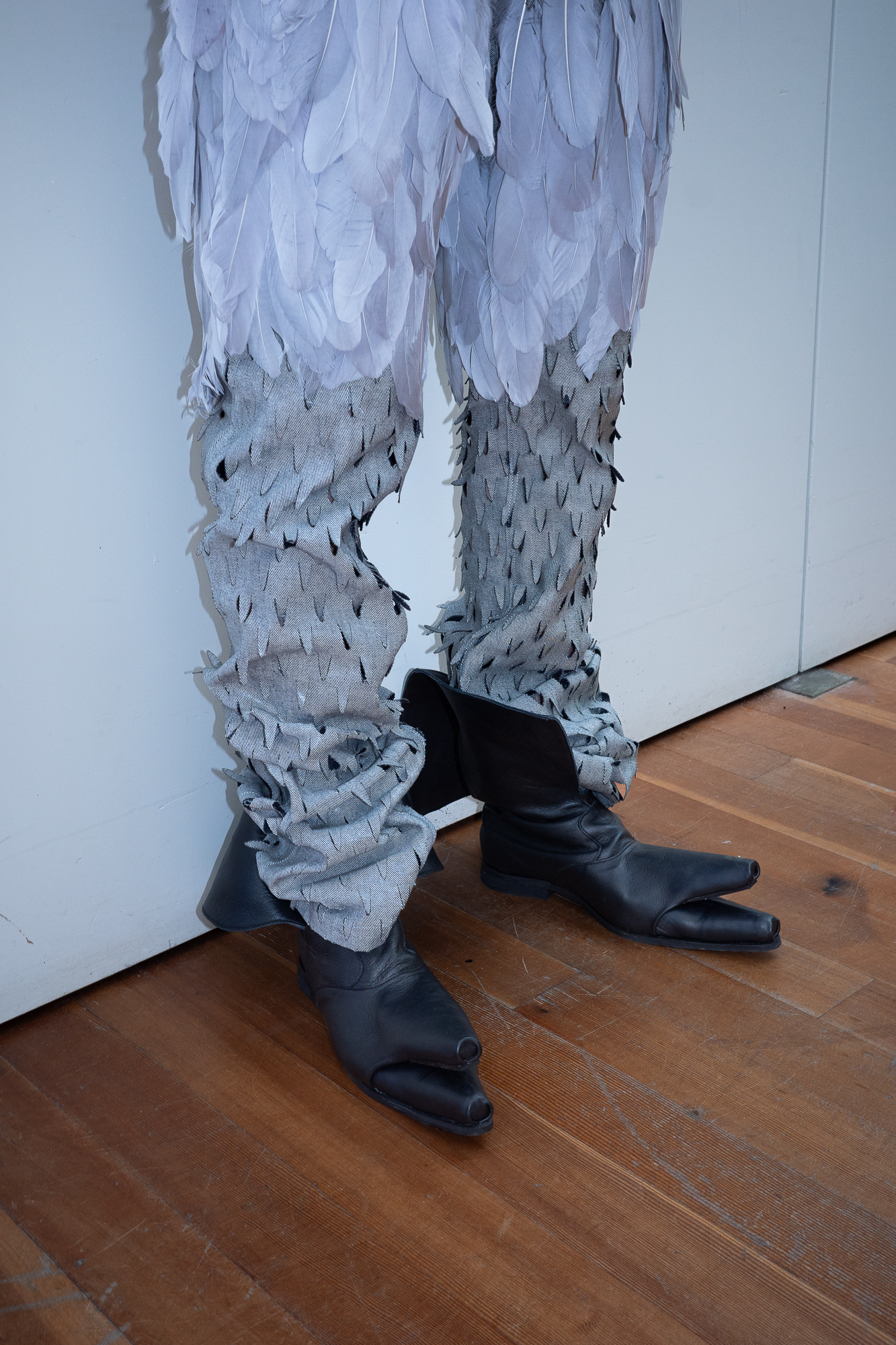
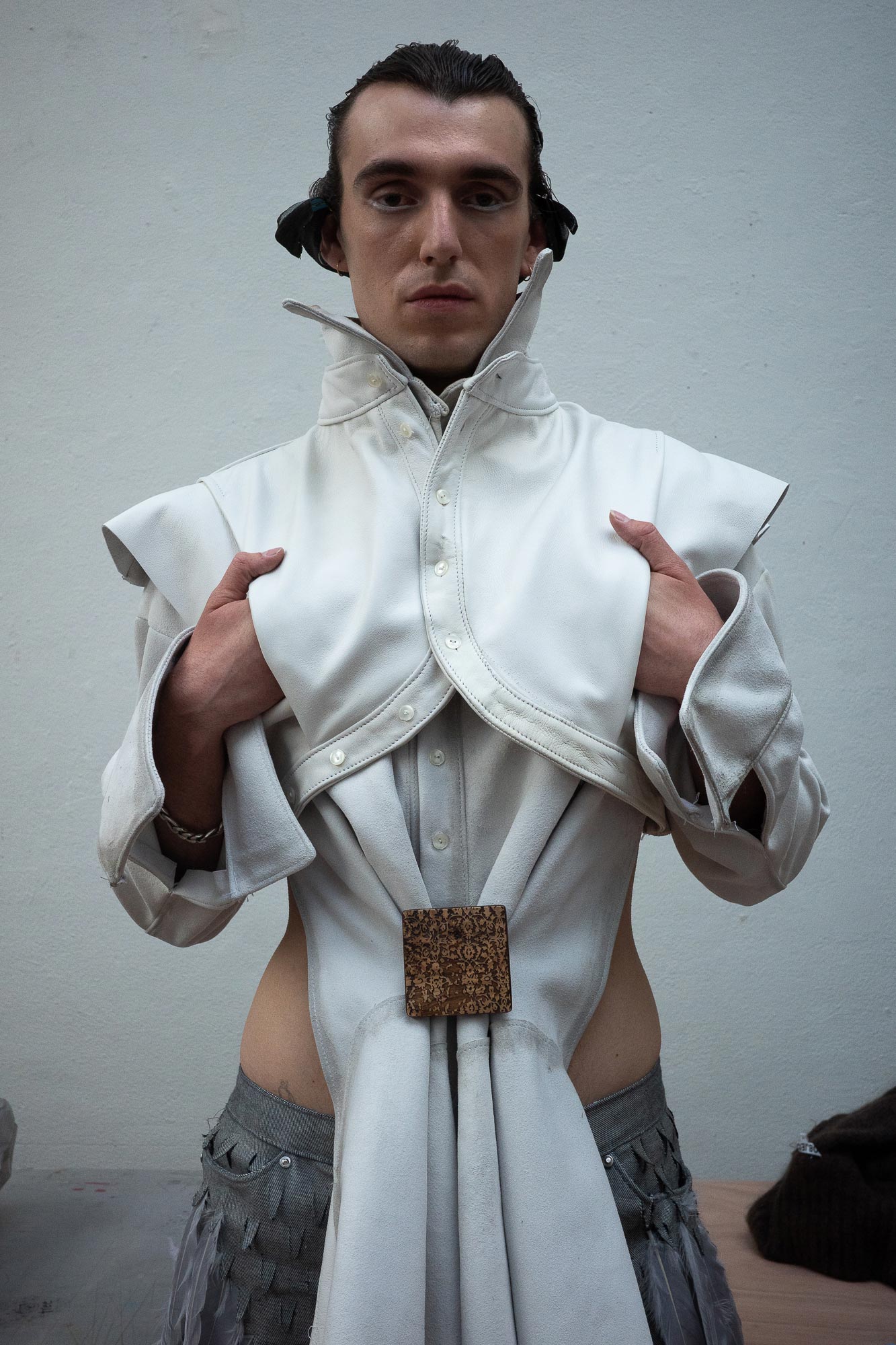
In the quest for self-discovery, the collection physically manifests her history with ornamental wooden brooches paying homage to the ones her grandmother adored, and the upholstery of the family hotel inspiring a rich yet subdued colour palette. Elsewhere, pointed beak-sole leather shoes are nodding to the avian. To embark on Mina’s journey is to delve into a Persian myth of migration and self-mastery, where bird moulting inspires the double edge of her pieces, striking a delicate balance between the softness of wool and controlled laser-sharp incisions.
Hi Mina! Lovely to be in touch. How are you feeling after the graduate show?
Hi, thank you for this opportunity! I’m really relieved but I still haven’t had time to come back down to earth after all these adventures, not just this semester but these four years in general.
I’m sure they went by so fast! Let’s begin with an introduction, could you introduce yourself?
My name is Mina-Héloise, I’m going to be 24, I was born in the south of France and later grew up in Paris.
Can you tell us more about your final collection, The soaring of the Simorgh?
This collection is a sort of tribute to my mother and grandparents. Born into a Franco-Iranian family that immigrated during the 1979 revolution, I’ve spent a large part of my life wondering about my identity, feeling like a foreigner and not understanding part of my family. Farsi, the Persian language, was like background noise to me, incomprehensible and mysterious.
The Simorgh is, in fact, a mythological bird from a Persian legend, in which a group of birds set out to escape the chaos and fly into the unknown, encountering a thousand dangers in their search for a master who can show them the way. In the end, only thirty survivors remain — for Simorgh means Thirty Birds. They then form a circle known as the ‘Conference of Birds,’ and facing each other, they become aware, as if in a mirror, that they are the Simorgh, that they have become, through their initiatory journey, their own masters.
The Simorgh’s flight — and I realise this even more today — illustrates for me quite literally my grandparents’ take-off into the unknown, just as they did over 40 years ago when they took a flight from Teheran to Paris for ‘a better life.’ It was an act of hope and freedom. It also speaks of the liberation of a community in search of freedom, breaking its chains with intelligence and collective courage. Through my work, I chose to develop this metaphor for the path of self-evolution. The making of the garments was based on a retroactive self-analysis, an inverted journey to bring to the surface a set of memories, feelings forgotten or suppressed... This self-reflection was intended to be both a sign for my family and a representation of my evolution after my four year course at school.
That’s such a beautiful myth, thank you for sharing that. Can you walk us through the more literal ties between the tale and the tactility of the clothes?
In the myth, the birds pass through seven valleys, undergoing a distinct transformation at each stage. And each valley carries an initiatory theme: the valley of seeking, of love, knowledge, independence, fear, uniqueness, poverty, and the valley of annihilation. It’s a painful journey. I’ve translated this literally into the clothes through the idea of bird moulting.
For example, I deliberately chose not to make the pants entirely of feathers, to emphasize the transition. I used laser cut-outs to imitate the punctuation of a bird’s skin without its plumage. The myth also addresses the theme of compressing oneself to evolve, and ultimately, become a better version of oneself. This dynamic of compression and expansion is present throughout the collection. It can be seen in the brooches, which are also a tribute to my grandmother, who loved them. Each brooch creates a slight compression on the garment, as at the junction of knit and leather on the skirt.
Inspired by your mother’s Persian roots and her story, has working on this project led you to discover something new about yourself, such as your own identity, or your relationship to that heritage?
Over the years, I’ve come to realise that this return to my identity is something I feel very strongly about. Before, I honestly thought it wasn’t that important. But then I realised how little I knew, and I felt like I was missing out on something. If I’d been interested earlier, I might have learned the language, for example, and become perhaps more ‘complete.’
Your colour palette is quite colder, with grey, blue, and burgundy hues, with your collection hinting at more ‘protective’ garment shapes and textures with knits, wools, and then thick collars, overblown shoulders. There’s a sort of shield and softness to it. I would love to know more about these specific design choices?
The colour palette I’ve installed is inspired by an environment I associate with the past, with childhood memories, with the atmosphere of this place, where I was bored, as I imagine it today. These are the tapestries and paintings in my grandparents’ hotel in Nice. These are colors that clearly exist in relation to each other, but not in opposition. What interests me is their relative neutrality, sometimes enhanced by warm tones, which speaks volumes about the afternoons spent there. The meeting of a form of wandering with moments of excitement…
The choice of materials in this collection is a kind of synthesis of these childhood memories — the wall fabrics, leather or imitation leather armchairs, bistro furniture and stools. They all made up a somewhat disparate whole, which led me to create an approach based on permanent hybridisation and a kind of childlike compensation between cold and hot, salty and sweet, rough and soft. And this also conditioned the question of the shape of individual garments. Beyond all that, of course, the question of form followed me throughout this work. I wanted each element to live its own life, both on the wearer and in relation to the other components of the outfit. But certain constants are repeated, such as the wooden brooches used to bind the garments together, with motifs both similar and different. Structured, like the pleated Bermuda shorts in pursuit of the wide, supple oversized black leather jacket. The reference to bird’s tails reappears in the form of the jacket’s fastening, or through a bag. The exaggerated shoulder pads express the final phase of expansion, while the pointed bird’s beak shoes are the constant linking the models through the floor.
You’re questioning the feeling of loss and belonging, and then the construction of identity through compression and expansion. When growing up, what was your relationship to garments like? Was it actively shaping your construction of identity? The question of loss I think comes a lot from losing what you were before in order to change. We have to let go of the weight of certain things that tie us to the person we once were, and that’s another facet of the myth that explains it.
Coming from a family of architects, I didn’t grow up in the world of clothing. I grew up hearing about architecture and I think that made me see construction in a different way and, later on, specifically for fashion design. When I moved on to design in the fashion world, I wanted to maintain this link with structure, so I started working with wood as an element of continuity between architecture, design and clothing. The notion of loss or questioning identity intersected with these intuitions generated by listening to parental conversations. I’ve continued to mix and hybridise very diverse, even antagonistic influences, and that’s what interests me most of all.
What was the process like in terms of working on this final collection? What were the pivotal moments, such as challenges or unexpected breakthroughs?
During this semester — which was very short and dense — what I thought was my strength at the beginning eventually became my weakness. I had a very precise idea of what I wanted. When I designed the collection, I was probably too quick to think ‘this is it!’ So I became a bit self-blocked, restricting my exploration of fabrics and canvases to remain extremely faithful to my drawings. This left no room for unforeseen events, new intuitions or the specific qualities of certain materials. When reality doesn’t turn out the way you imagine it, you have to go back and rethink the process. So I had to start over several times with outfits that didn’t render what they promised. The turning point came when I finally abandoned the canvas models and started working with the fabric itself. It was when I saw the actual materials taking shape that I realised this could work.
What’s the best piece of advice you’ve received during your studies?
In my first year, I began exploring wood through fashion. I didn’t ask myself many questions about it. I just wanted to try it, and my teacher really pushed me to keep exploring as he thought this could become my signature. I am really grateful because I realised that, beyond a simple experiment, it could become a personal path that I could pursue, a sort of trademark.
And how has your design language evolved since your first year?
I do think that my work is still traceable, and that my language has evolved by gradually adding up and mixing everything I had inside me and the influences that came my way. I’ve always wanted to preserve the opposites, the duality of the materials I use, which has perhaps become more subtle over the years.
What are some of your influences, the elements that inspire your work?
Growing up in the south of France, between the sea and the mountains, I’ve always been surrounded by contrasts and dualities. This coexistence of very different landscapes, textures and atmospheres still nourishes my way of conceiving and creating.
Henri Matisse — who made Nice his chosen city — whose world I discovered at a very early age through the museum dedicated to him, has also had a major influence on my outlook. His forms, symbols and above all his use of color have guided my choice of motifs and palettes.
Where would you like to take your creative journey next?
I’d like to pursue my creative path by further developing the field of accessories, while continuing to explore the integration of wood which particularly interests me for the possibilities it offers, both technical and aesthetic.
I’m also keen to deepen my research into innovation, experimenting with new methods, new assemblies and new ways of combining materials. The aim is to continue creating objects that combine craftsmanship, functionality and uniqueness, while pushing back the boundaries of what is traditionally expected of accessories.
Words by Lora Lolev
Photography by Renée Benerink