“Sometimes when I want to post a thirst trap on my Twitter, I think to myself, “Is this good enough to occupy a cover and a full-page spread in the New York Post?”
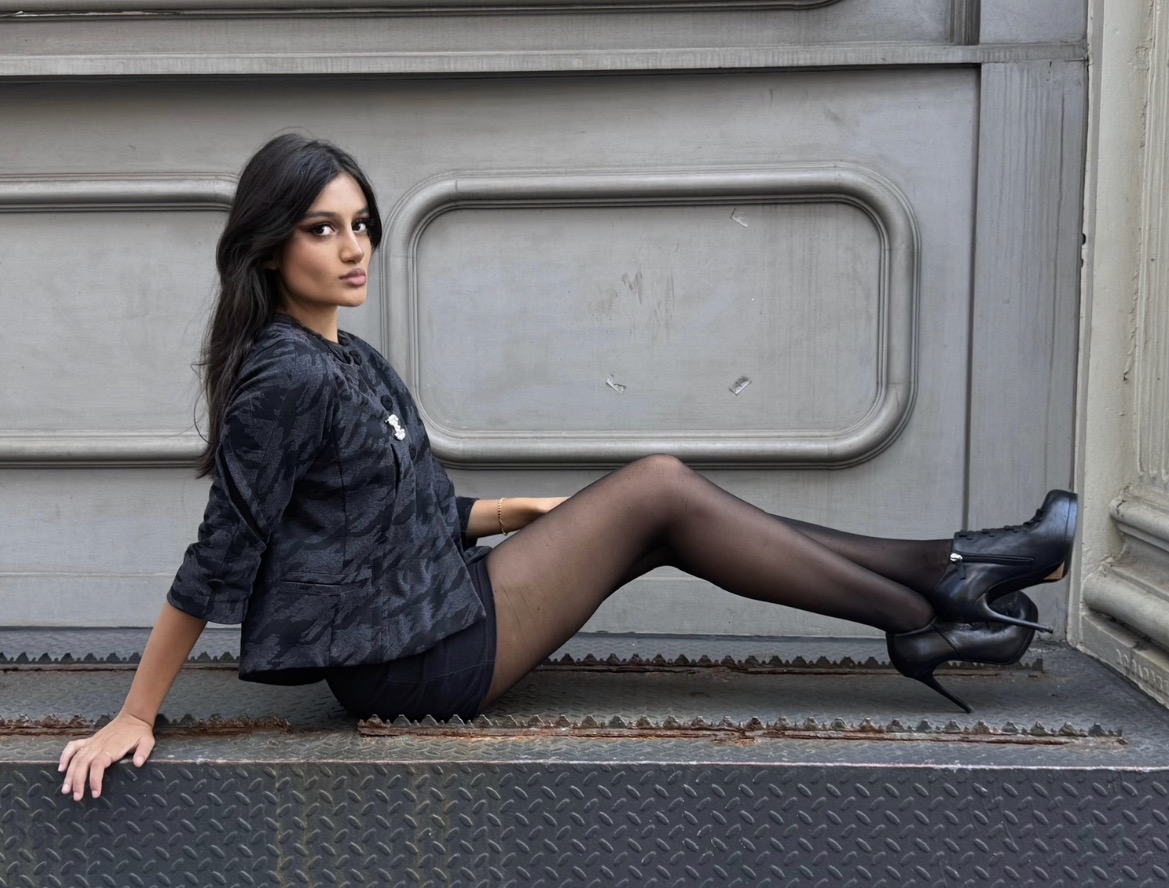
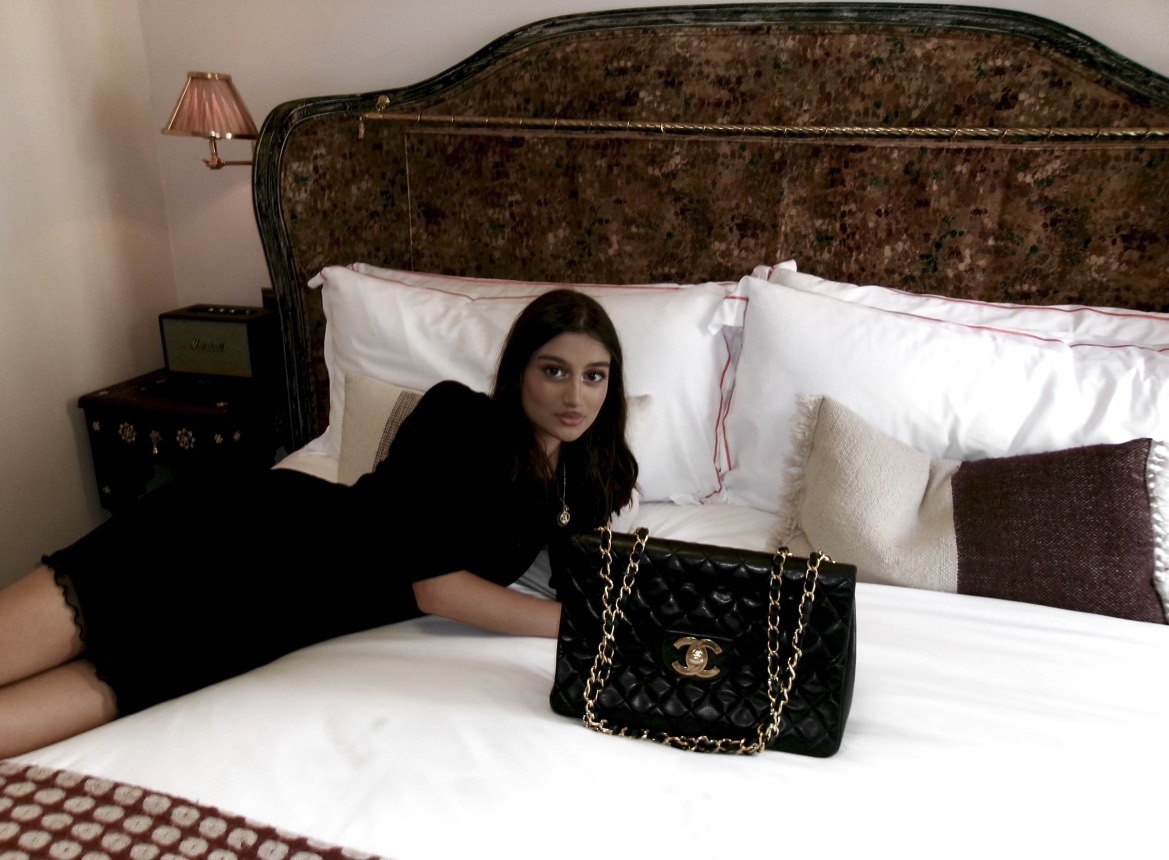
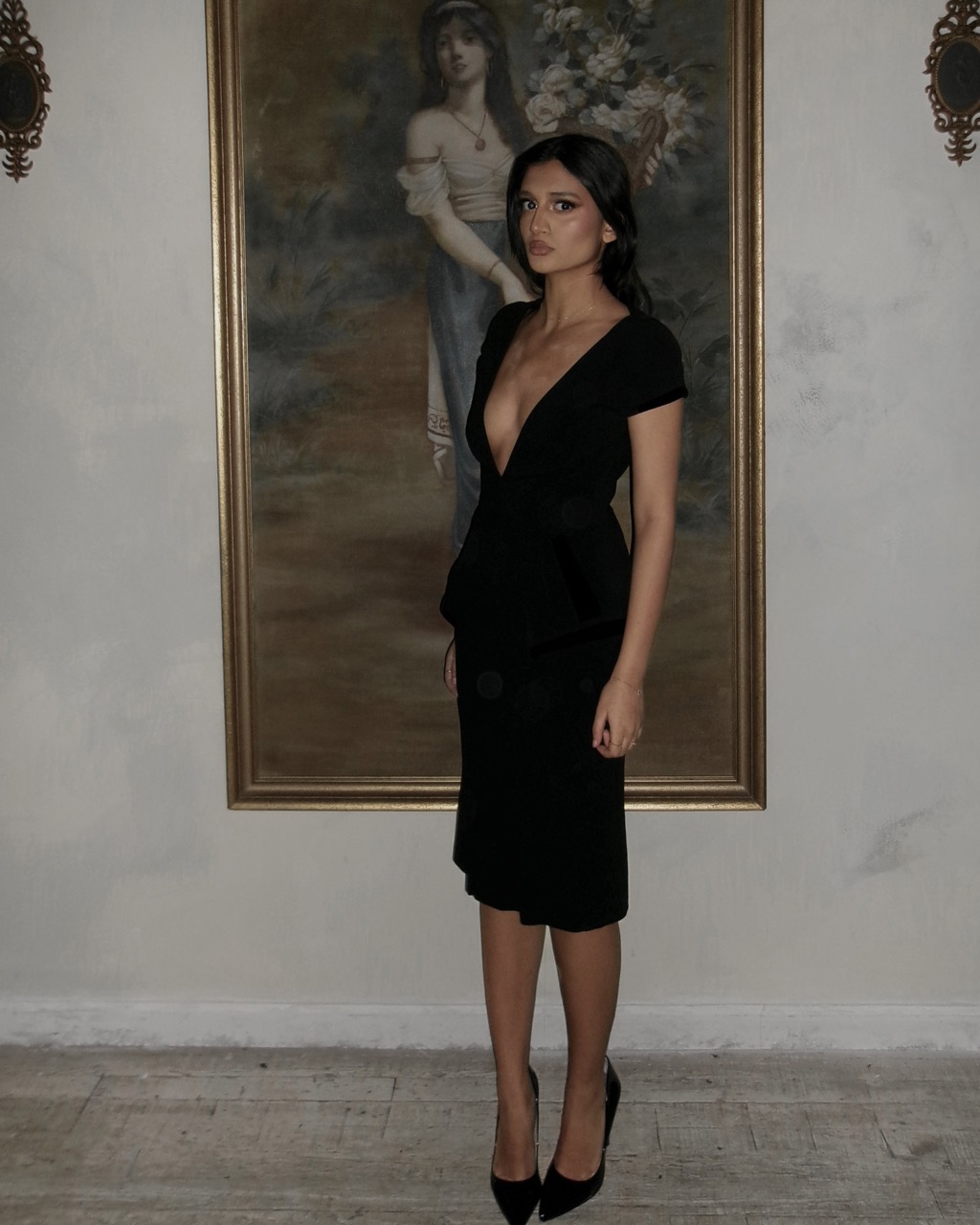
Ella Devi absently reapplies her lip gloss while she recalls the hundreds of death threats she received, as if both are equally ordinary in the life of a 19-year-old. It is an oddly apt introduction to someone whose online presence seems to short-circuit people’s brains. The self-proclaimed Socialist Socialite posts selfies wearing Chanel bangles alongside electoral work for Zohran Mamdani, talks about Japanese eBay with the same ease she discusses democratic socialism, and wears campy pearls and ribbon blouses while arguing for radical wealth redistribution. Her wardrobe may read Upper East Side; her politics prove to be at home at a DSA meeting. Her pastel-font TikToks and Blair Waldorf references are backdrops to her thoughts on surveillance capitalism and the politics of beauty.
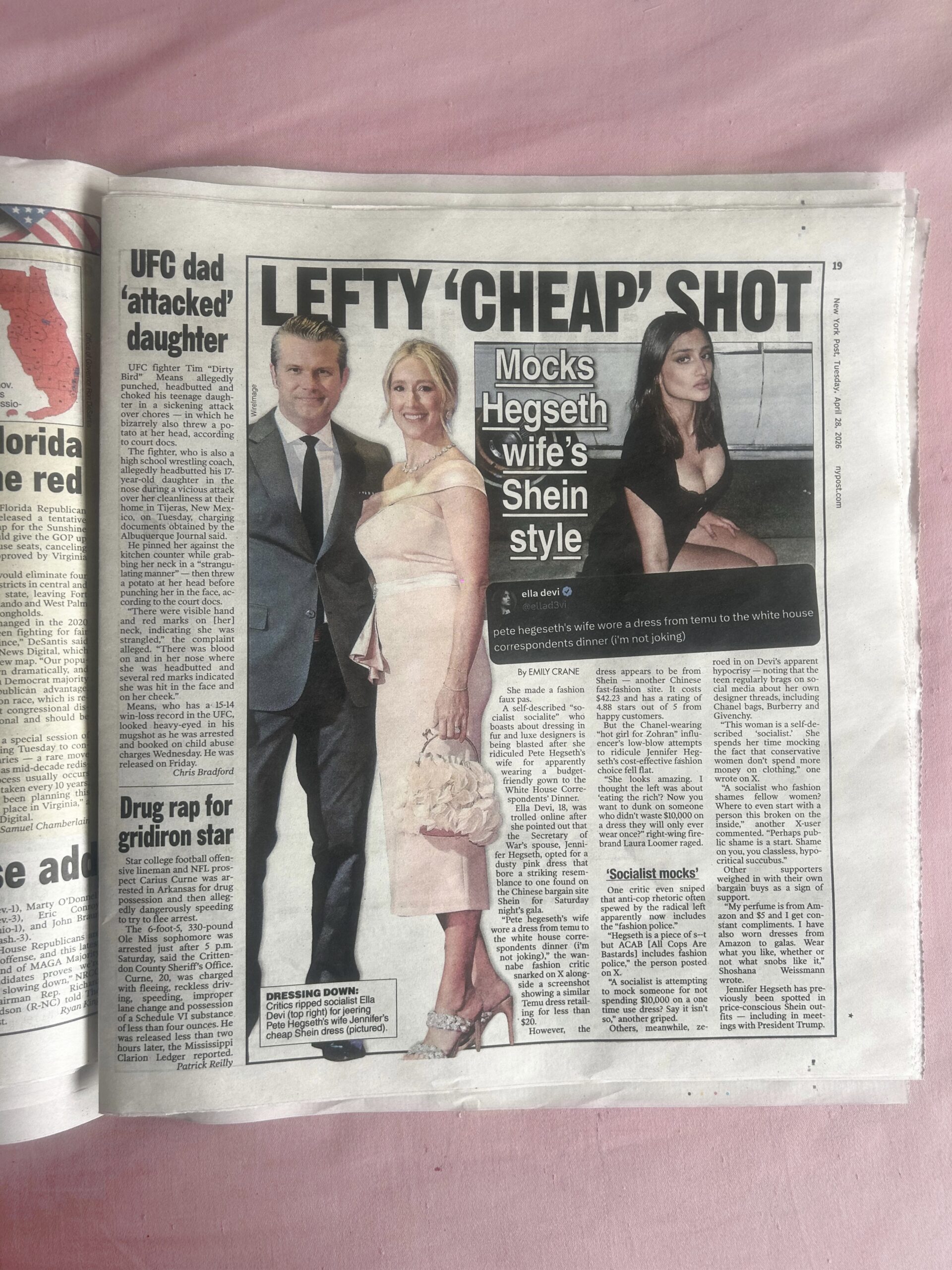
A few months back, when the New York-based fashion intern clocked Pete Hegseth’s wife in what appeared to be a Shein dress to the White House Correspondents’ Dinner, the then-18-year-old found herself at the centre of a right-wing smear campaign. Her thirst traps were splashed across the New York Post, mogging the right-wing Shein-wearing official with ease, but also lead to strangers picking apart her appearance and politics, to the point of spreading conspiracy theories about her family and sending death threats with a ferocious degree of hostility. Her effortless demeanor on TikTok makes it easy to mistake her for someone unfazed by it all, or even someone simply capitalising on a moment of online notoriety. But beneath the clout is a teenager acutely aware that the slander was never just about a dress; it was a political attack on her as a brown woman, on who gets to be taken seriously, and why femininity continues to be weaponised against young women. Luckily for us, she’s resilient, funny, disarmingly self-aware, and perhaps most importantly, completely uninterested in abandoning fashion in order to prove she’s politically serious.
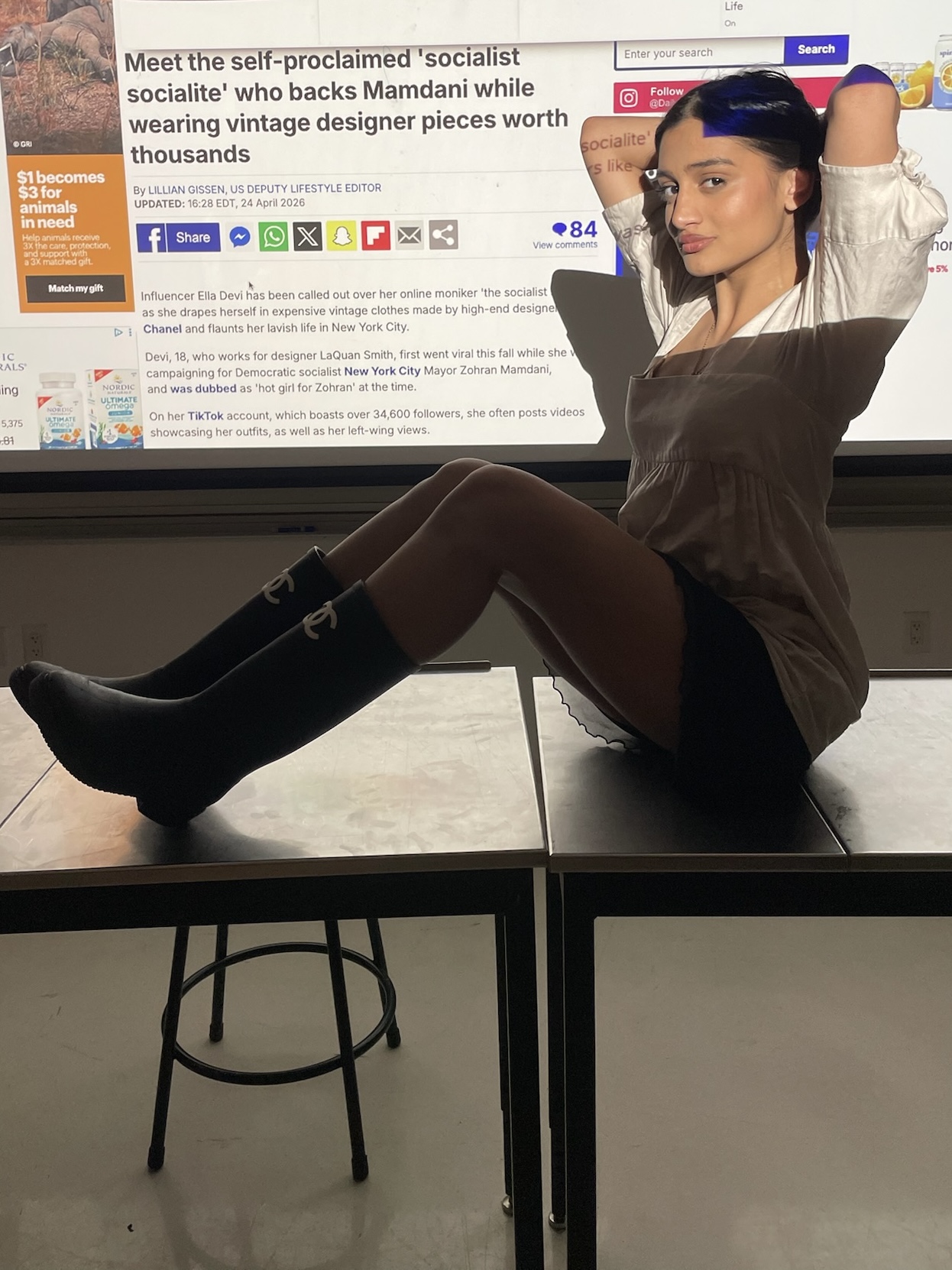
So you’ve become kind of the final boss of the “Can leftists wear nice clothes?” discourse. You, of all people, know that people often treat expensive clothing like it’s a moral failing. How do you respond to people who expect activists to look broke?
Look, the entirety of my wardrobe is secondhand—found really, really cheap, or gifted to me, or sent in PR, or borrowed. So in reality, I think people have this illusion that I’m spending thousands of dollars on my clothing, which is just not true. But, you know, coming forward and saying, “I find really good clothes at really, really good prices because I spend a lot of time on Japanese eBay”, that’s how I do it. I really like the hunt. I appreciate nice clothes, and I find them at prices that are acceptable to me, and I put in the work for my community. So I don’t really see the issue.
I guess people get confused when they see the brand itself as a symbol of luxury, regardless of how you got it.
I mean, I like the irony of that. I like to be a little over the top, a little camp, a little self-parodying, and I really like designers who incorporate that. Ashley Williams is a great example. But it’s also about quality. At the end of the day, I think so much of what luxury fashion stands for is incompatible with my political values. But I also don’t want a world driven by fast fashion and endless consumption.
Nine months after the smear campaign, does it feel like it’s behind you?
It’ll follow me around for quite some time. When you Google my name, there’s still a lot of really nasty stuff, and that’s painful. It’s my name. It’s my life. That’s a hard load to bear, you know, as a teenager, but also just as a person.
What helps is showing up offline. I joined New York City’s DSA seven or eight months ago, and it’s been one of the most rewarding things I’ve ever done. It functions kind of like a church. Besides being the organisation that brought you Zohran Mamdani, AOC, Claire Valdez, and Darializa Avila Chevalier, it’s this amazing community that really sticks up for one another, advocates for our neighbours, and fights for our city. I’ve found amazing friendships there, and the community really looks out for one another. Whenever I’m canvassing or working on a campaign, I feel like I get some of my life force back.
Understandable. What’s the biggest caricature that people still have about you?
Um, my best friend sent me a tweet: “Did Marx ever consider that women be shopping”; I guess that’s how they perceive me. I mean the right-wing people have clearly many misconceptions. It’s actually not funny at all. It’s actually really sad.
Are we gonna try to laugh about it to just lighten it up?
Yeah, absolutely. When I was getting smeared on Twitter, a massive right-wing account with three million followers found my parents’ names and jobs and spread a conspiracy theory that they were sex traffickers because my mother had been cited in an anti-sex trafficking article. I was crushed. I never thought people would go so low as to target my family.
With something so easily debunkable.
It’s just so easy to conclude that conservatives can’t read.
Damn.
People on the left were like, “It really wasn’t that bad,” or, “You’re just being dramatic.” And I’m like, “You don’t even know.” There’s no line that they feel is too far to cross. The right found my parents, my address, my school. I got hundreds of death threats and rape threats—all because I pointed out where a dress was from. And it really does show that I pose a real threat to the right wing. If the right wing’s biggest commentators, like Laura Loomer, are gearing up against me, then I must be doing something right.
Yeah, it definitely shows how fragile their whole mission is, and how far-off their moral compasses are too.
I think part of that comes from the right wing staking a lot of cultural capital on being the side of beauty and culture. They’ve built this narrative that the left is blue-haired, unattractive and doesn’t appreciate art, but that falls apart when you see they’re also just cutting costs and buying from brands accused of using slave labour.
They don’t care who lives or dies making their dress. Has going viral in this way changed your way of posting at all?
Sometimes when I post a thirst trap on my Twitter, I think to myself, “Is this good enough to occupy a cover and a full-page spread in the New York Post?” If it’s not, I don’t post.
Iconic statement, ngl.
The number one thing that people say to me is “Well, I’m so sorry it’s happened, but you look great in that picture.” And to that I say, I wish that you guys could stop saying, “You look great in that picture,” and more say, “I’m so sorry,” because the ratio is a little bit off.
I think there’s an honest discussion to be had about what they were trying to do with that image. I was a teenager, and they chose a sexually provocative picture of me and placed it next to an image of Pete Hegseth’s wife, who was looking modest and chaste. It reminds me of the Madonna and the whore narrative, where it’s like, look at Pete Hegseth’s wife, the chaste white Madonna, and look at this Brown woman who’s like, a harlot.
It would match up to the rape threats that I received. I think there’s a discussion to be had about how the New York Post very much facilitated these threats of sexual violence.
I think on a surface level it’s easy to see the irony of them trying to make you look bad and choosing a picture where you look great. But you’re right, it is actually that deep. I didn’t think about it that way.
Unfortunately, I’ve been thinking about it.
In most of your online posts, you wear very traditionally feminine pieces—like pink ruffled blouses or pearls, which can read as camp, but to some people might even seem conservative. How does your personal style connect to your politics?
My personal style online and offline is different. Offline, it’s much more understated and wearable. I can’t canvas for socialist congressional candidates wearing, like, a crazy pink getup, you know?
And my personal style online is very feminine, and it’s a little over the top, to appeal to other fashion people. I’ve always dressed that way, and I want young women to see someone on the left who embraces femininity. The right has used aesthetics to draw young women in, as creators like Ballerina Farm do. So many women are pulled into the right wing because of aesthetics; they see these very attractive lives with beautiful clothes, and they don’t see the subliminal messaging. And I want to act as a similar pipeline, a similar Trojan horse, but for the left wing—for young women. I want socialist politics to be as accessible to them as right-wing politics are.
Do you have a take on what the fashion equivalent is of having no media literacy?
Wearing the Ray-Ban Meta glasses. Fresh on my mind. If you’re wearing those, there are very few things in this world where I look at you, and I’m like, “That is not chic at all.” I think anything can be made chic. I hate the word chic, first of all—it annoys me. As long as what you’re wearing isn’t harmful to the people around you, I think it’s fine. I think it can be made cool. But the Ray-Ban Meta glasses are ushering in this new era of the surveillance state, and I’m just like, “Get those off your head.” They’re ugly, they’re hideous, they annoy me. They’re so predatory. And I just think less of people who wear those.
Lol! So I was wondering, because I read you’ve been working in fashion since you were 14.
God help me. Yeah, I’m in therapy.
You’ve been building a resume that most people don’t have until after university, which is just objectively kind of insane. Do you feel like you’re the kind of person that boomers say they want Gen Z to be like?
I have a lot to say about that.
Go off.
Actually, I frequently hear Gen X or Boomer-aged people say, “Oh, Gen Z doesn’t work.” That’s not true. And even if it were, I can’t blame Gen Z—look at the world we inherited. Students are already dealing with impossible workloads and pressure to check every box before they even enter the workforce.
I’m an anti-capitalist. I don’t think someone’s self-worth should be based on how much they work. I got into fashion because I loved the work. I was a miserable kid, I wasn’t getting along with my family at all, and my family didn’t approve of me going and working in fashion. So much so that my father would threaten to call the cops every time I left my house. And I got into the work because I loved it. And fashion gave me something I cared about. I wish everyone could have that relationship with work, but that’s not possible when people are working for little pay, living paycheck to paycheck, and struggling to survive.
And not every job gives you a dream. Fashion is also 100% work, and it’s toxic, and it’s a hard industry. But it also has an aspirational part. Not every job or every career path has that.
The number one thing I hear from people in my comment section when I talk about working in fashion is, “Oh, that’s my dream. But I can’t afford to do that because I have to go be a doctor to support my immigrant parents.” That breaks my heart, you know? I am so lucky that I can afford to pursue working in fashion. But what about the people who can’t? This industry is so deeply inaccessible for people who need to pay rent to survive, people who don’t have a support system. People say you can’t love fashion and be a socialist at the same time, but that’s exactly why I love fashion so much. I want everyone to be able to have access to living that dream, to creating art, to being around art. I don’t want there to be a financial barrier. That’s why I love fashion, and that’s why I’m a socialist.
What would you advise young people trying to get into fashion?
Build your own spaces with people your age. Read everything you can, watch everything you can, and spend time around fashion in your community—whether that’s a vintage store or a small atelier. And just experience the world around you, too. I think the people I know who know the most about fashion know the most about it because they also know the most about the world. They understand the context in which this art is set, and they understand that all art is informed by the world that we live in. And what good is knowing everything about fashion if you don’t know everything about that world?
I think this is great advice. But if a 14-year-old asked you, “Do you advise interning so early?” would you say yes? And do you feel like it has helped you now?
Do I feel like it’s helped me in my career? Yes. Do I feel like it’s helped me mentally? Not at all.
And yeah, so if I’m going back to your political work, you became known for this “Hot Girls for Zohran” tagline.
Oh, let me walk you through that. So there is an organisation; it’s called Hot Girls for Zohran. Well, now it’s called Hot Girls Organise. They do great work. You know, Emrata was associated with it, and so many other amazing, cool people. After I was canvassing for Zohran, The New York Post slapped my face on an article with some bullshit headline like, “Hot Girl for Zohran Doesn’t Recognise Who Wallace Shawn Is.” They put “Hot Girl for Zohran” in air quotes as if I’d ever called myself that, which I hadn’t. It was this weird dialectic where it was objectively very funny, but also the harassment I got was unbelievable. I was getting deepfakes of me taking my clothes off and all this other horrible stuff. Other than that, it was so funny. But it was also terrible. Then the co-founder of Hot Girls for Zohran reached out and invited me to their election night watch party. Her name is Cait. She’s the best, and I’ve been lucky enough to work with her many times since.
It really showed me how much the New York City socialist community looks out for one another. I’ve met so many young women who’ve been smeared by The New York Post, and when that happens, our community, NYC’s DSA, really bands together to make sure they’re okay. I’m really grateful for that.
That’s such an important counterpart to the harassment—to know that there’s also a really big community that comes from it, and that sees how harmful it is.
You need people to back you. Otherwise you lose your mind.
And I don’t even think you necessarily start believing it, but you do start questioning yourself. Do you feel like younger people are still underestimated politically, or is that changing?
I think it’s changing, but I also think young people are undereducated when it comes to electoral politics—not only because they don’t consume traditional media, but because the candidates the Democratic establishment offers often don’t speak to them. We really saw that change with Mayor Mamdani. His positions on not funding a genocide, on universal childcare, on taxing the rich—those things resonated with young people in a way they’d never really been spoken to before. People complain that young people don’t vote. Well, they do vote when candidates take them seriously—not just by making TikToks or social media gimmicks, but by offering policies they actually believe in. What young person is going to go out and vote for someone who supports funding the genocide in Gaza?
Sounds like you have some great ideas. Are the people in charge taking you seriously?
I mean, I’m an intern.
That makes sense, but still, do they listen to your ideas?
A lot of my work is coming up with video ideas, reaching out to new media, and suggesting ways to connect with different audiences. I think building creator networks for candidates is really important because you want to reach people who don’t normally consume political content. You have to meet people where they are—through food, sports, fashion, all these different spaces people already engage with. Most people aren’t just watching TikToks that are only about politics.
And why do you think that Hot Girls for Zohran worked so well, even internationally?
I mean, have you seen the face? His face is very handsome. Not much else to say in that regard.
I have some last quick fire questions. Which celebrity is an example of great style plus politics?
Ziwe. She has some pretty good looks. It’s really interesting to see what she wears because I think so much of what she wears revolves around her persona for the talk show. Rama Duwaji is incredible. I will wax poetic about her style. I recently did so to a reporter who called me asking about Mayor Mamdani’s style, and I just went off on, like, a 10-minute tangent about Rama Duwaji, and they had to cut it.
But it has to be said.
I have to speak to the people about Rama Duwaji. You know, Gabriella Karefa-Johnson is incredible. Her work is incredible. Her politics are incredible. Same with Zara Rahim. I adore her. I think Darializa Avila Chevalier has great style, and I’ve been on that train since day one. I think she’s very chic, very understated. And she actually rents a lot of her clothing from Nuuly, and she keeps whatever really speaks to her. I think it’s a very conscious and sustainable way of dressing. I asked her recently what her favourite clothing brand was and she was like, “Schiaparelli, but I don’t have Schiaparelli money.”
I wish…
Just walking around with a giant lion on my chest.
And whose wardrobe would you raid personally?
Blair Waldorf. Since I was 12 years old, I’ve always had that answer. I love that she’s just so over the top and ridiculous.
And whose closet would you politely decline? If you don’t want to answer, don’t, but I feel like you have an answer to this.
That’s such a nasty question. My God! Um, now I’m just thinking of people I hate.
Smart.
Not really, they’re people in my personal life. They’re not famous.
Lol, I always imagine a friend reading this and hoping it’s not them.
They’re not going to read it! They’re my opps.
So maybe I’ll just put “my opps.”
Thank you.
So if you were invited to a White House state dinner tomorrow with an unlimited budget, what would you wear? And what message would you bring to the table?
I wouldn’t go to the White House state dinner!!!
If you’re trying to change things, maybe you’d need to sit at this table and wear something ridiculous!
I wouldn’t be caught dead at the White House state dinner. You’d have to drag me there by my cold, dead body!
…Wearing?
No answer. My pyjamas.
If Schiaparelli sent you a really nice dress, would you go to the White House state dinner?
No!
Okay. That’s the end of it then.
Thank you. That was very fun.
Is there anything else you want to talk about or that we didn’t cover?
I really think you got everything off my checklist. I was like, what do I want to make sure people know about me? I don’t spend a million dollars on clothing, number one. Number two, stop being mean to me on the internet. And yeah, that’s about it.
Words by Pykel van Latum