“Cuteness creates this sense of safety. And so much of what I’m interested in is how to create safety, but also how to disrupt it.”
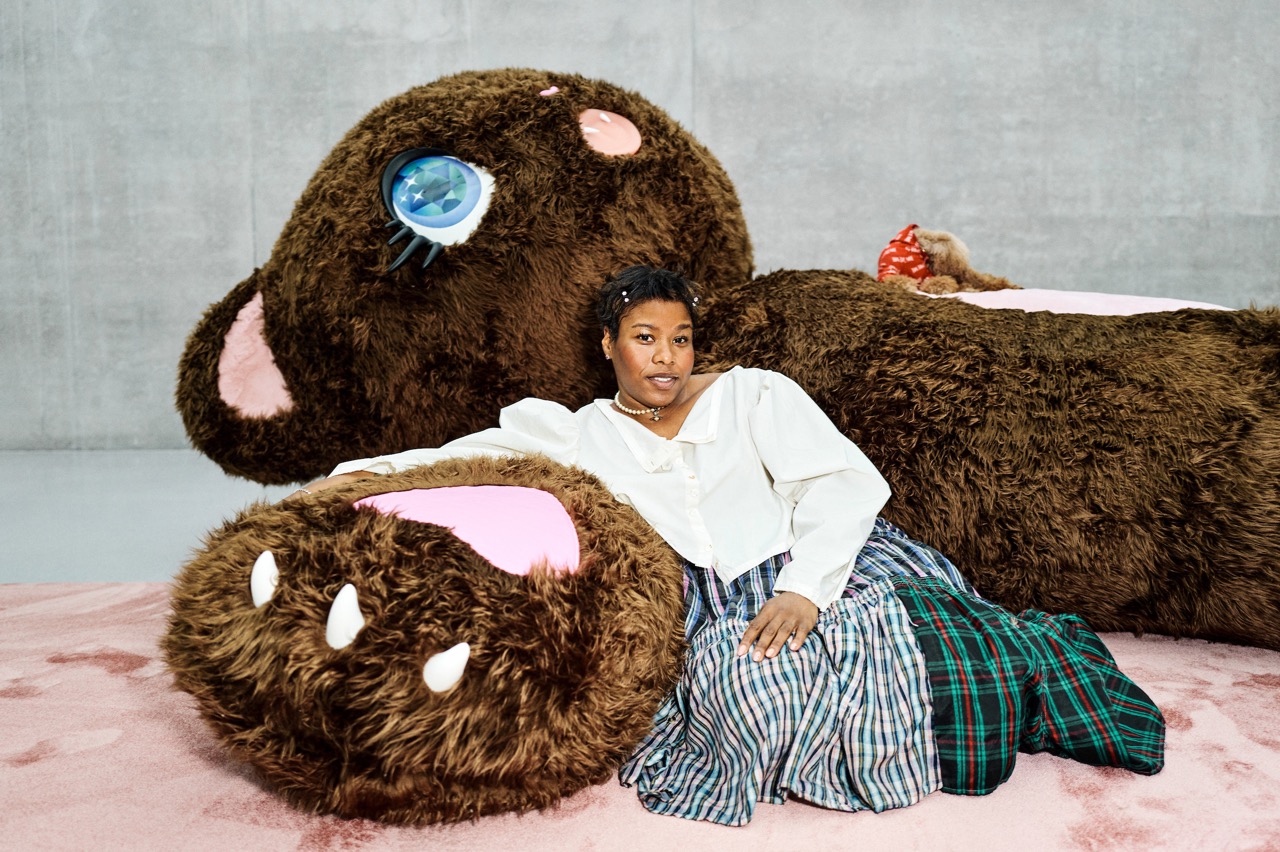
Miro Kuzmanovic, Precious Okoyomon at KUB, 2025
Whoever you are, a teddy bear will probably disarm you easily — especially if it’s a 25-foot one made out of concrete that you have to enter via its butt in order to understand what tenderness means under late capitalism. Precious Okoyomon builds installations populated by cherubic creatures: cute at first glance, so beguiling even that you may want to hurt the winsome figures in question, but before that can happen, suddenly you’re inside of its guts, taking part in an act of (reverse) digestion.
Precious Okoyomon first entered our circulation in GC #132 with a two-page poem. Since then, her work has expanded into visual arts (though poetry remains the root system at the core of everything she makes).
Sometimes, prophets speak to you from their carseat to avoid a parking ticket. It quickly becomes clear that any instinctive reading of her work is too superficial in comparison to her references that come rapid-fire and are impossibly wide-ranging — internet lore, radical politics, hentai, to the point of quoting philosophers verbatim — and it can be hard to keep pace. But, in the vein of a prophet, she has the ability to convince you of… anything really.
Right now in New York, there are two entry points into her world. At Everything wants to kill you and you should be afraid at the Whitney Biennial, you’ll find two types of her assembled creatures (found toys that are stitched together with taxidermied bird wings and then hung from nooses, alongside whiteface bunnies turned into Blackface bunnies). And then at the New Museum, there’s When the Lambs Rise Up Against the Bird of Prey: an animatronic lamb-slash-girl, waiting for the end of the world to happen.
Hi Precious! I recently came across one of your poems in Glamcult from years ago already. It was about a hummingbird covered in shit trying to make friends. Do you ever go back to it?
Someone sent it to me recently, actually. I go back to it! I remember writing that at a waterfall with friends.
Sounds like a luscious setting. How has your practice evolved since then?
Everything starts with poetry for me, and everything is born out of that. I don’t see images in my head, and I’ve always translated the world with language. Poetry was just the only thing I understood the world to be. So yes, my work evolved, but it always comes from the seed that was planted. And then it’s like a rhizome.
The first time your work came to my attention was actually through the work It’s Important to Have Your Fangs Out at the End of the World. The bears are obviously cute, childlike, and manga-inspired, but also (more jarringly) kind of sexually charged, with their legs splayed out and their undies exposed. I was wondering what you want viewers to feel after seeing this subversive, almost furry-like soft porn.
There’s a very soft violence in this work. In a world that enjoys the cannibalisation of innocence, I was thinking about what it means to know that you are the thing that is being consumed, to be aware of it, and to live in that world continuously. There’s cuteness in it, but also repulsion and horror. Because it is horrific to live inside a world that continuously abducts innocence, especially the innocence of children, and especially girls. A lot of the way this is usually explored comes through a more masculine lens of handling violence, but I’m speaking from my own position: from a feminine perspective, and from the lived experience of that ongoing psychological and emotional violence. So in a way, I’m just asking the viewer to meet me there. That’s really all I’m asking.
Does making art give you relief from any of these feelings?
For me, art is a continuous process of finding ways to give my heart to the world. Making work becomes a kind of container — it’s an incubation space for whatever I’m trying to hold or work through. I’m constantly, endlessly processing things through my practice. So it’s not really about relief in a final sense, but more about ongoing movement and transformation through the work.
Besides being in psychoanalysis for about eight years, my art is another place where that digestion happens. It’s how I try to survive things, how I process them, and sometimes how I share them in an open-hearted way. But it doesn’t absolve anything. It’s not that my history gets resolved through making work. I’m always trying to find language for what I’m going through, even when there isn’t really a language for it yet. It’s always like a continuous digestion and vomit.
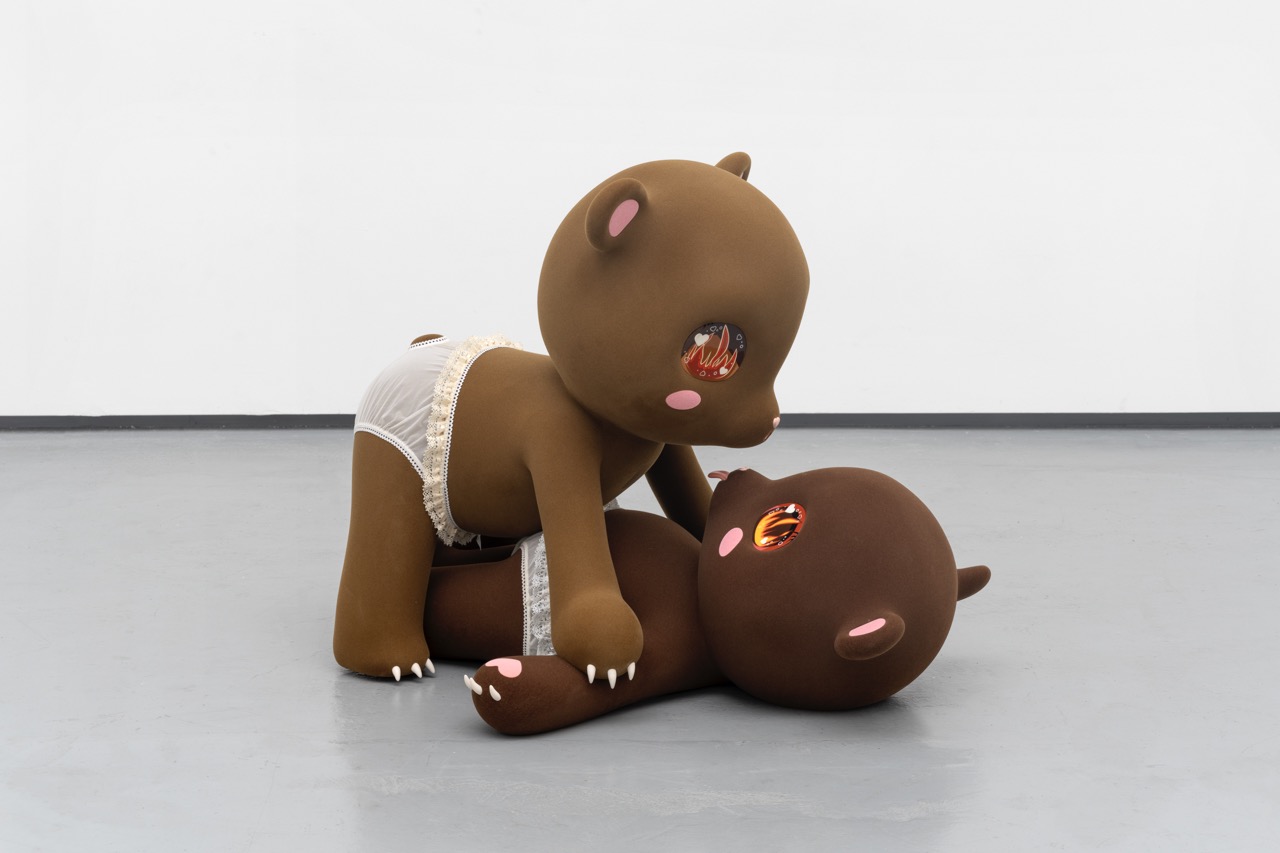
Precious Okoyomon, The animal that is most vulnerable – is usually the most cruel – It is impossible to separate it from what it remembers, 2025, Image courtesy of Nicolas Brasseur
Seeing all the bears throughout your work, my first thought went to a broader pop-cultural lineage of stylised, ‘cute’ bears… like Littlest Pet Shops, the early Kanye West bear mascot, Tokidoki figures, and even Happy Tree Friends, where innocence and violence are intertwined. So I was curious whether any of those references played a role for you?
The teddy bear has been a constant motif in my work. For me, it comes from a kind of Winnicott idea of the comfort object, the first object of care we attach to as children, and then what it means to eventually lose that object, in order to develop a sense of self. So a lot of these bears are actually modeled on my own childhood bear, the one I had, and lost. I also grew up watching a lot of anime, including hentai, so that is definitely a big influence on my taste and my cultural references: this ridiculously obsessively cute object that you want to destroy… the cuteness and violence of that.
Cuteness aggression!
Yes.
Your upcoming show will also feature a giant teddy bear that visitors can enter and exit… Do you go in through its mouth?
Through the butt, actually! You climb up these stairs, and then you fall through a trap door into its butt, and then you slide down until you drop and you’re in the head and can walk out through the mouth. The whole thing is like a giant, 25-foot bear, made of concrete.
Wow. So what’s the significance, for you, of entering a body, or this focus on orifices?
I’m a real big fan of having to pass through something. It’s something I’ve been thinking about a lot. So much of my work, and honestly my life, circles around this idea of digestion.
I was going to say, it’s been a theme in this conversation already.
Exactly. For me, it connects to love as well. In a way, to love someone is to pass through the other, or to let the other pass through you, and then return to yourself. It’s this ongoing process of transformation, of digestion. And I’m really drawn to that synthesis, of being taken in, processed, and changed.
It’s also interesting then, that you don’t fall into the mouth and come out of its butt, but the other way around? What’s the opposite of digestion?
Oh true. I’ll think on that.
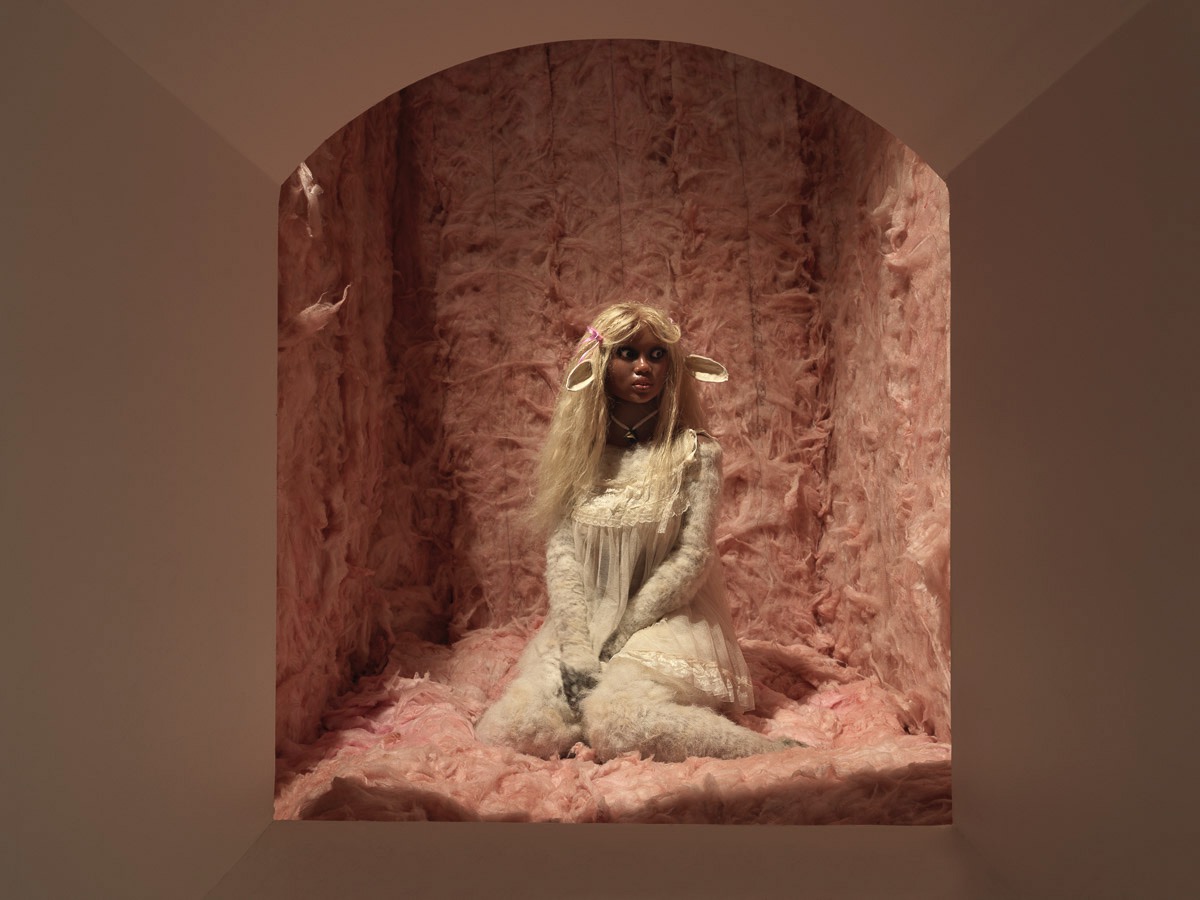
Precious Okoyomon, When the Lambs Rise Up Against the Bird of Prey, 2024
I was wondering if you see your use of cuteness as a kind of radical pushback against traditional or institutional art, or if your interest in it comes from a different place?
I feel like it’s coming from a very different nucleus of thinking — about our first attachments, innocence. Cuteness creates this sense of safety. And so much of what I’m interested in is how to create safety, but also how to disrupt it — and what are the bonds that hold us there. It wasn’t really a conscious decision, to be honest — it’s just where my curiosity lies. And then it leads us to what we hate, and what we fear — which is always really fun to me, because I’m always thinking about Freud in Instincts and Their Vicissitudes. He says that hate is older than love because of the ego, that it’s part of our instinctive, given nature. I keep thinking of why, naturally, it feels good for us to hate, and how we learn hate. So much of our lives is shaped by indoctrination of hate, as children, we don’t even realise it. And that ends up forming our drives and our relationships to most things in life.
Unfortunately, because we forget most of early childhood, part of what I’m doing is going back to that source and saying: you’re not separate from this. It’s all just part of the endless questions I have, this desire to know the core of who I am, who you are, who all of us people are together, me, us, and everyone I love. That’s what drives me. My questions are like… how do we escape the struggle of the isms, how do we move forward in the 21st century without the human as the main model of understanding, and what is the movement towards love? So any way I can navigate those questions — in my work, with myself, with others — that’s what I keep returning to. Sometimes, the things we can safely hold onto are these comforts we find in innocence.
There’s already so much underlying ‘just’ the cuteness of your work, but beyond that exterior, there are very serious themes — lynching trees, surveillance laws, migration, social death. Is the softness in your work a way of lowering the volume just enough that people move closer before they realise what they’re looking at? Do you think it might function almost like a trap, a way to get people to engage with things they might otherwise avoid?
I love making traps. Isn’t that our whole life — something we live inside of? I enjoy trapping people in these small incubators of new relational thought, or time. I’m really interested in trying to slow time down as much as possible. That’s why I love installations — because you can really abduct the senses: smell, environment, plants, heat. I’m always thinking on a bodily, relational, almost spiritual level of time. So there is something about softening people, where they’re a bit unsure of what they’re encountering.
It’s nice when your guard comes down, when you see something cute, or when you’re in an environment that brings you back to a time like childhood. You become more open, and it’s easier to accept something once your shield is lowered. That way they can let go of that more primordial fear and anxiety. And, you know, I hate to say Freud is right sometimes — because mostly he’s wrong — but there is something there about that underlying hate, that instinct. The drive that moves us sometimes is that the difference of others isn’t often a comfort but a fear. And we have to move away from that, because it’s killing us — spiritually, socially. The way it gets sublimated, it ends up destroying us. So so much of it is about softening, to be able to see without fear. Yeah, I think it makes it easier to digest. It’s something familiar, so you don’t fear it as much.
So when it’s then revealed that this thing also sits within a history of ongoing racial and capitalist violence — this continuous extraction and abduction of everything around us — it helps you see that it’s actually in everything. It’s in the very air we breathe. We learn these patterns through relational experience, from birth and childhood, and then we reproduce them through our classifications and taxonomies. Even the way we blame things in nature — like plants. Kudzu, for example, is illegal to grow in the U.S., even though it was brought from Japan. Even our objectified fear of nature is often based on things that were just trying to make it easier for us to breathe.
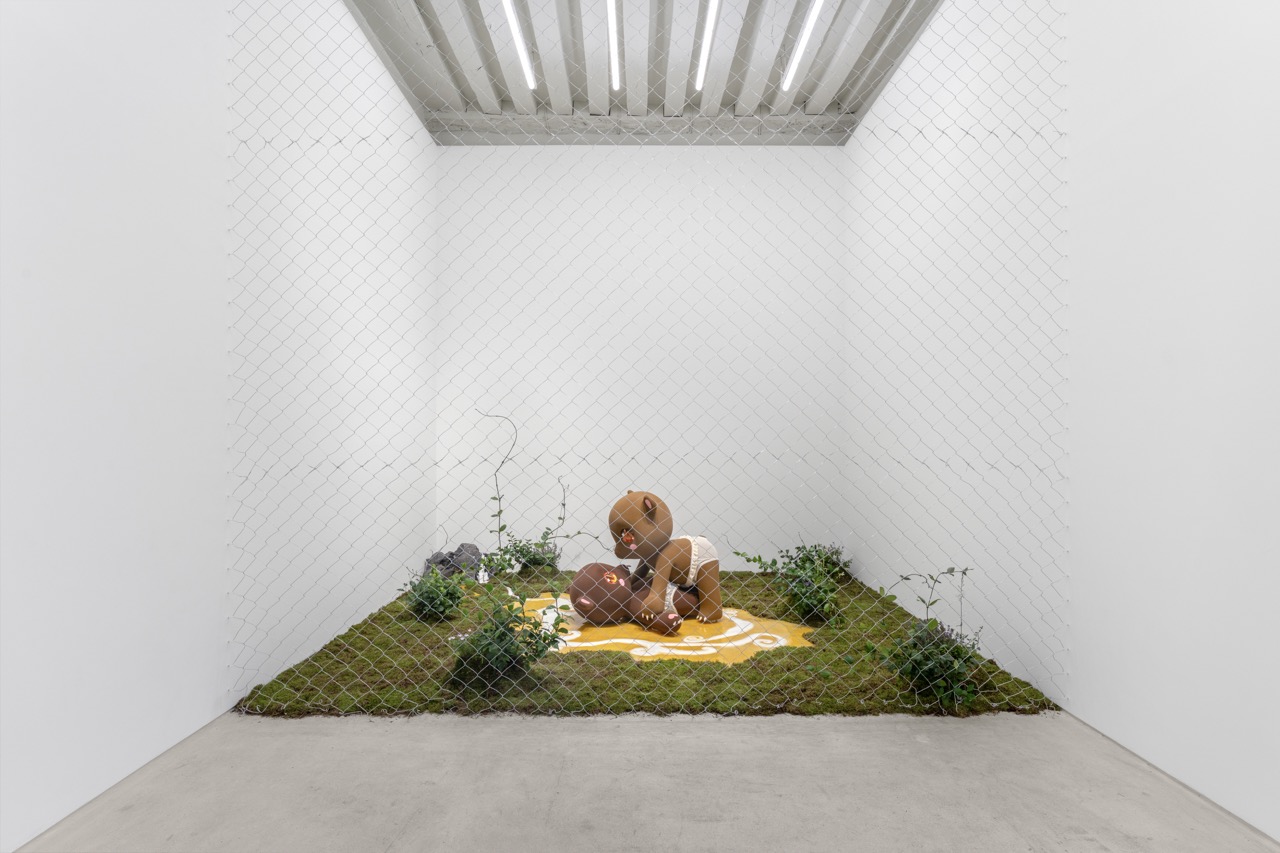
Precious Okoyomon, It’s important to have ur fangs out at the end of the world, 2025-2026. Image courtesy of Nicolas Brasseur
I was thinking about the creatures you hung in Everything Wants to Kill You and You Should Be Afraid. They’re toys, ‘rescued’ from thrift shops, that you stitch together with taxidermied animal parts, and then they’re hung from a noose in the museum. I was wondering: you’ve simultaneously put care and violence in these little beings you’ve made. Can you tell me more about it?
Some of these objects are actually from my own childhood collection as well — so it’s all these different layers of people’s loss and lack, and my own migrated childhood inside of that. The bird wings are from people’s pets that have died. My taxidermist gets them from people. There’s something there about already having been loved, handled, and then abandoned. So there’s this really intense condition of loss — where they’re never really permitted to fully die, but they’re also never able to be saved either. The angels refer to a transcendence, of not even getting to be in a space of eternity, you know.
How cruel!
Such as life.
And in the same work, there are also these six figures that combine plush bunny suits from the 1960s with the heads of Blackface dolls, if I understand correctly?
From different decades, yeah. I mean, I’m a huge collector — it’s part of my archive process. So I have a large collection of these strange Cold War and 1930s Russian dolls, and that’s where a lot of those bunny suits come from.
What were they?
It’s all these old Russian plastic-faced dolls from the 1920s and 1930s, kind of white-face dolls in bunny suits. They have these really crazy green and blue eyes. And then I take that off and replace it with the Blackface. For me, childhood has become the locus of where racial fantasy begins. Because toys seem like harmless objects, but they’re not. Especially with the Blackface ones from the thirties, you start to realise even innocence isn’t actually innocent. This is where violence begins. Innocence is revealed as continuously and always already being implicated.
And why do you want to give these Blackface dolls new life or visibility?
I mean, childhood is like a disciplinary theater that teaches you the technology of how you carry out the rest of your life. The ideology is made for small hands. And for me, it’s about thinking through and exposing how race persists, how we come to see and understand it. Working with these cursed objects becomes a kind of historical recursion, a way of thinking through them again. But the racial caricature never disappears. It just mutates. We can never escape it. It’s why I’m continuously like, ‘ the human can only reproduce its own definition by excluding someone else from it.’ So we need to expose and open ourselves into new ways of thought, because otherwise, it’s just going to find new hosts, you know?
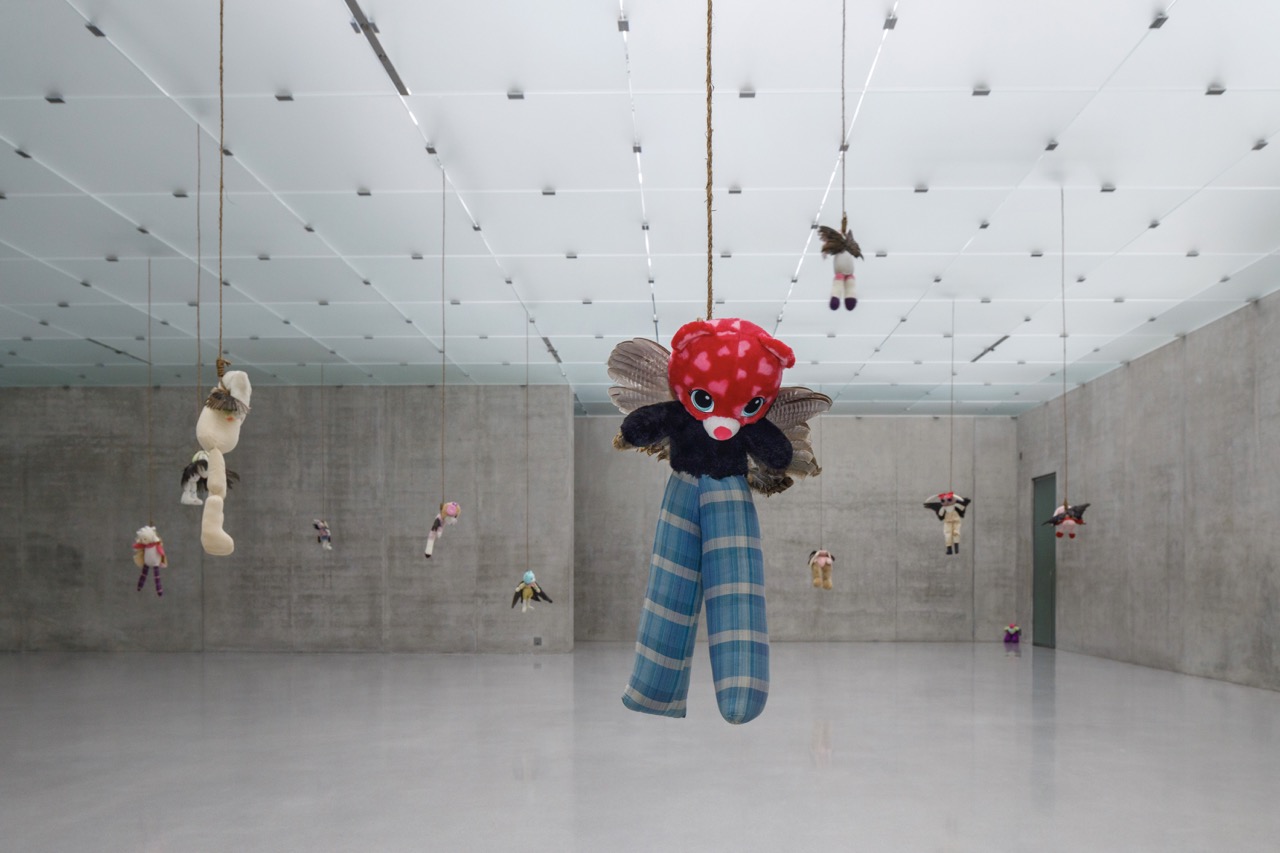
Precious Okoyomon, Everything wants to kill you and you should be afraid, 2026. Image courtesy of Ron Amstutz
How do you decide what to collect, and where do you come across these materials?
I love researching on the internet, so a lot of it starts there. But sometimes I just find places. This guy from a cursed thrift store in Astoria had so many objects from the thirties and forties, a lot of Blackface material. He told me he thought it was important that these things not be destroyed. So I bought a bunch of them from him. I think, in a way, things just find me. And I think it’s important to archive, to collect, to make space, and to hold all of these things.
Yeah, for sure. What else do you collect besides Blackface figures?
I collect a lot of toys, really strange toys. That’s a big one for me. I’m also a big collector of rocks. I love special rocks. I find them all over the world — or they find me.
What’s the strangest toy that you have?
I have this thing, I think it’s more like a power object than a toy. I got it at a market in Benin, and it’s really old — maybe from around 1820 or something like that. It’s this carved wooden object with bronze eyes and a very grim-looking mouth. It was meant to ward off evil spirits. There’s glass set into the bronze, and inside it there’s dried blood. It feels very cursed. So I was like, ‘I want it’.
Do you feel like it’s protecting you in your house?
I think it’s protecting me. At least I think it’s doing something.
I also read that you’re a pilot. Does being in the air influence your work?
I love flying because it takes me outside my perspective of myself. It makes me remember how small everything is. It’s a really grounding ritual for me. And then it helps me see colour differently.
Funny to say that it’s grounding, when in a literal sense, it’s probably the furthest from the ground a human can be, besides like, astronauts. How did you get into it at first?
I grew up in the super suburbs of Ohio and Westchester — and I always say all Westchesters are exactly the same. So you can imagine my suffering as a child. I was like, why are we here? There was a small airport nearby that we would always pass by on the way to my mom’s work, and I’d always say, ‘I want to go there.’ One day she finally took me. It was important that I knew escape was possible.
So nice that she didn’t just say ‘go play tennis.’
Sometimes it’s important to give in to your children’s whims.
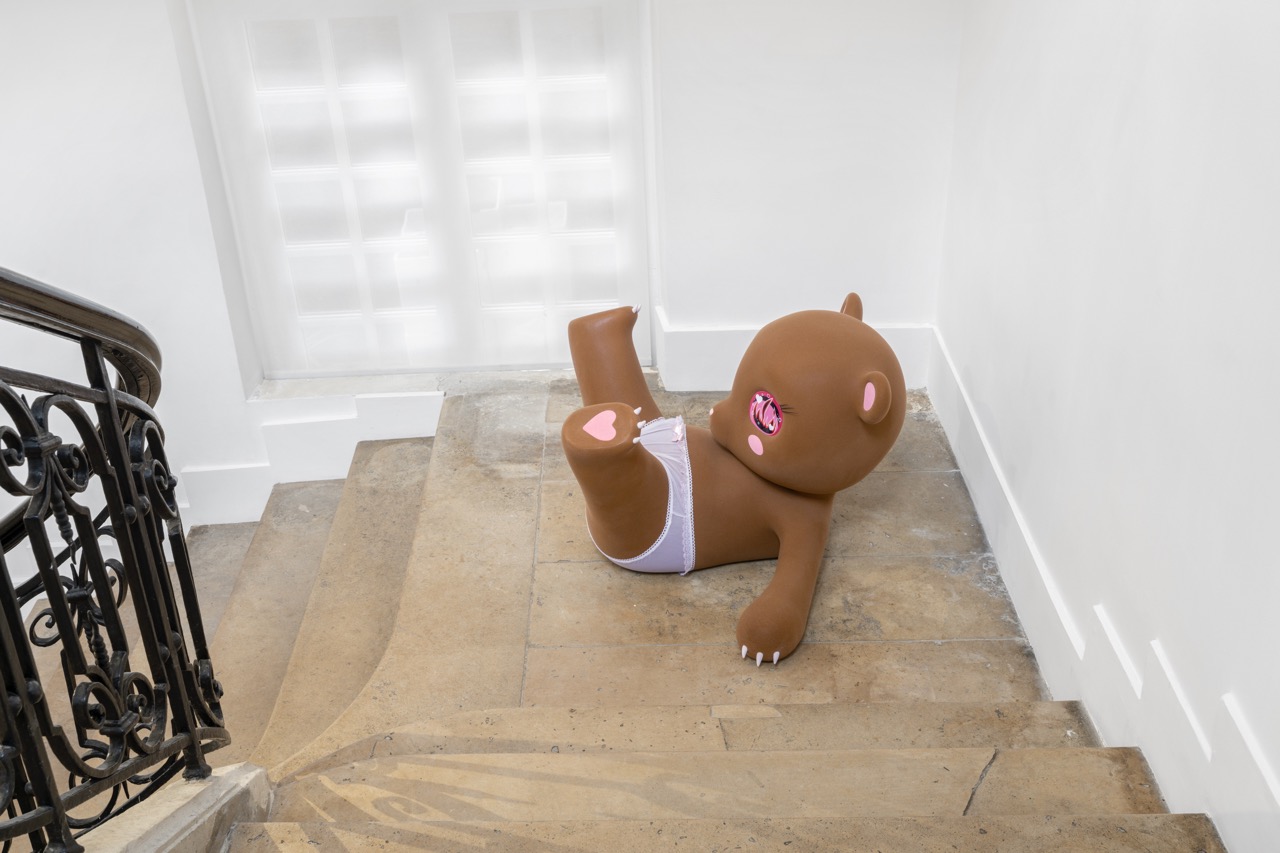
Precious Okoyomon, It’s important to have ur fangs out at the end of the world, 2025-2026. Image courtesy of Nicolas Brasseur
And you also often involve nature in your work. Your earlier work with Kudzu stayed with me, the parallel you draw between slavery and kudzu is really interesting because it obviously involves unwilling subjects to relocate, and then once they emancipate, they’re criminalised. For this issue, we’ve been thinking about how loudness isn’t always about volume, and quietness isn’t always absence — it can also be persistence. It made me think of kudzu, this idea of something aggressively (yet silently) creeping across a landscape until it becomes a problem.
Kudzu grows in places where there was the most intense relationship between racism and the environment. It’s just doing the thing it does, which is surviving in a place where it’s not supposed to. So it becomes a miracle that is then criminalised. I think the implication of it just being what it is, and being brought in to solve a problem it wasn’t originally meant for, is actually the most powerful statement. It was supposed to magically fix the topsoil after colonisation and the overplanting of cotton, repeated for so many years. And slavery didn’t only impact people, it impacted the environment itself. It was an abduction of air, space, earth, and time.
Also, you had a period of doing experimental dinners at Alinea, involving your thesis Spiral Theory Test Kitchen. What about food inspires you?
It’s the most relational practice of changing. Food actually enters people and you change them from the inside out. And that feels so romantic to me. Food changes people. You can have a food experience that completely revitalises and shifts your energy and spirit.
Digesting=loving! It was described as ‘BDSM-influenced, quantum-entangled, psychosexual cuisine,’ which really sparked my imagination. Do you feel like food and eating together need, or traditionally lack, psychosexual influences?
These influences have always been there. Even in our first act of being fed as children by our mother, that’s a relational act of care. One of the rules of the game was that you had to let a stranger feed you. So it was about wanting people to experience these kinds of transcendental feelings (of love, of sexual desire) through something as simple as a slippery, wet meal, being fed by someone else. I think about Jean-François Lyotard, and how he says we’re always trying to get back to the water, that’s our main problem, that we left the water and don’t know how to return. And sexuality, too, is part of that return. It’s all about this pull toward wetness, in different forms. And food is basically that for me. It’s the easiest way for people to soften, to be transformed. I love small things that transform me, and food has always been the biggest gift. Everything, for me, comes back to love. I’m kind of obsessed with this idea that love drives everything I do.
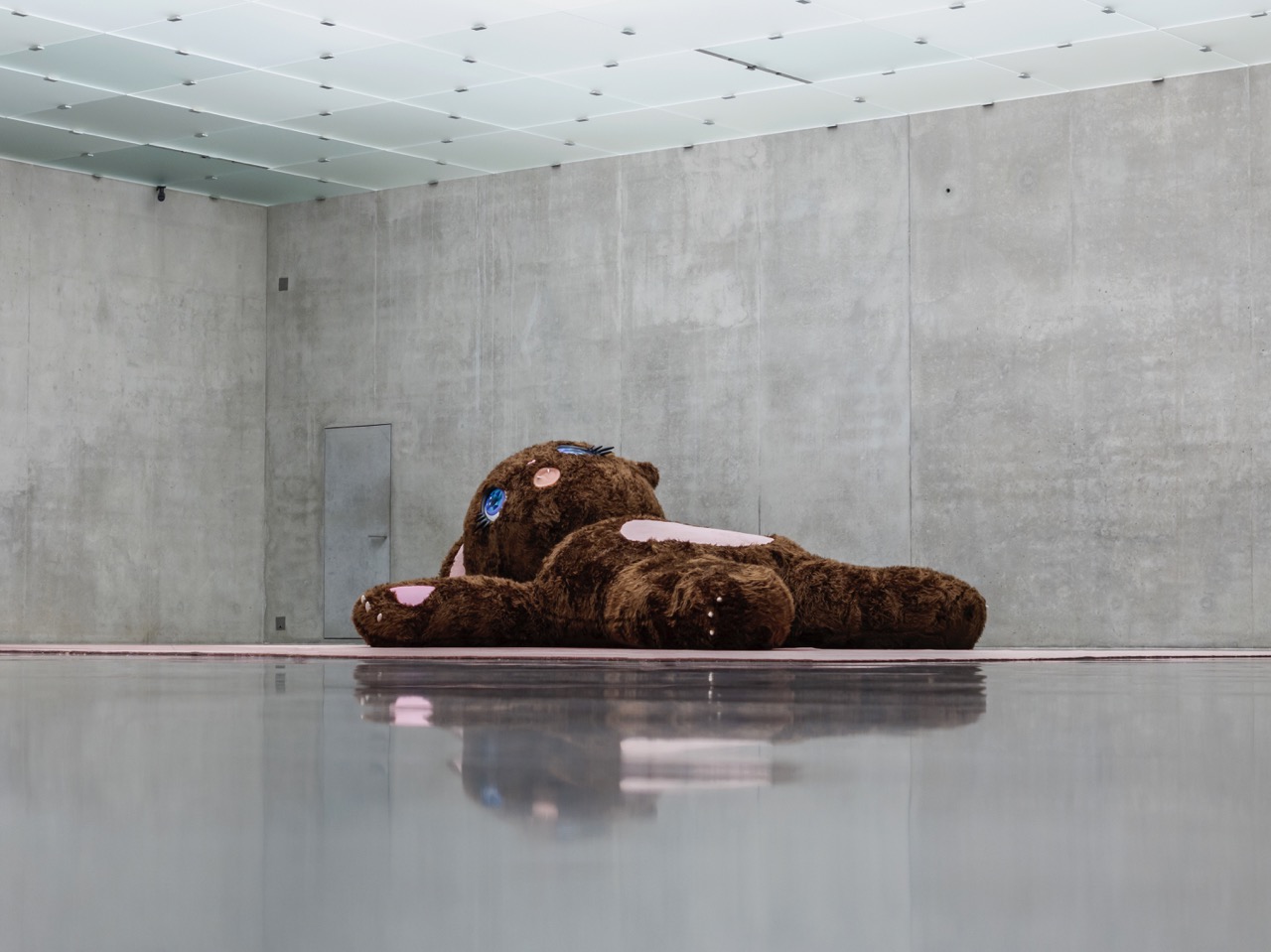
Precious Okoyomon, in the belly of the sun endless, 2025. Image courtesy of Markus Tretter
Words by Pykel van Latum