It’s just about being in that mindset where you walk past something, and you hear that there’s actually something really beautiful happening right next to the sandwiches.
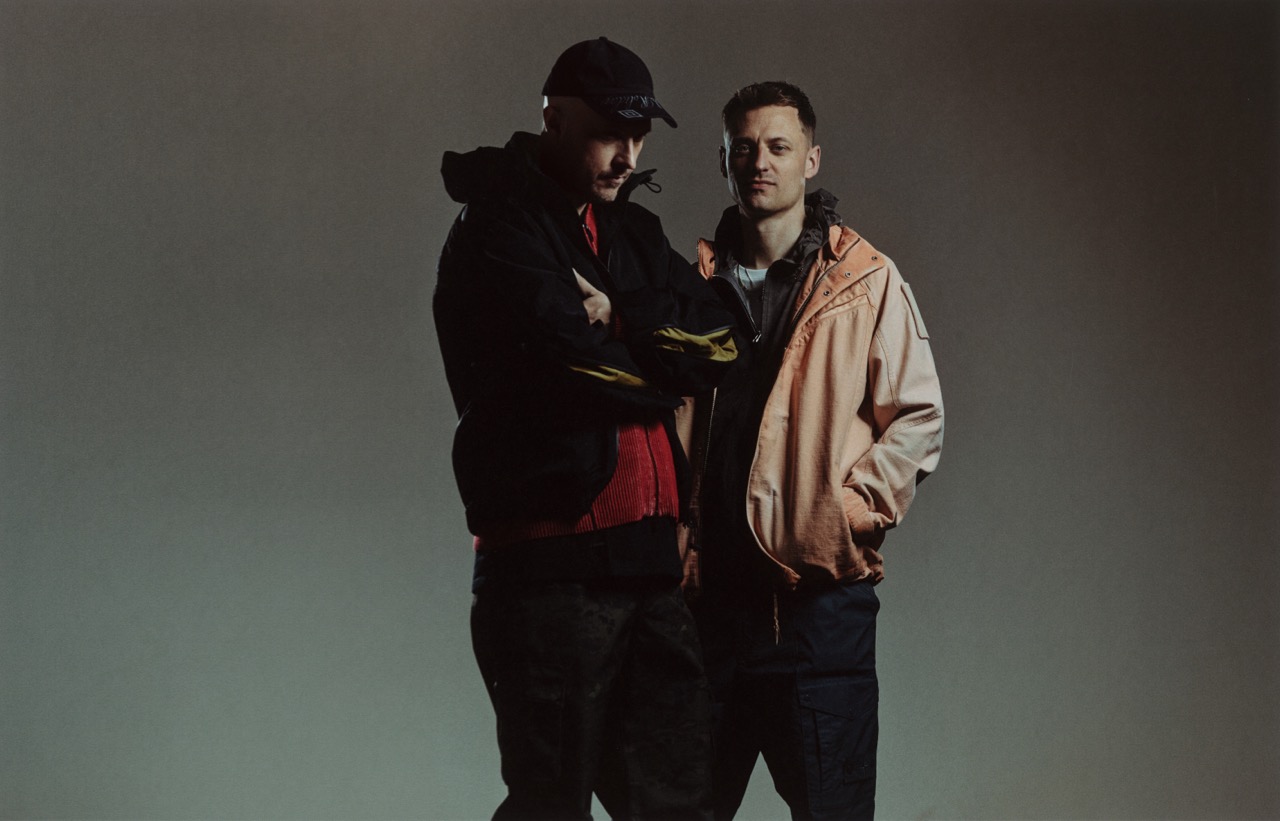
Overmono are big-room musicmakers for people who want to experience the emotional devastation of an MDMA peak without having to deal with the taste of rawdogging paracetamol. Their music moves between melancholy and euphoria — emotions that, according to the duo, sit at opposite ends of the emotional spectrum, yet always seem to show up at exactly the same time. The duo is made up of Welsh brothers Tom and Ed Russell, who have the slightly uncanny energy of two people who share a nervous system, and possibly all their brain cells. They finish each other’s thoughts and seem to operate on the same creative frequency — while still being total opposites. Tom is more timid, reserved, and reflective; Ed is more restless, expansive, and ready to talk through approximately every thought he has ever had.
Their music isn’t really autobiographical; it’s more about yearning to scratch the itch they both feel in their shared musical brain. The brothers are driven by a shared compulsion — an obsessive relationship with sound and an instinctive need to create. Inspiration can come from anywhere: two refrigerators harmonising in a supermarket aisle, a CD leaving a player, a single scratch on a microphone. The world is basically one giant sample pack if you’re paying enough attention.
With their new album Pure Devotion released on 7 August and a headline tour now on the horizon — including a stop at Amsterdam’s Gashouder on 11 November — we spoke with Overmono about how two people thinking almost as one can turn the smallest, strangest sounds into something that feels absolutely enormous.
Hello!
[Both] Hey, hi, how’s it going?
I’m good, how are you guys?
[Both] Yeah, good, thanks, thank you.
Oh my god, are you gonna do this whole interview saying the same things at the same time?
[Both] Probably yes.
I’ve been a really big fan of your music,but I don’t know that much about you guys as people. Would you be able to describe each other’s personality to me?
Tom: I’d say Ed has the ability to become easily obsessed by things in ultimately a very positive way, but once he gets an idea into his head, it’s very difficult to convince him not to go through with buying a new compressor or completely rewiring his studio yet again. Yeah, once he gets a thought, he runs with it, but ultimately I think it’s a very good character trait, as frustrating as it can be sometimes if you’re around him.
Ed: Tom basically just spends the whole time trying to stop the wheels from falling off, trying to keep me in check when I have an idea for something that’s blatantly not going to work. I’d say Tom is… I’ve never met a more hard-working person in my life. We call him the shire horse because he can just keep on going and going with any aspect of his life.
So congrats on the new album coming out August 7th, I believe? What feels different about this album compared to your previous work?
Ed: I’d say with this album we had more intention from the beginning than we have previously.
Tom: I think setting up the parameters both from a studio point of view and a philosophical point of view, that’s something that we find really important. Otherwise you can step into the studio, and it can be quite overwhelming with the possibilities. For instance, quite early on, we talked a lot about the sort of general equipment that we were going to use. And it’s not exclusively that, but leaning as much as we can on sort of late 70s, early 80s synthesisers, especially like Japanese-made synthesisers, Roland, Yamaha, Korg. Stuff which is quite basic, I guess, but has a real sense of character and personality. It’s not so far as a manifesto, but definitely some walls that we’ve put up ourselves, to ask ourselves which ones do we need to try and like break through. And that took us to why we’re so drawn to these instruments in the first place: there’s no presets or effects on anything. It’s kind of like a basic instrument, like most normal instruments exist in the real world.
The constraints can make you more creative.
Ed: Yeah. Yeah. It’s the kind of classic thing, isn’t it? Of like being stifled by a blank canvas and, you know, as humans, you don’t want too much choice ever. I think we’ve spoken about it before, this idea of how we’re always trying to find something new, but you don’t necessarily need every element to be new along the way. A lot of the time you just need all those elements there to be combined in a certain way that feels like something new, which is kind of like what happens in like fucking coral reefs and cities and everything. It’s like this mad thing, as long as stuff is able to like get information between different points, then something bigger comes out of it. It’s kind of hard to overstate how much we obsess over what things that we want to be developing and, and how we can approach things. We’re sort of obsessed.
Makes me think of how dreams are formed by having these memories of how it was, but then your brain is processing it by seeing all the different pathways that go through neurons and then in this dream, creating, you know, these completely new ‘experiences’ that were not actually the actual experience, just to figure out which pathway was worth remembering.
Ed: Yeah, exactly. Ultimately made up of things that all exist, and combined together make something that’s completely different.
Yeah. So tell me about the opening track. I feel like it reminded me a little bit, at the same time, of Crystal Castles and at the same time, Crystal Fighters. So I was wondering if there’s any kind of like electro-clash influence or…
Ed: You know what, funnily enough, not directly, neither of us were particularly into the kind of electro-clash thing when it happened, but there was the thing that you could easily relate to there is the rawness and directness to a lot of the way that those records were put together, which was…
Tom: It’s almost like a crass kind of way of making music, which goes back all the way back to like post-punk. Things don’t have to be perfect, and things can just be like quite brash. And that sometimes is a really good thing. You don’t always have to smooth off all the edges, you know. So from that view, yeah, I think there are similarities and parallels.
Ed: And I’d say it probably comes from being inspired by the same things as those electro-clash artists were. We were trying to record everything through physical processes whenever we could. If we wanted to change a sound, we’d try to find a real-world way of doing it rather than just adding a plugin.
Like Martin Hannett putting the Joy Division drummer on a roof to get a more open sound—that’s the same idea. If we wanted distortion, we’d run something through a guitar amp or physically push it until we got the sound we wanted.
I can imagine it’s also part of the craftsmanship.
Ed: Yeah, we’re always really drawn to music that feels tactile. It’s hard to put into words, but it’s like you could almost touch it coming out of the speakers. A lot of the time that means you can’t recreate it. There’s one synth on Even Angel’s Ghost that we both love, and we still have no idea how we made it.
Tom: What’s important for us is having a carefree, almost childlike state in the studio. Not overthinking the process, embracing mistakes and the chaotic nature, because that’s what provides character.
Ed: We want it to feel human—not like fucking Daft Punk. I mean, no shade, I fucking love Daft Punk. But it’s important that it feels like us in there somehow. We’ll spend days setting up the studio, but once we start writing, all of that goes out the window. We just think about it as songwriting.
It reminds me of when I was a kid playing with Barbies. The longest part was always setting up the dollhouse, the wardrobe, all of it. But once everything was in place, the playing just came naturally, and maybe only took a few minutes. The setup was such an important and fun part of it.
Ed: It’s so important. It’s exactly the same. Sometimes we’ll spend three days setting up the studio, and then write the song in half a day. Literally. Yeah, that happens all the time.
I mean, you’ve probably heard this a lot—or maybe you’ve even said it about yourselves—but you can’t really bring this kind of brooding melancholy to every club track. Would you describe yourselves as melancholic people?
Ed: No, I certainly wouldn’t describe us as melancholic. I’d say Tom has his moments. [laughs] But no, we don’t really view our music as melancholic.
We’re both really intrigued by how people perceive the music, because different people get completely different emotions from the same piece. That can be circumstantial, or just down to the individual, I guess.
For us, it’s more about exploring the spaces between emotions. Some of our favourite music is the kind that makes you feel something, but you can’t quite put your finger on what that feeling is. I find that incredibly magical about music—and art in general. It’s amazing that two people can have a completely different response to the exact same thing.
What’s the best example you’ve had of the same song being interpreted in completely different ways?
Tom: There was one recently. I can’t remember which song it was—I think it was something from the album. One person said they’d listened to it in the morning and found it a bit too heavy, like, “You don’t really want to start the day with that sort of emotion.” Then someone else said the same song really uplifted them and that they found it incredibly optimistic.
Ed: Yeah, that was it. One person said, “I can really hear this thread of melancholy running through your music,” and then, about an hour later, someone else told us, “I can really hear this thread of optimism running through all of your music.”
For us, that’s exactly what we’re interested in. You rarely experience emotions in isolation—they’re usually a strange blend of different things, sometimes even two extremes at once. You can be crying while you’re laughing. We’re always trying to tap into those emotions that exist somewhere in between.
It reminds me of that drawing that’s both a duck and a rabbit, depending on how you look at it. If you’re in a melancholic mood, you’ll hear that side of it; if you’re feeling optimistic, you’ll feel that rush of energy. In the end, it’s always gonna be a duck-rabbit hybrid.
Ed: Maybe we just need to get a painting of the duck-rabbit.
Once you start defining the process, you might want to try and recreate it—and that’s just not how inspiration or creativity works in the end. It’s such a trap.
Ed: Worst move ever. You just have to go and do it. We always find that whenever we try to set ourselves up to write somewhere secluded, we have to go in with the expectation that there’s nothing we need to achieve. We’re just there to make music. If something good happens, then that’s a bonus. Otherwise, we’ll just enjoy our time there. Someone we were working with once said something like, “You can’t talk about scoring the goal. You just have to do the work and then see if you score a goal.”
It’s a good way of thinking about it.
And yeah, curiosity and inspiration—it feels like they don’t really come if you search for them. They only come when they find you.
Ed: Yeah, exactly. You kind of have to stop looking for it, but just leave yourself as open as possible. Yesterday, and this is a really obvious example, we walked into the supermarket to get some drinks on the way back to the studio, and Tom was like, “The fucking way that the air conditioner on the fridges at the back is harmonising with the fridge next to it, which is a different brand…” They were making this really lush little harmony between the two of them. I guess it’s just about trying to be as—without getting too Rick Rubin about it—as receptive as possible to everything that’s happening around you. Because you don’t know what things are going to inspire you. Sometimes the things that inspire us are the most random.
Yeah, I mean, I was about to ask you, “Okay, what is it that you’re listening to, thinking that music would come out?” But it turns out it’s two different brands of refrigerators lol.
Ed: It’s just about being in that mindset where you walk past something like that and you hear that there’s actually something really musical and beautiful happening right next to the sandwiches.
Do you feel like your music is ever about yourselves? Is it vulnerable?
Ed: It’s definitely vulnerable, yeah. I don’t think it’s possible to make music that’s really meaningful without it coming from as honest a place as possible. It’s always a combination of lived experience, your state of mind on a particular day, all these things informing what comes out. That might mean moving in directions where people who were into our old stuff are like, “I don’t really like the new stuff,” but that’s something you have to accept. We want to keep moving forward as producers and artists. And yeah, that’s vulnerable, of course.
The fact that you’re making a new thing and putting it out into the world for other people to see is, by definition, vulnerable. But what I was thinking more about is something more specific—like, “I got dumped,” or some very tangible emotional experience. Are the lyrics ever about something where you’re emotionally vulnerable in that way?
Tom: No, not directly. We never really make music that’s overtly about something like that. It’s much more abstract. It’s interesting. I’ve never really thought about the difference between that direct route of, “I’ve been dumped, so I’ll write a song about it,” and something that’s more abstract.
I was wondering if you feel like there’s maybe a pressure, especially for men, to appear kind of untouchable or separated from the music?
Ed: I don’t know if there’s a pressure. I think it’s more just a natural disposition in certain men, definitely. But no, it’s not really that. The fact that you say you don’t know a huge amount about us as people probably says a lot. We’re both naturally quite private, introverted people.
Although, meeting you, you’re quite talkative.
Ed: Yeah, but I guess there’s a difference. I could talk about creativity and music and art forever. But talking about what we’re like as people is something I find incredibly difficult to put into words. I just don’t think I have the vocabulary for it.
I feel like if I spent a lot of time in a cabin just making music, that would inevitably be influenced by whether I’d just got dumped or not. That would always be part of the conversation. Do you feel like you only talk through or aboutmusic?
Ed: No, we talk about everything else as well. But I guess what it is, is that when we’re in the studio, we always try to be really instinctual. We follow whichever idea feels like the most exciting thing to us in that moment. Naturally, life experiences will feed into that and influence it to some degree, but we’ve never really arrived at a studio session where one of us is like, “I’ve had a really fucking shit week, let’s just sort all of this out through the music.” But even then, going back to the dream thing, making music for us is just as abstract as dreams. Neither of us has ever really felt like we’re trying to make a piece of music that directly reflects something about ourselves or our state of mind.
Tom: For us it’s just as abstract as dreams. It’s never really been about trying to make something that reflects anything overt about ourselves.
Ed: It’s normally more about trying to find a particular feeling. And describing that feeling would be incredibly difficult, but it’s something we’re both always searching for. And we both seem to know when we find it. Tom wrote this amazing chord progression a couple of days ago, and I couldn’t tell you exactly what it is about it that I love so much. It just makes me feel this very, very particular way. I wouldn’t even know what that emotion is that I’m trying to describe. But as soon as I heard it, I was like, “You know…”
So it feels like, instead of making music about yourselves, you’re making music for yourselves—or for each other.
Ed & Tom: Yeah, that’s a much better description. That’s nailed it on the head.
Can you tell me about Kindora? The track made me think a little bit of a Destiny’s Child song. What was the energy behind it, or was that something you were consciously exploring?
Ed: No, but that’s amazing to hear, because I’m a huge Destiny’s Child fan, haha. Kindora is just the most incredible person—a vocalist and a melody writer. We’re huge fans of hers. We feel so lucky to have discovered her music and then become really good friends with her. So having her properly feature on the album was something that was really important to us from the very start. She’s one of those people who’s just unbelievably talented, but she also has a normal job that she has to work. She should be a global household name.
Amazing! And so the final two tracks on your new album feel quite—again, using the duck-rabbit analogy—upbeat and celebratory to me, with the last song almost feeling like the end credits of a film or something. I was wondering if you’d ever want to make music for movies, and if so, what kind of movie?
Ed:I think scoring a film can be the ultimate expression of what we were talking about earlier: setting up a particular process and then using sound in its most basic and primal form to convey emotion or lift up a certain scene. The reductive process of scoring is what really appeals to us—the idea that you can set some very, very specific parameters before you start, and then just work within that. I think that’s a really exciting challenge.
And what kind of movie would you envision? Or what kind of movies are your favourite movies?
Ed: IIt’s funny, we were actually talking about this just before the call started. We were both trying to recommend each other a film that we thought the other one hadn’t seen, and for some reason we both just had a complete mind blank. So far, we’ve come up with absolutely nothing. Tom came up with Atomic Train. [laughs]
But in terms of films we’d like to score, I don’t know—that’s really difficult to say. I think if you look at something like Under the Skin, which was scored by Mica Levi, that’s a really good example of the kind of thing that interests us. A film where you’re given complete creative freedom to really push boundaries. Someone like Trent Reznor, for example, has a really interesting approach to scoring. Again, it’s that really reductive approach—taking something incredibly simple and finding all the possibilities within it. It’s like, what does 50 oscillators sound like if they’re all just playing the same note? It’s only one note, but you’ve got 50 different things playing it. Stuff like that is really exciting to us.
What if it’s 50 refrigerators?
[both] Yeah, exactly!
Tom: We actually scored a short film quite a long time ago, and we made the entire instrumentation out of a three-second sample of us scratching a microphone.
Ed: It sounds like a weird alien orchestra or something, doesn’t it? Because there are violins and cellos and everything, but ultimately they’re all made from this one tiny sound that you’ve had to process and transform. We did something similar where we recorded the noise of a CD being ejected from a PS5, and then recreated the instrumental from Teardrop by Massive Attack just using the sound of the disc coming out.
I can’t wait to hear this. I have one last question, and it’s a very short one: if the world ended tomorrow, what would be the final song you’d want to hear?
Ed: Fucking hell. Mine… I think mine would be Brian Eno, An Ending (Ascent). I think that would be a pretty epic way to go—to just float off on my way.
And you, Tom?
Ed: Yours would be like some fruity Italian number.
Tom: It’d be some sort of Italian number. I’d take A Chance by Mr. Flaggio. Great one.
Words by Pykel van Latum