“Girls who misbehave grow up to be women who question things”
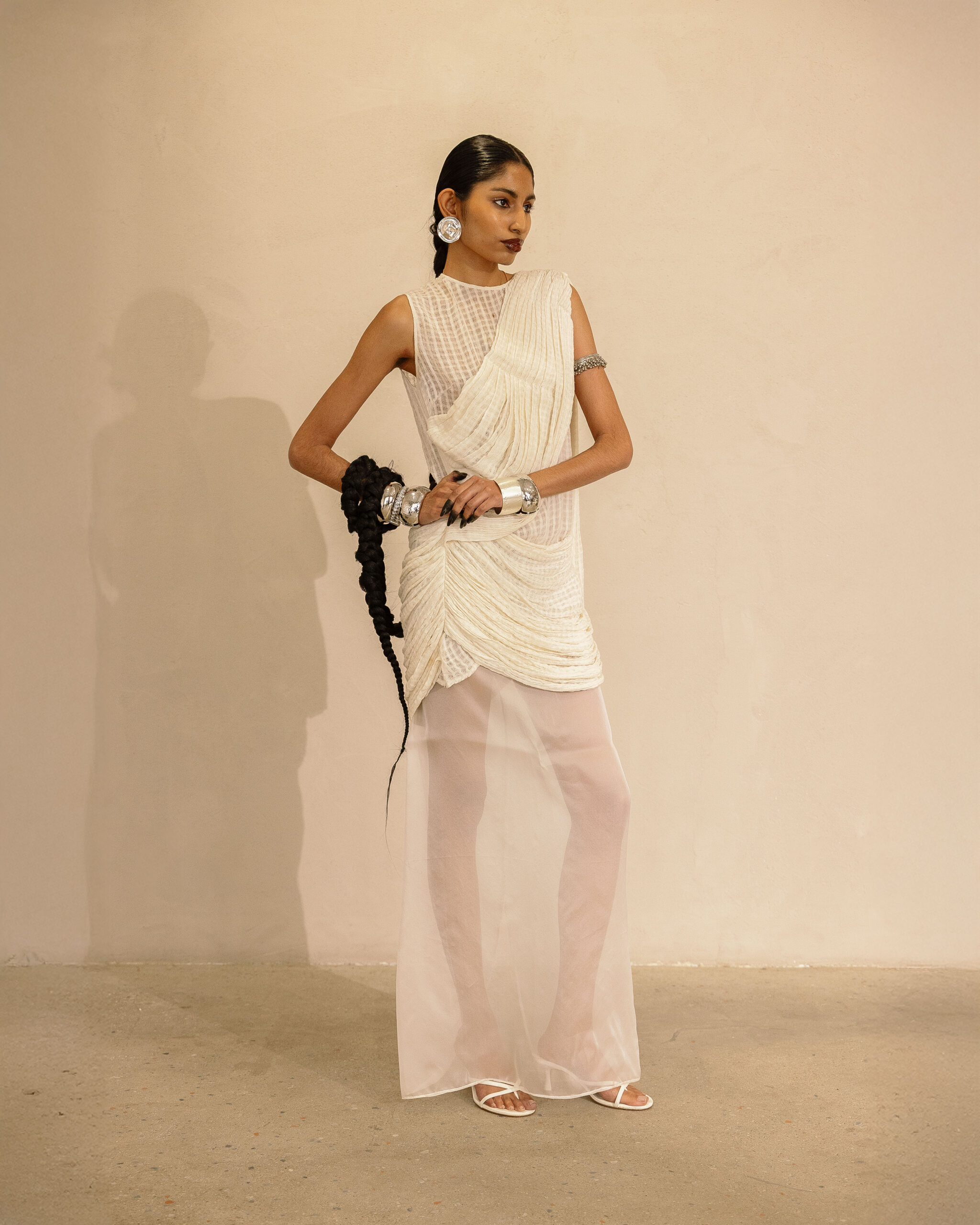
Gundi was born out of rebellion. Twisting her Indian heritage into new experimental forms, founder Natasha Sumant refuses to play by the rules. From a ‘slutty sari’ to embroidered typography, Gundi has carved out a signature aesthetic — one that fuses meticulous craftsmanship with a fierce, subversive message. At its core lies a philosophy of dismantling expectations of womanhood, using often overlooked traditional techniques to tell a story far removed from the ones they’re typically assigned. To celebrate Gundi’s latest presentation at PFW, we spoke to Natasha about the new collection — an exploration of female rage, the recontextualisation of indigenous practices, mythology, and punk.
Tell me a bit about Gundi! The name means female thug, right?
Yeah, it means female thug; it also means misfit. That’s kind of the philosophy of the brand. I’m from India, and you use that word when young girls misbehave. It’s kind of a cute word. It was a nice jumping-off point because I think young girls who misbehave grow up to be women who question things. I started the brand in 2019. A little earlier than that, but we weren’t really a brand.
I read that it started more as an art project.
Yes, exactly. I was making a lot of art around that time, and I just thought about how there wasn’t really a female character in pop culture, except for M.I.A., who celebrated this outspoken badass kind of woman from my culture. So at the time, I made this embroidered patch. I would pin it on vintage jackets and sell them at markets in New York. Riz Ahmed had a band with this guy, Heems, and there was all of this underground music stuff happening. I was just starting to sell the patches with them, and then a stylist picked them up and put them in a movie. I then realised that people were more interested in the way that I artfully put the patches on the vintage stuff, so it kicked me on this journey of making clothes. I knew that I really wanted to make it with women in India, just because that’s something that I grew up around. I was always going to the tailor to get something embroidered or to get something made.

Nice! It sounds like a lot of things coming together beautifully.
Yeah, I think it was a natural progression. It was the best way to have a giant creative playground. Also, a lot of the work that I do is with different women’s groups. There are quite a lot of different indigenous techniques that I use in the work. The brand was also a reaction to me being in New York at the time and seeing the absence of women in the fashion system on every level, even though it’s a craft that is literally passed down from mother to daughter most of the time. That’s kind of what the impetus for the brand was and what it’s really about.
How would you say your vision has evolved in the last six years?
I think it’s more grown-up. In the beginning, a lot of it was influenced by the language of underground music. And it still is in many ways, as well as politics. I think it felt a bit more street earlier on, just because of the music that was around me. It was mainly rap, a huge medium through which people were expressing different issues. As my work has evolved, I’ve delved more into tailoring and techniques while looking back at more inspirations, like from my school days, where I had a uniform and loved researching Vivienne Westwood. Working with artisans has grown the vocabulary of materials that we use. Every time I go to India, I like to discover a new female group. Most of them are practising ancient techniques that they just don’t have enough of a market for because they work really organically. I always work with the first daughter of the village. Like, there’s this girl, Krishna, and she’s the first daughter of the village to weave. All of her dads used to weave before her, and she fought with them because she wanted to be a weaver. Now being in Paris, I’ve been able to work with so many amazing talents here as well. There are a lot more shapes, volume, and draping.
Would you say maybe it’s a similar story for you, in the sense that you had to fight certain expectations and norms to get into the art world?
Yeah, absolutely. From a conceptual level, the brand was just a reaction to that. A reaction to the fact that maybe I’m not as girly or demure as my culture might want me to be. I think a lot of that is infused in the brand. Every season, I try and have the themes be around an issue that I have faced. For example, the last collection was called Can You Cook?. It was based on the idea that no matter what I did in my life, people would still ask me if I can cook and not how many degrees I have or whatever. These themes are all inspirations from things I’ve faced in my life. So in the recent collection, it used the idea of this mythology, but really it’s a story about consent and women’s rage and how they show up in the clothing and material.

Do you also see it having a backwards reaction on your family dynamics or the culture around you through your work? Broadly, within those six years, feminism has also been changing so much in South Asia.
It’s a pretty deep question. I think the perception has changed in the West a lot, as global shifts have made people view us differently. In terms of family dynamics, I’ve just grown into a more independent woman, and this work has allowed me to express myself in all the ways. The biggest impact is probably on all of the artisans that we work with. One of them wants to marry this guy that her parents don’t like, but now she’s earning her own money, so she’s got her own place, and they can’t really tell her anything. So, it’s small things, but bigger things, too.
They might be small, but they have so much power to snowball!
Yeah. And I think from when I started the brand, to where we are now, there’s more visibility in pop culture, which is really cool. Like, there are whole Netflix shows. And a lot of people pull our clothes for shows and things like that. I think there’s also a global conversation about how different indigenous cultures contribute to craft and fashion, especially in Paris right now.
These conversations are so important. The knowledge of indigenous techniques is getting more widespread, but then at the same time, a dupatta gets rebranded into ‘Scandi-core’.
Exactly. I think it’s really important to just claim that. Hopefully, it doesn’t get rebranded. I think we have enough people who recognise that it’s not. I think that it just needs more brands like us, perhaps.
Yeah. Can you share any examples of your favourite pieces or design translations of the philosophy of Gundi?
I think it’s infused in a lot of the pieces. I would say that the embroidery that we use has existed forever, and you can see it everywhere in couture. All of the weaving, too. It’s deep because I think there are so many processes. But yeah, I would say the embroidery for sure is something that you see everywhere. I think there’s a huge recognition of that. Lesage has been doing work in India for years. And I feel like people are now drawing the connections. In Dior as well.
And how do you approach recontextualising these traditional techniques to your personal and more contemporary vision?
The embroidery, for example, has a lot of organic forms. We like to recontextualise it into typography, which is not something that you would normally see. It’s also the kind of embroidery that you would usually see on saris and burqas. So moving that into more street silhouettes is something that is an example of recontextualising it. We have a dress that’s like a sari dress. It’s inspired by the ribs of a sari, but all of the bases are bodice bases or shift dress bases, which combine this Western way of working with Eastern draping and then using sheer fabrics for that. I love to call it a slutty sari dress. We also explored this big white dress with a huge drape. We took the idea of a drape from a sari and all of this volume, but to a dress. I definitely see that dress being worn like an old wedding dress.
NEED a slutty sari!
Yeah. Needed. We do that with knits as well!

Can you tell me a bit about your latest presentation in Paris?
The collection is called Draupadi, which is basically an old mythological story. She is a queen, and in ancient India, you were allowed to be with four men until you were considered unfaithful. But she was married to five brothers, and they bet her in a dice game. Everyone was outraged by her behaviour. So they dragged her to court and disrobed her to essentially rape her. All mythology just has that for some reason. She prayed to the gods, and they made her an endless sari. Then war breaks out. That was the inspiration for this collection and this presentation. I wanted to explore the darker side of what that looks like when a woman is angry, which translated into a slightly more punk approach to the styling. We took some inspiration from Michele Lamy with the black fingers, which is also something you do with henna all the time. We had super long braids. And we had Toutia do the food. It was really lovely and such a privilege to be able to show the work.
Beautiful. I feel like working with craft, it gets a lot of expectations and connotations of being patient, tame. It’s great to see you explore the more emotionally charged and ‘darker’ directions within mediums that are not often given the space to do that.
Yeah, absolutely. I think also, when working with craft, we have a very specific idea of what that’s going to look like. Talk about like fabric that’s all organic or hand-woven. You have a very specific idea of what that looks like. It’s like you go into a more earthy, kind of crunchy aesthetic, which is cool. But I think it’s more about how we bring that into this darker, more punk styling aesthetic.
At the end of the day, creating a well-rounded idea of femininity and feminism has to include all the different facets.
Absolutely. I think that’s like the approach with all the pieces as well, is that you don’t always wear a cute dress every day. Sometimes you need a big, chunky, oversized sweater. And then, another day, maybe you need a light knit.
On a final note, what’s on the horizon?
Yeah. I’m already thinking about the next collection, running on the fumes of all the energy from last week. I’m thrilled to be in Paris, so I’m expecting to do more community events. Vision-wise, I’m excited to explore some jewellery with a group I’ve been building a relationship with, and more outerwear. I went on a motorcycle trip in the Himalayas, and I met women who own yaks, and in the summer, they shear them and make the warmest coats. I’m excited to explore that!

Images courtesy of the brand
Words by Evita Shrestha