as featured in Glamcult #143, the DEEPREAL issue
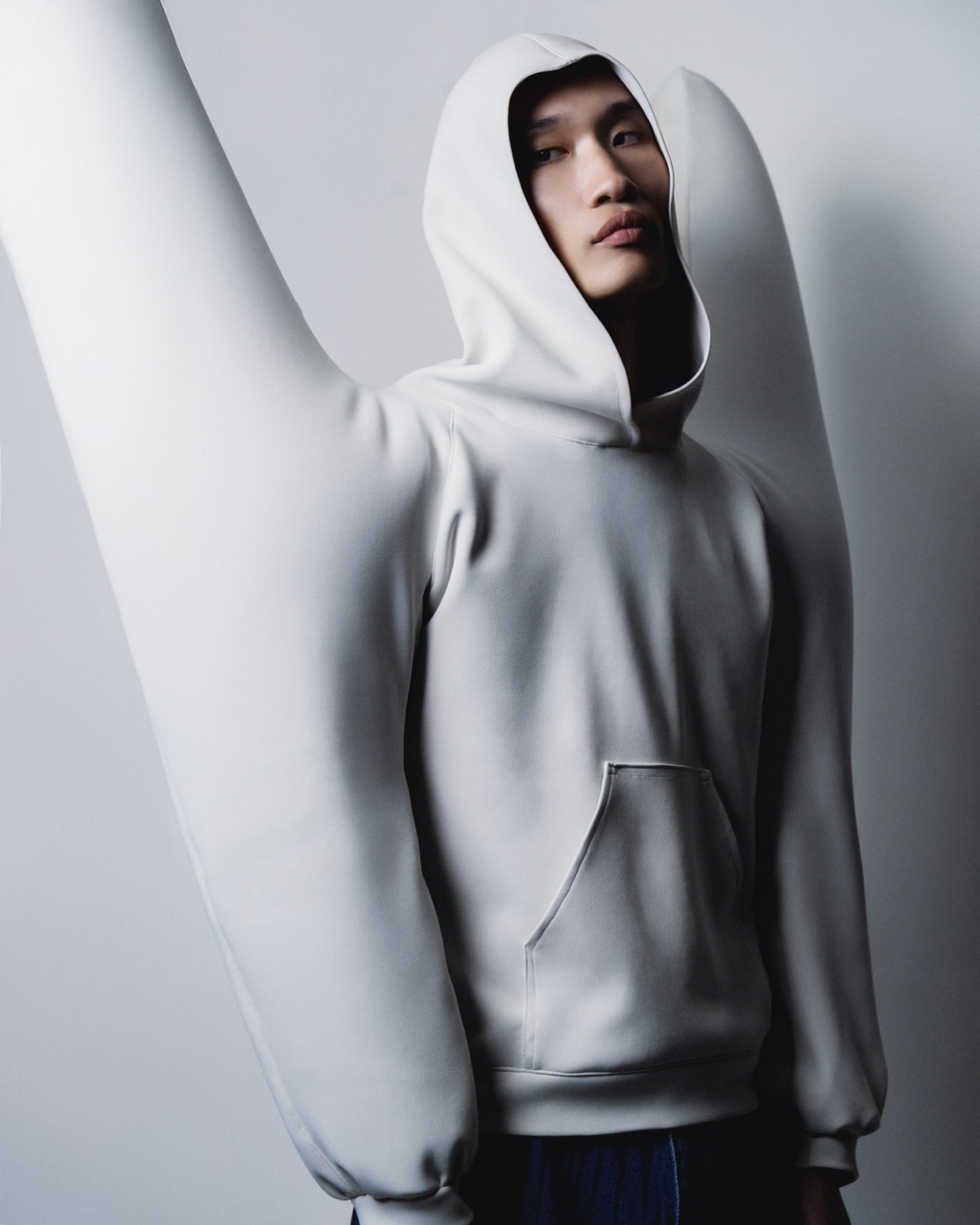
“I’m just a social media manager here,” Harikrishnan Keezhathil Surendran Pillai says with a laugh as I walk into his London studio a few days after his eponymous label, HARRI, captured Fashion Week. Their Instagram account has just crashed, banned for ‘being a bot’ after a sudden burst of posting — the result of returning from a three-month social media detox. He scrolls and troubleshoots, a scene almost fragile set against the mythic image his work has taken on. HARRI’s startling creations tease proportions and gravity, recently claiming the record for the largest inflatable latex dress ever made, and adorning icons (and our cover stars) like Michèle Lamy and Sevdaliza along the way.
The Kerala-born artist carries two identities: Harri, the person in the studio trying to build a livelihood, and HARRI, the name that moves through a fashion economy obsessed with the outrageous, where spectacle often eclipses the lived reality and skews our perception of it. Yet his priority these days (a profoundly radical concept in this industry) is simply paying his employees. This philosophy is an intentional act of anchoring — building a connection with his audience beneath the digital rubble and explosions, a foundation that makes fashion a sustaining craft. Within this, his turn toward ready-to-wear is not a retreat from the extraordinary but another way of testing its edges: translating the fantastical magnitudes of his earlier work into clothes that live and move with the body. If his inflatables once stretched our sense of what a body could become, his new collections ask how that same imagination might slip into daily life — how fashion can be both vision and sustenance, both wonder and work.

Thanks for welcoming me to your studio! How are you feeling after the show?
After a show, there is always an empty feeling. Especially when you didn’t sleep for almost two days. Now I slowly started seeing the results of the hard work that went into it. I’m very happy to see a new chapter, as this was my first independent show. Earlier, we were supported by the British Fashion Council. But now, everything from water dispensers to guests was handled by us. We never thought we’d come out of this alive. For six weeks, every day we would go to hell and never come back because everything was a problem. I’m just so happy that it has now happened.
The show was so flawless, it’s always surprising to hear about the chaos that was happening behind the curtain. You say only began working on it six weeks ago?
Yeah, the idea for the show was conceived then. But we didn’t have a venue until last week.
Last week?..
Yeah.
That’s insane. And you pulled the Barbican [London’s iconic performance arts centre] off! Very impressive.
We didn’t have anything. We had to raise sponsorships. We had to make the collection in under four weeks. 36 looks. Every step, there was always a problem to solve, and every time we solved it, a new problem came. Now, I can sit here peacefully and say that two days before the show, 27 looks were still stuck in New Delhi airport.

You must have nerves of steel.
To anyone who wants to be in design: it’s never about design. Anyone can be creative and think outside the box. It’s about doing that when taking so much risk, when everything goes wrong, when you don’t have money. That’s the skill. Your degree will never teach that. At university, I had six months to do eight looks. Today, I have four weeks to do 36 looks. Under the most adverse conditions ever. It is a risky game.
It sounds unbelievable. This collection is also a risk in the sense that it’s quite a significant artistic deviation from your previous works — what inspired this shift into ready-to-wear?
I was working very closely with my business partner, who is in operations, marketing, and administration. I design, he tests and returns with precise feedback that’s coming from the data from our social media or e-commerce. Testing is essential. Even if you spend one day in the studio designing, you want that one day to be fruitful. You can make the most beautiful jacket with the most intricate embroidery. And if the jacket doesn’t sell, and it’s coming back to your storage after the show, I don’t see a point in doing that again and again. The only brief this season was that all 500 people who come to our show could see the look and imagine it on their body and their physique. We want to celebrate people — to celebrate their choices and their lifestyle. We are in a diverse place like London, and it’s very inspiring to see multiple cultures coming together. We are coming from India as well. We have transformed ourselves into what we do today, and this place has enabled us to do that. We wanted to turn that into something people can wear. Harri was always this idea that people like to look at, admire and repost, and that’s it. Instead, we want to create something they can access.
…And have a physical relationship with.
Exactly. That was never there because we always did made-to-order. Something very complicated and abstract, sometimes too intimidating. We wanted to change that.
It’s interesting how you talk about testing — it almost reminds me of the empirical cycle. It’s like utilising a mathematical approach to amplify the connection with your audience.
Yeah, it is very scientific. This industry is art plus commerce. You have to understand that if your end user is not able to visualise them in what you create, you are failing. Because in 2025, it’s very easy to know what works and what doesn’t. And if you’re not using that data to aid your design process, then you are probably wasting resources. It’s not sustainable.

Do you feel like trying to ‘predict’ the future ever impacts your creativity or the magic of designing, in a way?
No. The magic comes from team-building. It’s never about one person doing this forever, but about people coming in and sharing their ideas. The more people I can bring, the more magic. The way I can bring more people in is by making sure more people interact with and buy my work.
It’s also reflected in the wearability of your pieces — even in your most sculptural work. How does that come through in the design process?
My pieces are never a standalone thing. It might be big or daring, but it’s something you can always wear. It’s the same motion that you go through when you wear your regular shirt. It’s just that the proportions are slightly different. But the way you put your arms or legs through the other pieces that you wear is the same. And that’s how I restrict myself. I don’t want to create an abstract sculpture and then put it over the body. Rather, I start with the body and then build around it.
You mentioned that a lot of your work would get lots of media attention, which doesn’t really translate into tangible returns. What is your relationship with social media like? How does it aid or restrict, your practice?
It’s a double-edged sword. My work was born on social media. After my graduate collection in 2020 went viral, people started recognising me, and later the look I created for Sam Smith went viral too. But at the same time, it gives me daily anxiety because you can’t unsee things — it affects how you think. I even took a three-month break while making this collection, because I didn’t want anything to affect the process. Yesterday, I came back, and it felt unreal — I was flagged as a bot because I was suddenly posting so much. Still, social media is inescapable. It helps me understand what people wear and value. It’s a great place to learn. And it gives small brands like mine power. Universities should teach social media management, both personal and professional, and have checkups the same way they have mental health checkups. Graduates are the most affected — you spend months on a collection, then have to publish it yourself, and you end up judging your own work in comparison to others.

It certainly generates so much unneeded pressure. Was it scary for you to come out with an RTW-focused collection that may perform worse on social media?
I know that if I put on a big performance or an exaggerated proportion, it will overpower the clothing. I could have gone overboard with many things in this runway, but I deliberately chose not to do that. Fashion week is over in four days, but our business is for the next so many years. So, the collection was prioritising a healthy business rather than a gimmick that would give me an X amount of views for two days and nothing for the rest of my life.
I imagine it also requires an entirely different mentality of making the clothes come to life. How did you approach translating HARRI’s avant-garde foundation into wearable pieces?
Making it so wearable is the most challenging thing. With my avant-garde work, it’s just my imagination. But for this collection, it was a very beautiful process because there’s a customer, a lifestyle, a price on the other side of the equation. So it’s about a puzzle. When I make a pair of trousers, for example, you have to think about the material first, how it comes in contact with your skin, and then what is the best hand feel I can give at an affordable price. I have to do a wardrobe audit and ask people what they like. Most importantly, what they don’t like. A team of fashion psychology graduates does that for me. I would take that data and make sure that every step of my garment construction would satisfy that data.
What kind of materials do you work with?
It really depends on the product, but I work with everything from leather to wood.
I’ve also read that you work with rubber and have a familial relationship to the material as well.
Yeah, where I come from, we all have a plot of land in the corner. When I was born, we grew tapioca. Then we had banana and coconut trees. And now it’s rubber trees for the last 15 years. So, I do have a relationship with it, but I never thought I would work with latex or rubber later in my life. When it happened, I didn’t even think about that connection. It’s only occurred when the press started asking about it.

That playing with proportion comes through even in your RTW. Is this manipulation for you about fantasy or exaggeration — and where does the wearer exist within it?
My avant-garde work is about me and how I can push my ability to make a proportion never seen before. Then somebody steps into it and becomes a part of it. It’s not obscuring or overpowering the person, although sometimes it happens. Other times, it enhances the individual or gives them a different personality. People come for different reasons, which is interesting. But it’s still about pushing my limit. Whereas with this process, I had to imagine the wearer as the star. Everything is about them. No creator ego here. It’s like, if you don’t like it, I will change it. It was a very inclusive process, rather than me pushing my ideas. It was less of designing, more of studying people. The proportions are already there from the artistic side of the labour, so it was just about transforming them. How can I reinterpret those elements into something friendly to wear?
Does it in any way feel less you?
No, it feels like there’s no ‘you’ here. I don’t attach myself to what I do so much.
And for the next collection, do you already have a certain creative vision, or do you always wait for the data?
In a few weeks, my small team and I will sit down, see what worked, what distracted, what helped, and plan from there. We used to design blindly — graduates are programmed to be the most creative human beings ever, but not necessarily the most value-adding creatives. Giving value to someone’s life through your work is very different from simply being creative. I could never afford or wear my clothing, and I wanted to create clothes for people like myself and my business partner. If I only make avant-garde things without imagining myself in them, at some point I’ll crash and question what I’m even doing.
Why wouldn’t you wear your own clothing?
Because I am doing it from a making point of view. It’s like a director who directs a movie, they will never see themselves as a character in that movie. It’s about a story that you’re building. But now, for once, I want to see myself in that story. We interviewed about a hundred people from various trades and lifestyles, and the most important thing we learned is that nobody buys clothes. There are so many brands these days, but nobody’s buying new clothes. We want our customers to be able to buy and be a part of the brand. Affordable doesn’t mean devaluing the product — it’s about finding new ways, like loyalty schemes, and that demands a lot of work and creativity.

I think there is so much romanticism around the first kind of creativity you mentioned — the more sensational, awe-driven kind. That’s the only thing many people perceive fashion to be. This sensationalism draws more people in, but only on the surface. We read an article, repost an image, admire it online. So then it ends up existing in this liminal online space without ever descending into a physical, tangible realm.
Absolutely, and that’s not a healthy culture. You put all of the energy, and yes, there are views, but it’s not converting. The turning point in my career was when I hired two people last year. For me to pay them, my business has to give back. Every step I take is now about how I can retain them, because I love them. I love working with them and the value they bring. I want them to take an Uber back home. To have nice coffee and buy clothes. I want them to go travel. I want them to do all these things with the salary they get from my brand, and I want them to come to work happily and leave work happily. Maybe even early. To give them a cinema ticket or a yoga pass. That’s what I want, rather than just creating for the sake of creativity. It made me start taking myself seriously and realise I have to prioritise certain things, even if it might compromise my image for some time. That’s okay. I can always come back to it later.
This is so important to talk about. In the media, we’re almost conditioned to focus on ego, creativity, the groundbreaking and the unapologetic. We’re always chasing something new, bigger, better, more — especially in this state of constant dopamine depletion, often forgetting what a creative foundation is actually built on.
The more I look at it, the more I realise the problem is the media. The last four times I did a show, the media got what they wanted, the hair and make-up team got what they wanted, the audience got what they wanted — and at the end of the day, I am broke. My team did a lot of hard work, and I can’t afford to pay them. Only the media profits — they get their views and the viral content, and that needs to change.
Yeah, fuck the media…
Words by Evita Shrestha
Photography by Emily White
All clothing Harri