Pioneering nostalgia, demo-itis, and why their music couldn’t exist at any other point in time.
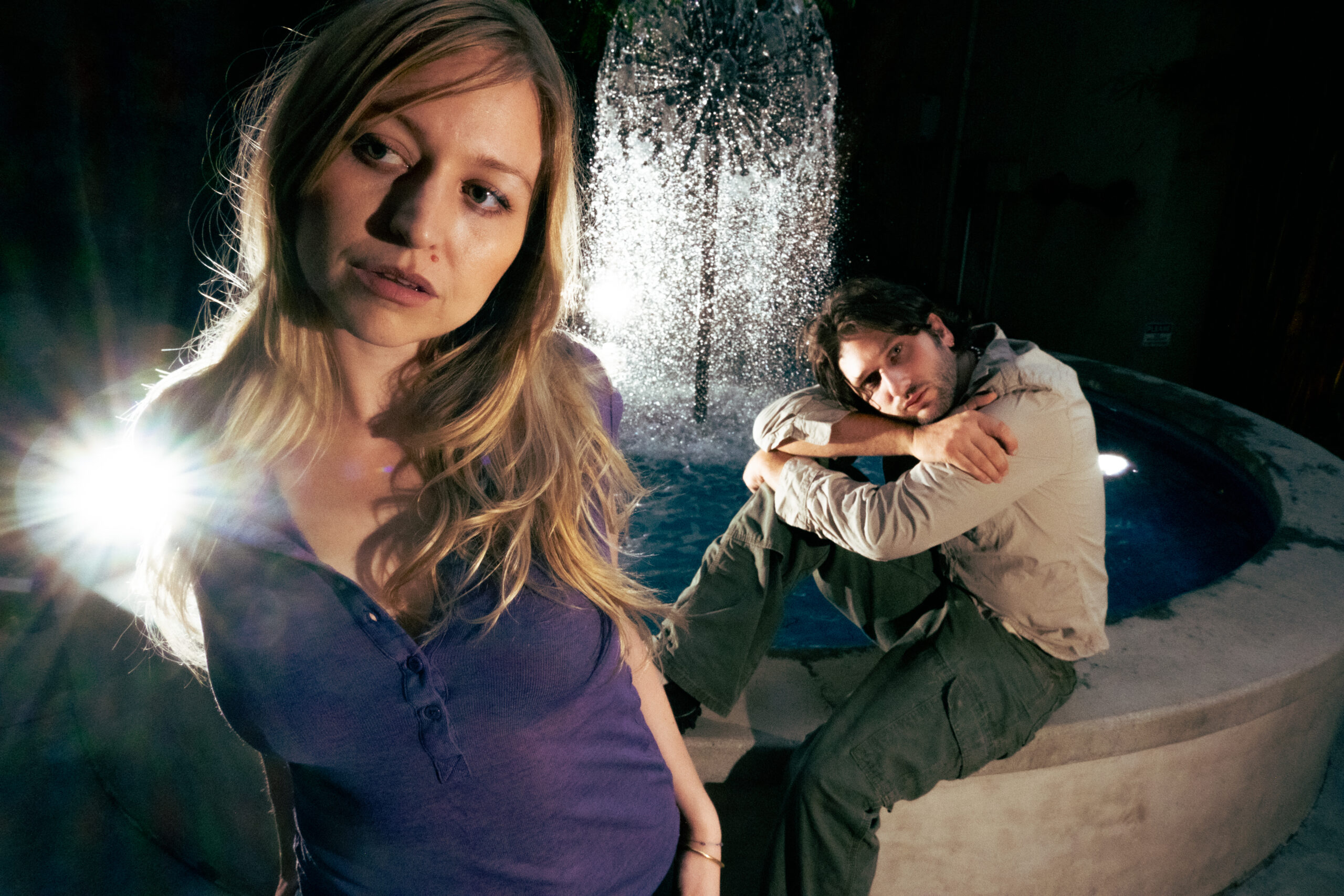
Self-described as a ‘forgotten memory,’ the LA-born trip pop band After are making great strides on their very first European tour. Formed by Graham Epstein and Justine Dorsey, the duo is deeply self-aware: the project is a kaleidoscope of everything they love, miss, and obsess over, stitched together with intention so sharp that what could initially read as referential feels entirely theirs. Just two hours after our chat, Justine will confess from stage: “I’m in Amsterdam for the first time ever — having a show for a full crowd!” with a smile at once proud and humble, and we’ll know, without saying a word, we’re lucky to witness something distinctly of our time emerge in front of our eyes — all of us united by the sound, fused by our longing for the days we can’t bring back, if only momentarily. But, right now, in the crowded bar next to Paradiso, Justine and Graham walk me through their creative process, the mercy of never killing a track, a newfound love for Lost, and how they feel about being referred to as “the band that met on Hinge.”
Congratulations on the first Europe tour — you’ve already played London and Paris, how’s that experience been?
Justine: Incredible overall, but especially the shows. Everyone’s singing along, everyone’s so happy, and everyone makes friends.
Graham: People come alone and leave with new friends, it’s great. The crowds seem to go crazy for our heavier songs like Ever. There’s such contrast in the tracks that it creates a very special energy but maintains it throughout the show.
The After universe is so specific, so is your songwriting, like stepping into a distinct world. Longing, yearning, being on a train. Your new single ‘Promise (When You Go)’ continues that narrative. Is there a theme you’d like to write about more but haven’t yet?
G: Homesickness.
J: That — and there’s also a really specific alpine feeling to a lot of the songs we love. Think of it as a cold, crisp winter morning with the sun shining, everything covered in snow, a clear sky. That’s been the direction for us lately, and a song we’re working on right now feels exactly like that.
Most creatives have the messiest notes app. Everything starts in there: all the genius, all the nonsense, the craziest ideas and gems living in undistinguishable chaos. Is that the case for you, too? Where do the roots of ideas live?
J: Yes! I’ve had a long-running, single note in my phone where I wrote so many lyrics for our EPs. I would write down fragments of thoughts and they’d all bleed together. I remember that’s where “Pulling on the rope that binds the sky to earth,” came from – the opening lyric to our song Deep Diving. But, also, voice memos are the greatest invention.
I love the tracklisting on both EPs — just brilliant. What’s the thought process behind it?
J: For us, the balance of moments is essential to archive with the tracklisting. I like to think of our music as a terrain you’re traversing. Going from landscape to landscape. It’s an open-world video game.
G: Track listing is super important — how one song ends and transitions into another, everything is considered. I want our songs to have a visual aspect to them, even when they don’t, to evoke a special alchemy in the brain.
It’s very clear that so much thought goes into the world-building of After, both sonically and visually. You’ve referenced many niche things your music is inspired by. I’m wondering if there’s any references fans haven’t picked up on yet? Or something recent?
G: Movies, always. Right now, we’re obsessed with the movie MirrorMask. It’s this weird mid-2000s CGI film. Crazily odd, gives you a strange feeling, but it’s also captivating. Also, landscapes and traveling.
J: If you watched MirrorMask as a kid, you would’ve been so freaked out by it. It’s a haunting movie.
Speaking of haunting, does the fact that you’re often introduced as “the duo that met on Hinge” haunt you?
J: We volunteer it all the time, so it’s okay. But there’s probably a lot more annoying people on the app right now being like “Hey, want to start a band?”
You’ve spoken extensively about your creative synergy and how easy it is to work together. When you’re working on a song, who’s the one saying “this is done” — and who’s the one going “no, it needs more work”?
J: Depends on the song, but generally Graham wants to add more, while I’m like, “we’re good.”
G: I like to keep adding stuff, then take things away — adding and subtracting. I’m a maximalist. But what tends to happen is we write things over a long period of time and then we sit with them — so we’ve developed really bad demo-itis where we’ll feel attached to a very specific mix from a year ago. Sometimes we enhance it by adding stuff, and then unanimously agree it was so much better a year ago. Generally, I like to throw things at the wall: there’s so many string parts and piano parts I want to keep playing with.
Who’s more protective of the original idea? And who’s more willing to let it flow into something new and unexpected?
G: We’re in sync on this. We’ve only been around for two years — it still feels fresh, so who knows how the process will evolve. Right now, everything is super synchronised. But, of course, there’s some songs one of us has loved immediately, and the other would come around to later.
J: We usually have the same instincts about songs. But sometimes I’ll be writing something I’m hesitant about, and Graham is the one assuring me – encouraging me to finish it, to try something, to go ahead. Even with Baroque: I was not fully convinced, and he said it was a really good song and we should send it in. And now it’s a favorite! And I absolutely love performing it live.
Which one of you is more likely to kill a track?
G: Me, probably. We never fully ‘kill’ it though — there are some really old songs we want to go back to.
J: Graham. But we’re on the same page about it, too. If we don’t have the same spark about a song, then it can’t work. Every once in a while, one of us may be not as into something as the other, but the other insists we just try it. To be fair, there aren’t a ton of songs we’ve just abandoned. Every time we’re writing, our goal is to legitimately make the best song possible.
How do you feel about being proclaimed nostalgia pioneers right now?
J: I think it makes sense for the time period that we’re in. It feels like an inevitable point. Graham always says he feels like everyone did everything cool and innovative in the 90s. He’s even found hyper-pop tracks on MySpace from its early days — it seems everything we know to be cool has been done before.
G: That being said, I think our music is so now — it couldn’t exist anywhere or at any other point in time but here and now. We’re living in a crazy time, and I don’t want to call what we’re doing escapism, but it’s a permission to go to a forgotten place. A refuge, maybe. Essentially, we just want to make the music we want to hear ourselves.
When people try to trace your sound back to its references, do you feel like they’re missing the point?
J: Our project is deeply referential, of course — we know that. Maybe a more cynical listener would say we’re just copying something old, but our references and inspirations are rooted in everything we love and obsess over. It’s kaleidoscopic, and it’s all done with so much heart, respect, and honesty.
G: There’s too much categorisation happening sometimes around aesthetics, which can be derivative. It’s never just Frutiger Aero and stuff. The fact that we have so many different sounds — we wouldn’t have been able to do that in any other time period. Every song is such a different energy and is in a genre and lane of its own, we’re never referencing strictly one thing. All of it is coherent and uniquely suited to Justine’s voice.
J: It’s like something you remember in a dream — something you knew, but forgot, and then rediscovered. That’s always been the energy we wanted in our music and the whole project: a forgotten memory.
What’s next for After?
G: We’re playing festivals we’re excited about — it’s our first time. Lollapalooza, Gov Ball in New York, Reading & Leeds. Outside Lands. It’s really exciting. Also, right now it’s just the two of us on stage, but I want to add more members to the band for the live performances and expand our set.
J: Some really exciting announcements in store. Soon.
Give us some recommendations that aren’t music!
J: Everyone should watch Lost. It’s so cool. I’m watching it now for the first time, and it’s weirdly inspired a lot of music.
G: There’s a movie called Walkabout (1971). It’s not sci-fi, but there’s something really sci-fi about it. The desert, the music, the ambience. It’s really sick. Also, I just started golfing, which may sound lame to some people, but it’s so fun.
Anything LA-specific?
J: Go to Barnsdall Art Park — highly underrated. There’s a Frank Lloyd Wright building there.
G: Yes, architecture in general is inspiring to us. I seek it out whenever I go to new cities.
Noted, all of it. Are you bringing anything home from Europe?
J: I should bring candy back. European chocolate is superior.
G: My brother always makes me go to record stores, he’s a big metalhead. So I’ll be hunting for 7-inches for him.
Words by Valerie Estrina
Photography by E. Martinez