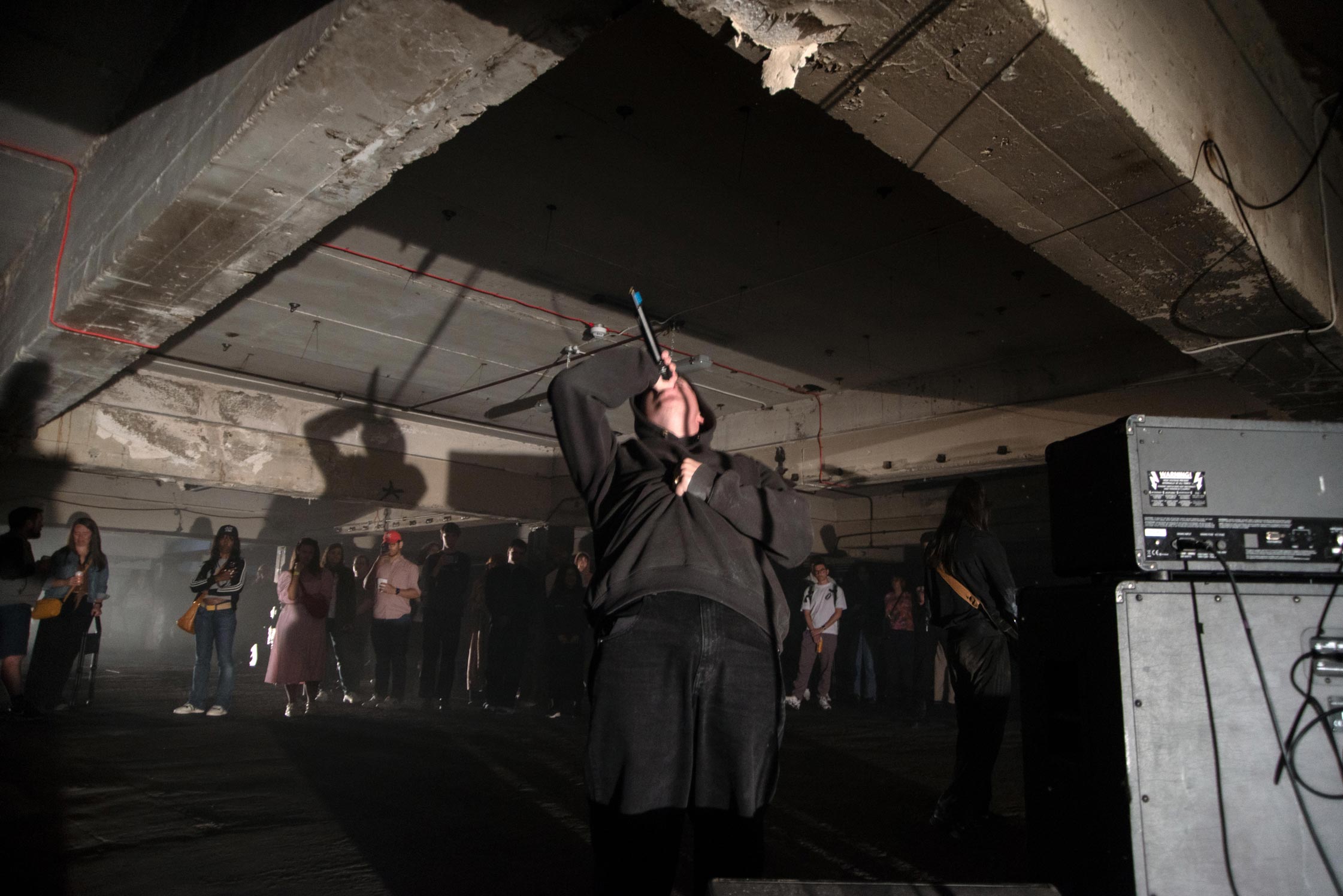
Blackhaine’s work begins where the body stops protecting itself. Arms wrench into impossible positions, torsos buckle, mouths choke out fragments through walls of distortion thick enough to feel physically polluting the room. Sound forces movement into existence — drill ruptured by ambient foreboding, post-punk abrasion, metallic noise stretched until it resembles machinery eating itself alive. Across performance, music, choreography and text, the Salford-based artist has built a universe governed by pressure: pressure on language, on space, on the nervous system. Though many first encountered his work through collaborations and scenography with figures like Playboi Carti, Blood Orange and Kanye West, Blackhaine’s own practice exists in a far stranger, more suffocating register.
In his choreography, the body absorbs external violence that interacts with internal strife, producing strain as a closed feedback loop amplified through movement. The work responds to the psychic residue of Northwest England, and a wider political landscape shaped by financial abandonment, cultural extraction, and the steady dismantling of public life and care. What comes out is a kind of dread that has learned the shape of the body and started wrapping itself around it, squeezing through organs, tightening around breath, vibrating through flesh.
Now, Blackhaine brings his performance And Now I Know What Love Is to the Holland Festival, staged inside Amsterdam’s former Bajes prison. The work pushes his choreography and sound practice to its most exposed edge. Bodies are driven past physical comfort in a desperate attempt to outrun themselves. Overstimulation, repetition, and sensory assault fold inward until something breaks through the noise: grief, dependency, and the unbearable need for connection. Beneath the brutality — and the impulse toward self-erasure that runs through it — sits something disarmingly simple: love emerging after every defence has run out. From here, Blackhaine speaks in fragments and half-logic, tenderly and to the point.
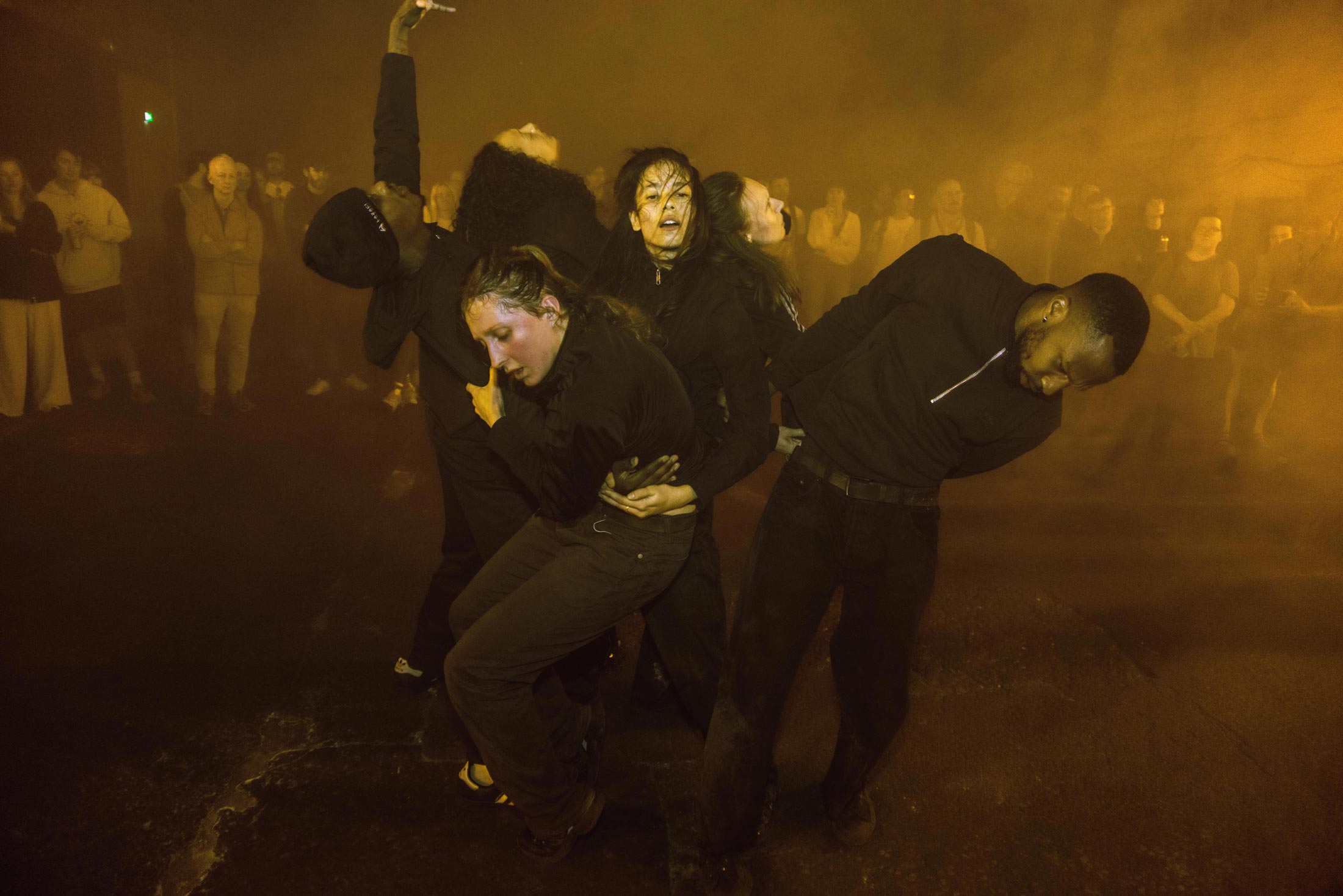
People often connect your work to Butoh, which also came from a landscape marked by collapse and trauma. The post-industrial North feels very different historically, but I wonder if you see those landscapes to share a similar psychic atmosphere — a body absorbing the violence of its surroundings.
I began to focus on the landscape of my own body — the North has many hills, dead fields, and beaches I can never fill with my performance, but the sight of that trapped spirit in a landscape is one of loss. This is what And Now I Know What Love Is is about.
So this is an echo of the original Butoh spirit. Yeah, there’s definitely a psychic connection.
What does the notion of ‘negative ecstasy’ mean to you? For some reason, I was so struck by this specific description. I interpret it as reaching a state of catharsis or transcendence, not through release, but rather exhaustion, repetition, and intensity. Does that resonate with you at all? And can that be in a way a pathway to peace, or a certain euphoria even?
Yeah, that’s exactly it.
The negative ecstasy was a remark from Conor Thomas from Death Of Rave, and I still think it’s the best interpretation of what I’ve created.
It’s a pathway to a peace or Eden landscape, yeah, and I think the truest one, because you have to earn this, alongside the viewer.
A lot of my early choreography, music was just a complete build-up —
I didn’t, and I still don’t, understand the value of giving the audience this euphoric end part. I often think they should be allowed to find it themselves when they leave the venue and hear the sound of the street.
And Now I Know What Love Is is about lost and gathering, the audience immediately sees ‘the lost’ and goes on to experience their own versions gained from the following acts.
He Loved Him Madly by Miles Davis was one of my biggest inspirations for the first hour of this performance.
It’s abyss, psychedelia, and loss.
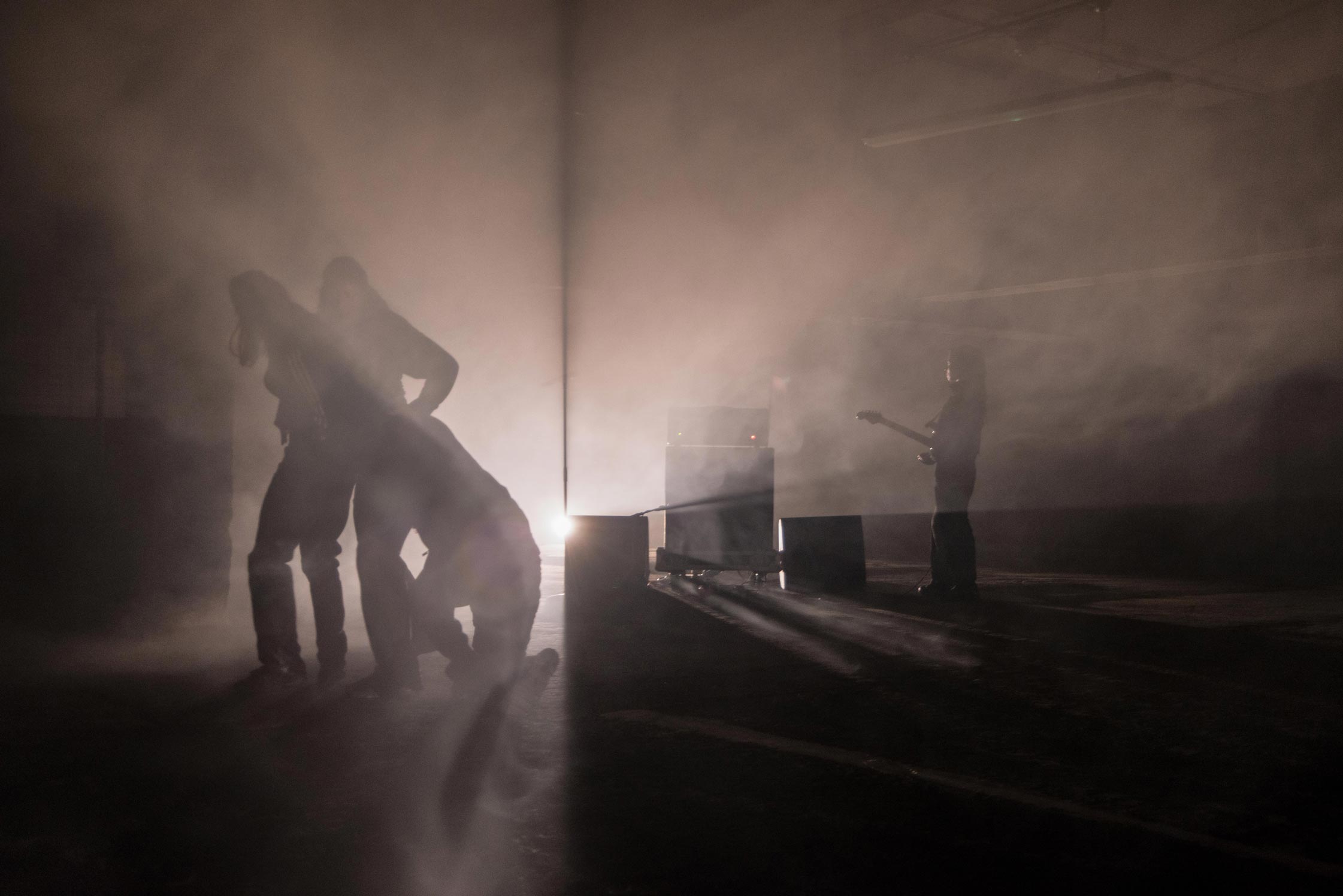
With And Now I Know What Love Is, you’re working with an entire cast rather than only putting your own body under strain. What did you look for in the people you brought into the work? You also push yourself physically to extremes in performance, what does it mean to ask other bodies to enter that space with you?
I just wanted honesty. That’s all.
Half the dance scene in the UK is rotted by an athletic-focused understanding of what dancing actually is.
The other half is too concerned with academia that it forgets what honesty is.
Most of the dancers in this work are people I’ve known for around ten years — they are my friends, and they understand me, so I don’t have to over-communicate technique.
I hate talking in the studio because we are working on movement. This is usually why I work with the same people as much as possible.
I try to work one-on-one with the dance artists, we both develop an understanding of emotional intent, and through improvisation and the artist’s personal embodiment we can both walk away with something real.
Your work always feels very responsive to the architecture it’s embedded within. For the Holland Festival iteration specifically, how did the space change the piece?
The ceilings in Bijlmerbajes are a lot lower than the industrial space in Manchester, so I’ve been able to implement more compression in sonic architecture, meaning I can reach an overbearing sensation quicker.
I’m about to fly to Amsterdam in a few days with the cast — we will be experimenting with compression in the choreography and the audience proxemics so that the overall feeling of containment is greater and easier for the audience to become lost in.
The title And Now I Know What Love Is feels disarming, and pretty surprising in its decisiveness. Love isn’t usually the word people reach for around your work. Why did it become the centre of this piece, and where does the certainty of it come from?
It’s not, but it should be —
All my work is about need.
All is shield, armour — all walls of noise, the abusive choreography, the text.
There are beautiful ambient textures, lost, reverted guitars buried deep within the noise moments.
Only when it is taken, do we know love.
When I began to make this piece, I was tired, very burnt out — I didn’t have it in me to even feign the extremity I was known for — I was walking into the studio, and I’d already done the aggressive part, so it was the hangover from the last few years of my life.
Even though I’m not in the work itself, it’s the most naked I’ve felt through my art because there is no armour here at the start. I try to build this during the next two hours, however, it quickly collapses on itself.
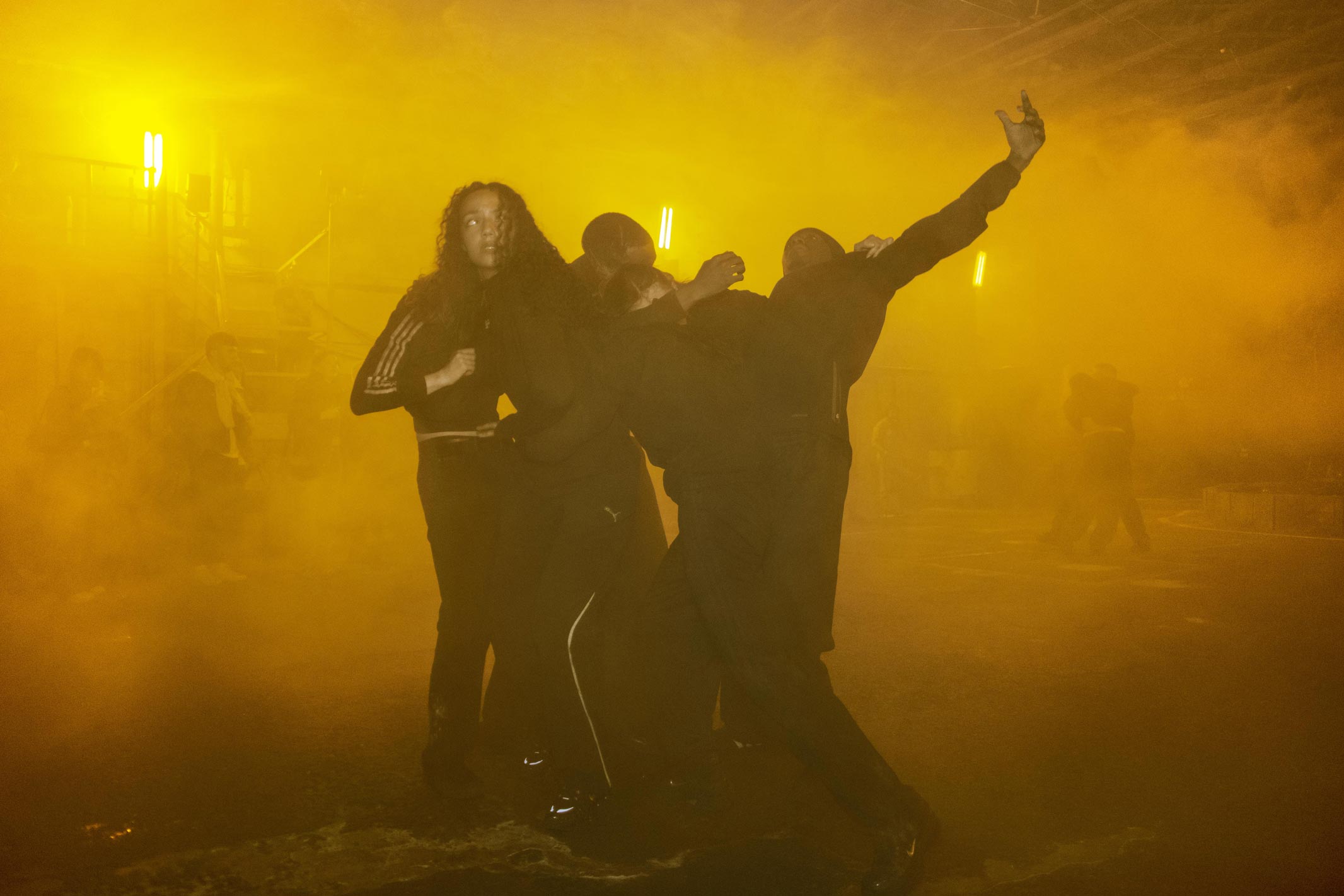
What did making this work teach you about love?
The best is unconditional.
And truce is never earned.
How do you deal with returning to certain emotional states repeatedly in performance? Is repetition desensitising, or does it deepen the wound each time?
We are all born from wound, and every moment in this state exists as unguided refraction, the line of catharsis and repression can become blurred so sudden.
That’s not to say this is a plain gamble to be in this state — however, you have to take everything that happened from before this point into consideration.
Some days you can be over it, some days you can’t.
The North feels culturally hyper-visible right now, but almost in a way that seems detached from the actual conditions people are living through. A lot of codes that came out of deprivation are now being circulated as a certain aesthetic. (Maybe slightly unrelated, but I’ve been seeing so many MET police reels with drill or jungle edits, which is just so twisted). When you look at the way Northern creative output is being perceived right now, does it feel like recognition to you, or extraction?
The MET police reels are related completely. In many cases, across the board, art born from suffering is being trivialised.
It’s extraction by a system that cannot comprehend.
And where do you see the perception of your work within this landscape? I wondered whether you feel a responsibility to resist that flattening, especially now that audiences seem increasingly comfortable consuming images of struggle as culture.
People who get it get it —
And the people who don’t won’t stick around for long, so fuck them.
And how do you take care of your body when your practice asks so much of it?
Structured rehabilitation and diet.
Blackhaine brings his performance And Now I Know What Love Is to the Holland Festival on June 5 & 6
Words by Evita Shrestha
Images Courtesy of Blackhaine