Discussing South Park, the fate of being born into an NPC, and all thing ‘autogratis’
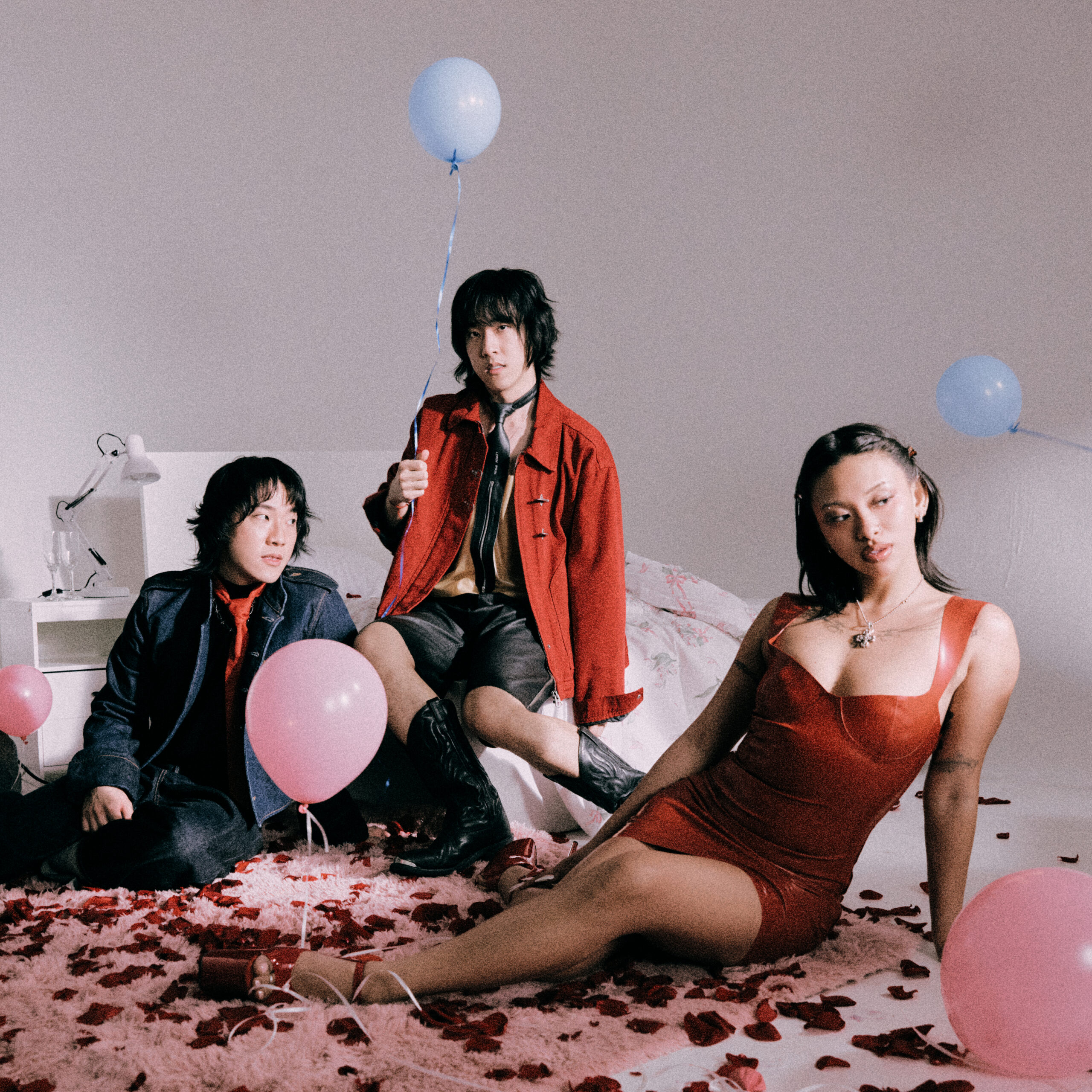
Three years ago, NY-based band Chanpan were passionately basking in the city’s streets. Today, they’ve embarked on their first EU-US tour, closely followed by the drop of their highly anticipated second EP (June 26 — mark your calendars), and backed by a devoted fan base that’s just as sharp and funny as the band itself. Building their sound on a tastefully layered mash-up of genres ranging from DnB and jazz to pop and rock, the trio is made up of lead singer Grace Dumdaw alongside instrumentalist twins Lance and Matthew Tran on drums and guitar.
With their upcoming EP autogratis right around the corner, single drops like the sexy buzzin and the confident rock anthem confessions part iii set a distinct tone for the project: think a little cheeky, brazen to the core, and packed with the perfect amount of sultriness. Listening to Chanpan is kind of like downing that delicious, high-electrolyte drink that keeps you energised and full of hope for the rest of the day.
That’s exactly the effect you get after a conversation with the East Coast-based trio, too. Inspired by their contagious energy and fueled by their wisdom, you leave feeling equally light and awake. Throughout our morning call, each member was comfortably cozied up on their couch, sharing inside jokes about disciplining each other, being born as an NPC, and their collective love for European supermarkets. We also, obviously, spoke all things new EP, from favourite tracks and hidden Eastern eggs, to what fuels their prolific mindset.
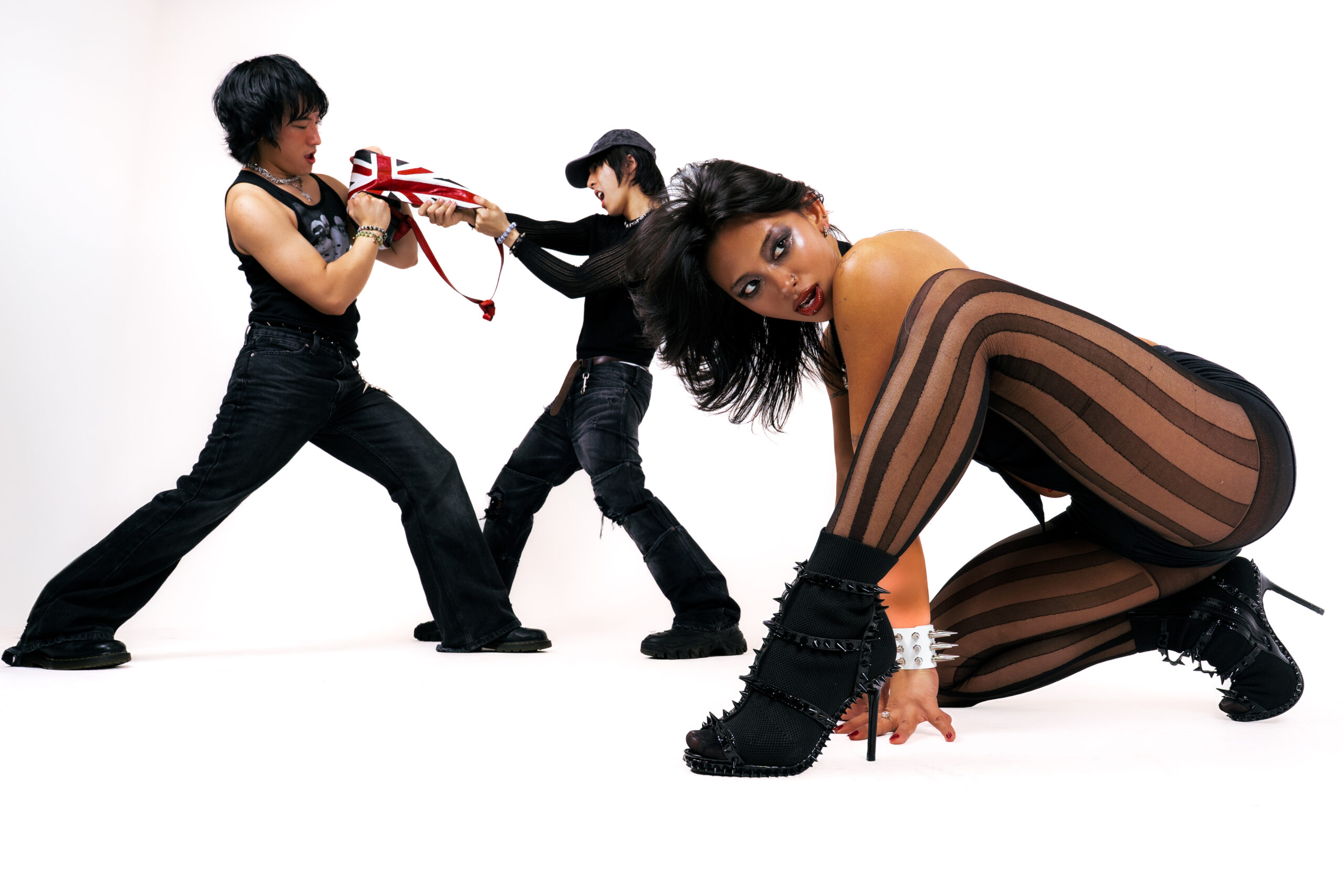
Autogratis is dropping exactly one year after last year’s EP Endlessly. What has been fueling this prolific mindset?
Grace: After our first EP, it was a really big learning process to put all that out, see how it was received by our listeners, and just sit with it and process it. Being a performer and putting out music and emotional content that is so raw, you have to analyse how you’re being perceived, and how you want to be perceived. That’s the headspace we were in after it.
I think we’ve definitely grown a lot as artists and gotten a lot of agency with our creative ideas now that we’re also working with partners that help us elevate that vision to the highest ability. So going into EP2, I just feel really excited and confident in the music as a representation of us and the message that we’re trying to put out there and all the visual things we have lined up — that feels really good too.
Lance: Compared to era one, we’re a lot more confident, emboldened, and maybe a little more brazen or cheeky because a lot of personality has come out. I see this in our music and performances, and even in things we feel comfortable saying as artists. We really didn’t expect to be in the position we’re now, to have a chance to be putting out music to so many people. We just started doing it for fun about three years ago, and now with the learning curve, settling in, everything is making sense as we’re a lot more comfortable. So we get to express ourselves confidently.
Matthew: We go at a crazy pace, and we always have to remind ourselves to slow down. I feel like there’s just not enough hours in the day and there’s just so much I want to get done on this earth, and our personalities are always like, ‘More, more, more, faster.’ And we have to take care of ourselves in the process too.
Lance, you just said you allow yourselves to be more cheeky now. And I was wondering what the gratuity is in autogratis? What’s that extra little thing you’re leaving on the table?
L: All credit to Grace for the title. I love that question, ‘What’s the extra thing we’re leaving on the table?’ I would hope that there’s some knowledge we share with listeners. I think our music and art is intentionally not so esoteric that you need to sit down to really enjoy it. We make music that we like listening to, playing and performing. So it has to be fun and enjoyable in the most authentic and pure sense to ourselves, which also translates into how people absorb it. But what we’re talking about, thinking and reading about, and wrestling with a lot of the time is pretty visceral and political. So I would hope that with our project we’re leaving some food for thought that pushes, challenges, and affirms people as political humans.
G: That name just kind of popped into my head randomly. It definitely means the auto gratuity, the free little tip, and I think about ‘auto’ as the self, too. So this EP is gratuitous to ourselves as I’m writing about my love life, and just being a little bit more emotionally open than I was in EP one. It feels like I’m giving part of myself for free to the audience and the listener. That’s kind of what that title focuses on. It feels really vulnerable to stand in front of a crowd, being so exposed, and sing songs that are about just really sensitive topics that affect us. So that’s kind of the world that the name lives in.
M: There are a lot of fun Easter eggs that make us laugh. And it’s always fun at shows when people in the audience hear it, and then they come up and ask what it was. So that’s my answer. There’s a little extra that we leave in our music.
The visceral, the emotional, and the referential. Love that. And talking about the Easter eggs you’re sprinkling in, what is the most challenging aspect of working on music together? Are the references in your music always ones that you all share?
L: My understanding is that the references of our individual taste shape the way that we are inclined to write or play a certain thing. But when we’re together, one of us plays, sings, or hums something that sounds good, on the inside everyone’s like, ‘Oh, yeah, that’s great.’ It’s less often that we’re articulating out loud what we want it to sound like. And that’s the most important part of the process. I suppose it’s less verbal communication, but it’s more sonic.
What about the challenge? Over time, I suppose it’s hard creating with anyone if you have certain expectations of what a certain piece of art should end up like. Probably all three of us, in equal amounts but in different ways, have grown to see what happens and to trust each other. And that just means experimenting, because you’re relinquishing some control. And that’s the point of collaboration. I haven’t really thought of it that way before. But I think trust is required for true experimentation, and that’s pretty cool.
M: First, I’ll say I’m very lucky to be in a band with these two particular people, and it’s like a ‘1+1=10’ kind of thing. But of course, there’s challenges, but it’s always been a more fun and exciting thing. I read that improv-people have a ‘yes and…’ rule, where it’s more about saying, ‘Let’s work with this and test it out’ — it’s more about adding something instead of taking it out. That’s the kind of mindset and approach that helps us experiment and end up in a lot of new places that we’ve never been to before.
And if anything, when you ask if there’s a challenge, it’s almost not necessarily even musical, but we’re also friends and family before Chanpan existed. So it’s just trying to find time and space to take care of these parts of us and hang out. And maybe in a non-intuitive way, it always ends up serving the art making because we’re in a better place ourselves.
G: For me, it’s kind of just a in-the-room thing: Throw something out there, if it’s well-received, you go with it, and if it’s not well-received, just keep cooking. And I’ve learned not to grow too attached to anything because this desire is the root of all suffering. And I don’t want to suffer. So if I want something to happen musically, but if it’s not feeling like a good fit, then just let it go. And hopefully something will replace it.
Is it hard sometimes to find the right balance between hanging out as friends and not as bandmates where you end up talking about your music, and being in constant work mode?
M: Yeah, definitely. I’m someone who needs an off-switch and so do other people. So we’ve developed an inside joke as a band — if anyone’s seen South Park, there’s an episode where a guy makes a sound to discipline a misbehaving dog. So we do that to each other when we’re doing too much and cutting into dinnertime or hangout time.
G: The sound is [imitates a hissing tsst sound]. So when someone starts talking about business and no one wants to hear it, we just all go ‘tsst.’
M: It’s like a shock collar we have for each other.
L: We’re gonna send you a YouTube clip so you can see the horrible context.
Perfect, we all need the context! Let’s go back to autogratis. Do you have a current favourite on the EP?
M: That’s such a hard question. It changes every day. Kind of like your children, you can’t pick a favourite. Actually, no, you do have favourite songs, they’re not like children. But I think the one that has brought me the most joy in terms of memories is jesus in china (overflow). There’s just something so magical about the one day session where we walked in without anything, and then we came out with that song. We made it with our now friends Taydex, an incredible producer, and Wes Singerman, an insane guitarist. And we had so much fun which completely translated into making that song. And it feels free and uninhibited. And it’s really fun to play. So that’s my favourite.
G: I can’t pick, but I think meaning wise, romantic is really personal to me, and I love that. It’s different because it’s really simple, compared to our really layered other songs. The mindset that I had going into that song was really gripping onto anything that would make me feel empowered during a time where I was feeling really scared, and just didn’t feel like I had much agency over my own safety. So that’s like the song that feels really good every time I listen to it because I love to feel a little evil at times.
L: I feel like Matthew and Grace’s picks were so emotional, semantic and meaningful. So I’ll give a more technical answer right now. I feel like confessions part iii — just for today — is my favourite. I also really like what’s under the hook, the drum part I’m playing is a callback to original funk drumming, like Dennis Chambers and the people who played with James Brown. So a lot of our songs have these tidbits that would show up with music history. But I guess you wouldn’t really know until you asked. So that’s my pick.
In the past, all of your music videos have such distinct visual words. I was wondering what world are you stepping into with this new era?
G: EP1 was a lot of world building. And this one is more like small vignettes that really fit closely with each song. So we had buzzin, which was like ‘sexy pillow fight, making out on TV type energy.’ We just worked on the video for I got a gun, which, you know, you can kind of draw your own conclusions from what to expect from that. And confessions part iii is really fun, and we have a break dancing child that just encapsulates the energy through an innocent approach to art and life. So we’re just jumping all around and building our own multifacetedness instead of going into a fantasy world. We’re just being really present in this one and being sexy, fun, and loose.
M: We’re having a lot more fun with it. And the breakdancing child’s name is Petro Politaiev, and he’s incredible. A lot of the collaborators we’re working with are super talented and cool, and it’s been really awesome to have them helping us create our vision. We’re getting to work with people like Patrick Linehan, Aaron Fenichell, and our friend Christopher Kim. So I’d also like to shout out our collaborators there too, and all the friends and people who help out with the visual stuff, because it really takes a million people in a village to create a piece of art like that.
With having this particular interest in world-building, are any of you film nerds?
G: I think I am the most film buff out of the three of us. I studied film in college and I post on Letterboxd — I log in that stuff. I try to watch as many movies as I can, but these days it’s hard to find some time. I love film, I’m an actor. My brain thinks in film-like visuals, and I’m always watching new things and making sure I document shots I like. I’ll literally screen record it and put it on a Pinterest board to reference later for music videos. And my Letterboxd is not serious though. I’m over trying to have an intelligent or provocative review of any film and kind of just be like, ‘This was good because it was funny.’ And I recently watched Project Hail Mary, which I went in with no expectation. I just knew Ryan Gosling was in it, but it was such a nice film and it was so hopecore. And I think I’m really into hopecore right now and going to try to find more hopeful videos because it’s been helping me keep my mental health together, honestly.
L: I’m going to say something so pretentious, so I’m so sorry. But to me, it’s Big-Film, or when I think about the impact film has had on my life, and watching movies and the feeling that it leaves in your spirit that something could change. I think the power of good film and media — if it understands the role it plays and the world it’s made into — can give you a taste of utopia. Unfortunately, it still operates within a capitalist world which we can’t escape. So it makes money, and it needs money to be made. And I also think that the pieces of film and media that I don’t like are where they give you this glimpse of something more revolutionary or norm challenging, but then it ends and resolves in a bad way where they kill off the villain who kind of had a good point. Or they just embraced the CIA at the end of Black Panther, you know, that kind of cop out is really lame to me.
I feel like I see an analogy between the pieces of film that have really changed me and stirred my mind. And hopefully music can have a similar effect, where good pieces of art can transcend that self-defeating cycle and give people a very visceral sense that change is possible and that it will happen. That makes me think of another quote that Matthew really likes, in which Toni Cade Bambara says: “Our role as cultural workers is to make revolution feel irresistible.” So I think that is the power of film and music.
M: On one level, I love consuming media like anyone else. And even as a younger person, I would make these short films with a little camera and Windows Movie Maker. I think I agree with what Lance is saying. I can’t help thinking this way — maybe because of my training — but there are some people who would phrase that any piece of media or thing that exists in the world is like a text, like T-E-X-T, in the way you would talk about a book. No matter what your intentions are in creating it, it’s always telling the audience something, even on an emotional level that the audience can leave with. So I really enjoy certain pieces that leave me with something that aligns with what I care about, and what I like to see in the world.
Sometimes I do think about what we do, big or small, and what we put out visually. And in terms of art into the world, it’s like, ‘What are we saying with this?’ Because on one hand, I don’t really think about it during its creation, as it’s whatever we’re feeling, and it’s genuine to us, which is the message. But on the one hand, if we’re choosing to play with certain themes, or things that are more grounded in reality and what’s on the news, then I want to have a certain kind of impact.
Thank you, that was really interesting. I feel like you’re also aware of the impact of representations and images. So if you had to choose a fictional world from a film in which you’d to live in, what are you choosing?
G: I’m going to go on Letterboxd, scroll for a bit to find out my exact answer.
L: I’ll just say Avatar the last Airbender because I still want to feel what it’s like to firebend and airbend.
G: Something that came to mind is the movie Birdman. It’s just New York City, but with ambient jazz all the time — the soundtrack is what I really like. And there’s also a small film of fantasy that is laid over that, like being able to fly. Maybe I’ll change my answer. That’s my answer for now.
M: I think I would choose a magical realism movie, something where it’s normal life, but you can have magical powers or there are weird things happening. I almost said Avatar too or a show like Naruto where you get magical powers, but most characters in those shows are like child soldiers when you think about it. And I wouldn’t want to risk being born as an average NPC, and statistically speaking, that might happen as a background character. So wherever I have the likelihood of having a fine life and not being a character that dies as part of the plot.
I love asking this question, because everyone’s answer is always so different, but you all approached it so much more differently too. Let’s do some fire-round questions now. You’re going to be doing your first international shows for your tour. Is there a city that you’re most excited about?
G: I’m so excited to go to Rotterdam because I just went to Amsterdam a few months ago in the fall and made some friends, so they’re all going to come and see me.
M: I want to see the city of Rotterdam the most because I’ve just never been there. And I’ve heard beautiful things. And I want to see Holland.
L: Matthew quickly googled where this magazine is based, and then he decided his answer.
Lol. I was about to say that Grace and Matthew are doing amazing promo for us.
L: My answer is the same as Matthew’s. But for the prior question — wherever I’m least likely to get killed as an NPC. I’m just kidding. Okay, but I feel like it’s because I don’t know anything about Rotterdam, and I’ve only heard good things. And also London, because I’ve also never been there. But so much of the music I love growing up and love now is from the UK.
I’m really excited for the three of you. And are there any touring quirks you’ve discovered about the other members?
M: The humidity in the air is really important to Grace’s well being.
G: That’s so true. Yeah, I need to keep a small thin layer of slime on my body like a little frog at all times. And if that’s not happening, I’m not in a good mood. I feel really uncomfortable. I think for Matthew and Lance, whenever they’re on an airplane, they have eye masks, face masks, neck pillows, and headphones on. So they’re in a cocoon and I’ve adopted that. It’s actually a leap to just turn off all of your senses on a plane and just be in darkness and silence.
L: I was gonna say this for the other two, but I’m angry it’s me too. But we all really love going to a local grocery store if we can. Getting fresh fruits and vegetables or whatever small meal from a grocery store and leisurely walking through it is really peak experience. And it’s most of the time so much better than getting a quick fast food ish meal. So I’m really pro grocery store.
If I can add something for the grocery stores, you’re going to France, the United Kingdom and the Netherlands, which all have great supermarkets.
M: You saying that just now literally you woke something in me.
G: I love Albert Heijn. I would just go in and get fruit, a little sandwich, and a protein drink. You guys have elite protein drinks in Europe. I don’t know why it’s so much better than here.
L: I remember when I’d go grocery shopping when I lived for one summer in Berlin, I saw the prices and products, and was like, ‘Wow, America is a shithole.’ I’m really excited to see the European grocery again.
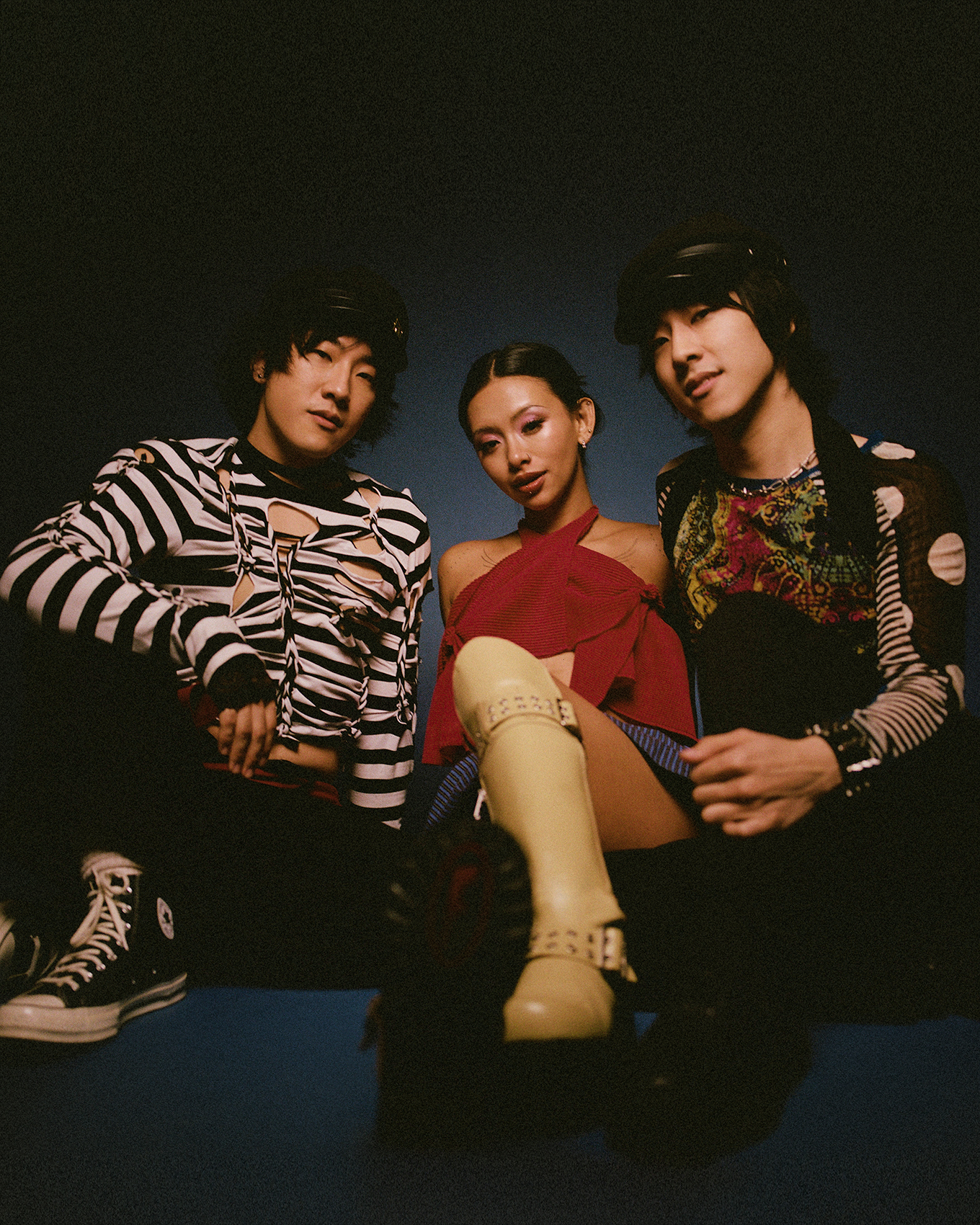
And who are your current on repeat artists or songs?
L: For me, it’s Justice, their self titled album from 2007. I think in a very positive way, I feel like every Indie electronica adjacent artist in 2026 wants to be Justice from 2007. So it still holds up like crazy.
G: Recently I’ve been playing two songs by Jim Legxacy over and over again, just because they make my brain feel good. Dexters phone call, there’s something about the way she [dexter in the newsagent] sings that is so beautiful. It just puts me in a very reflective mood.
M: Last night, I was listening to Paul McCartney and Wings, so I will always go back to that for sure.
Let’s finish off with a reflective question. Earlier you were saying how ‘romantic’ is a little different compared to your other songs — and it is a very good love track. So I was wondering what’s the best love advice you’ve given or you have received?
G: I was actually just thinking about this yesterday. I’ve had someone in my life for a few years now, where there’s romance involved, and I was thinking why I like him so much. I think I came to the conclusion that they’re very chalant, and I’m also chalant. And in dating, especially in New York, everyone’s extremely nonchalant sometimes, and I hate that. So my advice is be incredibly chalant, lean in, go for it. And then if it goes well, then it goes really well. And if it doesn’t, you get wrecked, and that’s okay. Because that’s just life, you got to fight through that and something beautiful is on the other side.
M: It’s become a meme to say that you read bell hooks to pretend to be something… but I think I read her writing as a 21 year old, and it did change the way I think about things. It put words to a lot of things that I was feeling as a young person, but it also helped me give language to express it to people that love is not just a sentiment, feeling or emotion, it’s not just a noun, but it’s a verb. And it includes so many things — being an active thing and something that you perform on a daily basis. And that requires intention, awareness, respect, accountability, honesty and openness. It’s really about how you are as a person to other people. Also bromance and love and these things can change over time. It doesn’t need to end where it started or not end, it’s about respect for another human being at the end of the day.
L: I would say to whoever’s reading that love is freedom. I would encourage anyone to think about, in a good way, melting the division between romantic and platonic love. Friendship to me is one of the highest forms of love. I don’t think romance is real or complete without that platonic friendship, you have to really actually like each other as people. And I don’t think that it’s healthy to have too many harsh expectations based on gender roles and whatever societal standards, just because you like each other romantically. The same decency, respect, kindness, and honesty that is a part of your most pure and loving platonic friendship should remain true for any romance that you’re experiencing. It’s a way to also protect yourself and protect the other person.
Words by Lora Lolev
Images courtesy of the artists