How to use the Jungian individuation arc to make album of the year
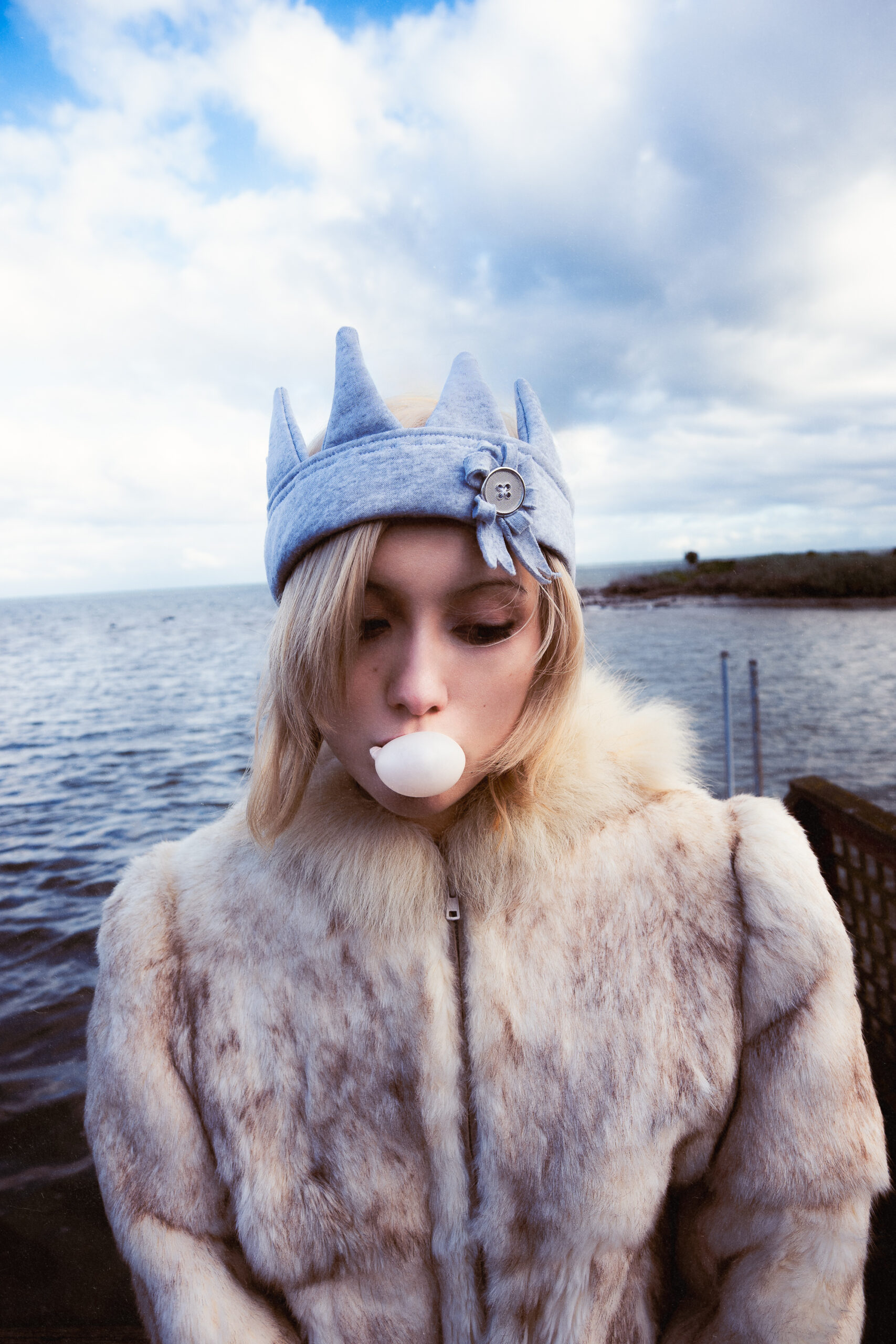
Photography by Piper Kennedy
If you’ve been on the internet over the last few years, chances are @d4ine is either on your playlists, or haunting your timeline as they seemingly know everyone and no one can figure out how (including themselves). Now with a leaping new sound reminiscent of simpler 2014 Tumblr-tinted indie pop times (think sunsets and Venice Beach obsessions), Daine is gearing up for their debut album, In Endless Awe & Agony. Active in the industry for over half a decade, autotune and full black looks are now exchanged for Jungian arcs, fabric crowns, and softer hues.
Having just wrapped up an Aussie tour with EDM royalty Ninajirachi and underground darling Lucy Bedroque, and carrying two mega-adored single releases under their belt in the past few months — PQC being dubbed Wasian anthem and song of the year (try competing with those) — Daine’s rising momentum is just the sweet build-up to this fall’s release. We got on a call with the pop star in between their tour dates, finally catching a break in their Melbourne home. We discussed the fun in feeling swept up in romance, their exploration of personas for a more fulfilled self, and how Melbourne is actually kind of like New York — but make that more utopian.

Hey Daine! You’re on tour right now, how’s that going?
Um, it’s good. I have a few rest days right now. I think I was running mostly off of adrenaline. I didn’t realise how tiring it was feeling… Oh my god, my dog is staring at me.
Awe, what’s her name?
Her name is Mika. She’s really old. I don’t know if she’s trying to tell me that she needs something… No, she’s fine.
So now you have a few days off, and then you’re going to Melbourne, right?
Yeah, so I’m back home in Melbourne for a few days before the show so I’m just resting. There’s so much adrenaline. I didn’t realise that when you pause, it’s actually like you’ve used way more energy than you think.
How do you slow down?
I really struggle with that. I’m just trying to go to sleep early, eat some healthy fats, some protein, and tea — always tea. I love matcha, but it’s caffeinated.
I believe you’ve been performing since you were 17-18, what’s the difference you’re seeing with your performances today compared to when you started playing live?
I think I’ve always been kind of awkward and clunky on stage. This year, I’ve really tried to get out of that and get a bit more confident because I was looking at performance videos from my European tour last year; my shoulders were rounded, it looked like I was afraid of people seeing me. So we got a movement coach before this tour, and I’ve been working really hard on being comfortable and connecting brain to body. It’s been really good, so I’ve definitely levelled up. It feels like a big jump.
Just knowing how to be on stage…
I didn’t realise it was so difficult, bro… I have so much more respect for all the pop girls even when they’re doing something that’s mid. It actually takes so much mental strength.
Let’s begin with PQC; it’s been receiving so much love. How has that response felt?
I kind of feel like this is the beginning, but it also feels like more love than I’ve ever received in my life… kind of. It’s both at once. I had a feeling it would resonate with people in this way, but at the same time I’m really surprised that my plan worked. [Soft laugh] I don’t know how that happened. I mean it took a lot of hard work, my label put in a lot of effort, and the product itself is really good — my producers, my mix engineer put a lot of thought into it. I think it was just right timing, and I feel really positive about it overall.
The song is also kind of dedicated to ‘recovering romantics.’ I’d love to know what that means for you?
It’s very easy to get swept up in a romantic spark without considering what you truly want in your life. And then when you wake up from your period of romantic limerence, you’re like, ‘Oh my God, what was I thinking!’ But it’s a really beautiful thing too. And I don’t regret it, and I hope it can be an embrace of being too much, feeling too much, and that it makes people feel better about themselves, to have a light-hearted attitude towards their entanglements.
Do you think we can stay recovering romantics forever, or do we let go that with experience?
I think most people are repeating the same patterns over and over, and it’s like, ‘Oh shit, here we go again.’ It keeps happening, and 99% of people are caught up in their patterns, it takes a lot of inner work and self-awareness to break from it. But I don’t even know if I’d want to be free from the pattern — it’s like the ups and downs that create the contrast, the experience and all those delicious things. Like where’s the next love at, let’s go!
I feel like the older we get, the less random-stranger crushes we get.
Yeah, like some guy at the mall working at the smoothie bar, and you’d get butterflies. I miss that energy! I hope that people can fantasise about their crushes in a wholesome, teenager-y way when listening to PQC.
And can you disclose what PQC stands for?
No. [Laughs] It was really stupid, we said it in the studio and everyone that worked on the song, they know what it means but it’s not leaving that room.
Fair. Now, to your second single Love Love (Love Love) is about balancing attention between the desire of isolation and the need of connection. Can you tell us more about the track and this tension between conflicting feelings?
I’m mostly writing from an intuitive place, I’m very direct. I just say whatever I’m feeling and thinking, and then I let it evolve naturally. But with this particular song, I was talking about my own experiences, thinking about how my best friend at the time would feel because I noticed that she would isolate more than me sometimes. I also noticed that both of us partake in behaviours that aren’t super healthy — we play along to fit in.
I think in a lot of social scenes nowadays, everyone has to play pretend a little bit. They have to pretend that being super skinny is super healthy, and that it feels great, it’s not stressing anyone out on the inside. Or how excessive partying, going out, and being super outgoing all the time feels great. But then the flip side of it is you feel lonely without it. I was kind of venting on how I feel about that dichotomy, and whether I can keep the mask of ‘I’m happy and I love being out and doing the things that everyone else is doing.’
It feels like this duality is already felt in the title of the album, In Endless Awe and Agony. What inspired you to finally do an album, and make it into something more cohesive for yourself?
I just had to get it done. I put it off for too long, I think I need to do things before I feel ready — I was never gonna feel ready to do it. But as for the title, that was just a thing that I had been saying for the last like two years when people asked me to explain my life, in like personal conversations or if I’m journaling. It’s the phrasing that I used to explain the constant intensity of how I experience reality is in endless awe and agony. On one hand I’m like, ‘Whoa, this is so amazing.’ And then on the other hand, it’s like, ‘Oh my god, this hurts so bad.’ So there’s this duality, and none of it is ever gonna last forever. The pain and wonder of it is so beautiful.
It can also be pretty reassuring to know nothing is permanent. I also read you were very inspired by Jung’s shadow integration and the individuation arc for the album. Can you tell us more about that?
So Jung is the father of modern psychiatry, and he based the archetypes off of astrology and tarot — two things that are a huge part of my life. And people will denounce those, and say it’s crazy, but then they believe in modern psychiatry. But it doesn’t make sense, like they’re using concepts that are based off what people consider mystic ones. I feel like they’re just psychoanalytic tools. So those are things that were at the forefront of my mind like when I was making the album. And Jung founded the concept of synchronicity, and that was another thing that sort of guided me along the path of making this album.
How did you apply this knowledge in your process?
[Daine shows me their notebook] So these were sort of all of the different aspects of self that were coming up at different stages of the creation of the album. On one hand, there’s the Machine side of me that I explore in tracks like White Collar and Product of Profit (P.O.P), and they’re linked to industry, ambition, ruthlessness, public persona, and social engineering. But then it also oscillates to the inner-animal, like primal urges and violence, then the inner child where there’s fear, joy, play, and loneliness. When you integrate all of those, there’s a purity to it, you can sort of see the self fully witnessing itself through a creative expression.
Jung believed that the most dangerous type of person was someone who was creatively blocked, because then they’re not able to have a full picture of themselves and their urges. They’ll be controlled by the subconscious forces, because art is the only way to become aware of those. So it’s a healing tool, basically. First and foremost, it was something that fixed me, it healed me in a really big way.
Did this inner-work prompt the album, or what is more the other way around?
I think I was just intuitively saying shit, and then I was looking at it and I was like, ‘Wait, there’s these different voices popping up.’ This is lowkey a Jungian individuation — unintentionally.
Talking about people being creatively blocked, what was it like for you growing up? Were you always in a musical tangent, or did you find that path later on?
I really didn’t sing until I was 15, and then I don’t think I showed people until I was 16 — and that was with autotune turned all the way up. I got like bullied pretty young — I never was really shy — but I was very self-conscious for most of my life, and I only really feel like this year I’ve been like, ‘I don’t give a fuck, look at me.’
You also fully dropped autotune with this record — was it a way of dropping a mask? It feels like with our generation and growing up on social media specifically, there’s this constant thought about our online personas, more than in reality, and there’s this high awareness of being perceived.
For sure, I see that around a lot. Our digital identities are something that people care about so much. Using autotune was definitely this thing I was using to hide myself a little bit, I was scared that people would find out that I don’t know how to sing. But now I don’t care if I don’t sing that well and people can hear that. Like my job is not to be good at singing, but to express myself and make art that I enjoy, and that maybe other people can enjoy. You don’t have to be a pitch perfect singer, and you don’t have to be a professional anything to be a musician — you’re an artist, it’s as objective as with sports. Like if you want to be technically proficient in something, go play a fucking sport. We’re not being graded on technical skill.
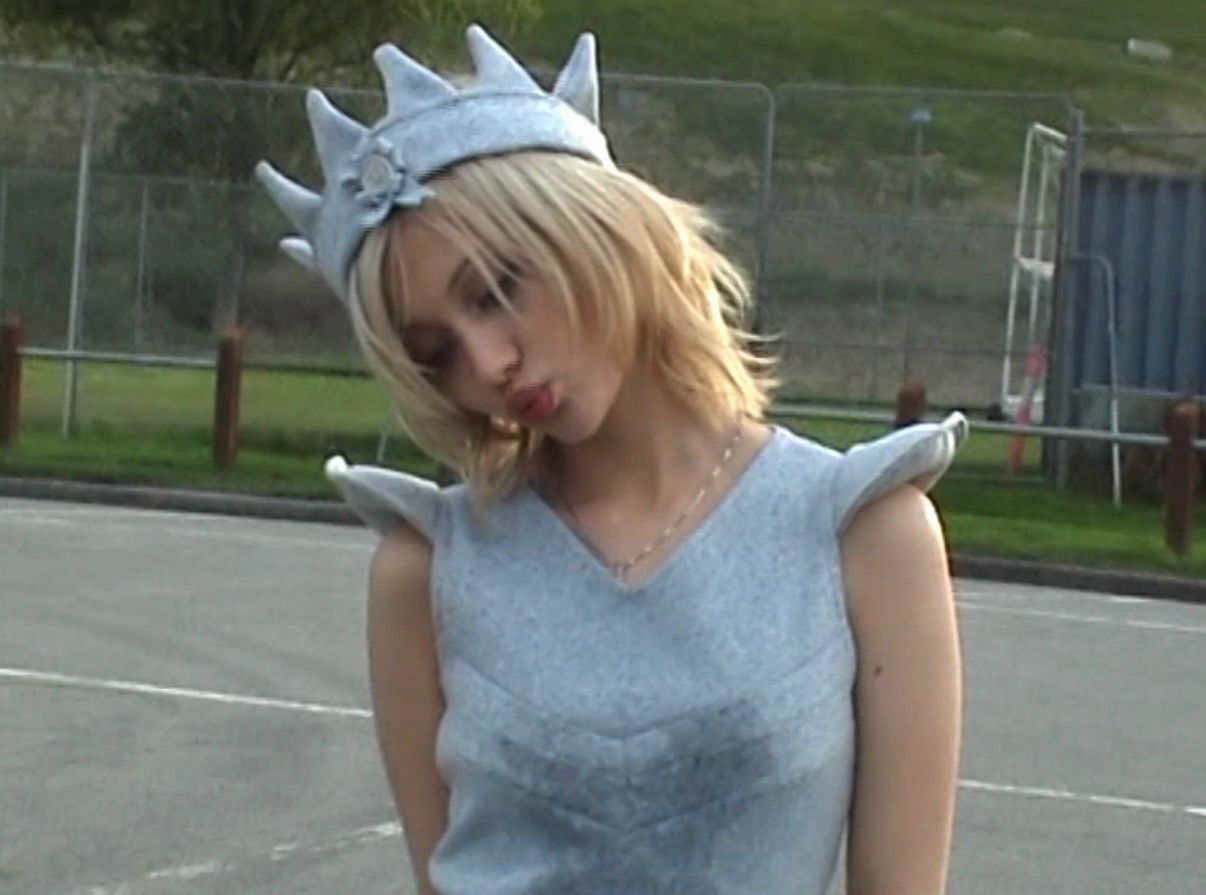
Were there any visual queues or fashion-elements you were gravitating towards more for In Endless Awe & Agony?
Well, I think with my previous eras, I was in a lot of all black. I didn’t do this on purpose, but I just started wearing way more colour. I really like grey now, and I really like crowns — made of fabric or metal. But the symbolism of a crown is so cute. I think the look is a little bit varsity, a little twee — but not too twee. It’s just really cute and fun, which is a big contrast from my previous looks. They felt a lot darker, and now we’re in wholesome territory.
Do you think that being on tour, you’ve been able to experiment way more in terms of style?
Oh yeah, I’ve gotten a few different stylists throughout the tour. And they’ve all put me in quite different looks, but that are all still sort of in the same universe. And oh my God, I have a fitting tonight! We’re putting on these two Australian brands that I really love — Maroske Peech and Emily Watson. There are so many pastel colours and just fun, itty bitty silhouettes.
Who are your all-time biggest music inspirations?
I feel like none of what I really loved growing up is applicable to my sound. I think the word inspiration should be used kind of loosely. I really loved Title Fight and Alex G growing up, and a lot of emo bands like American Football, I Hate Myself, and Texas Is The Reason. But I guess that influenced how direct I am, and kind of corny. I don’t know how obvious the connection is there, and I still love all that stuff.
I’d love to know more about Melbourne-lore. Can you let us in on some of it?
It’s like New York, but way better. [Soft laugh] I don’t know, it’s like a utopian New York-vibe. There’s a little bit of tall poppy syndrome here, and people can be a bit blunt or rude, but
I feel like overall my experience has been really supportive. And it’s just an amazing city to live in, there’s so much to do like it’s a huge vibrant city. I don’t know why people don’t talk about it more — I’m not just saying that because it’s my hometown — and I thought that Melbourne sucked, and I moved away, I was like, ‘Fuck this, I want to live in America.’ It really does not compare — Melbourne is amazing. I had to go away to realise.
Do you think that leaving abroad made you appreciate its artistic scene more?
1tbsp is from here, I think Nina still lives here, Mallrat lives here, and there’s a lot of small artists. And there’s a lot of small artists coming up here as well. I think it’s taken the industry in Australia a long time to come around to it, but I think me and Nina, in particular, have torn down a lot of barriers for that because we’ve gained an audience internationally. And no Australian artists really have done that in a really long time. I guess if we go back to the early 2010s, there was a wave of Australian EDM DJs that made it internationally. Gen Z has had nobody. We’ve had like no heroes coming out of Australia. But now we do.
Before we wrap this up, who are your all-time biggest music inspirations?
I feel like none of what I really loved growing up is applicable to my sound. I think the word inspiration should be used kind of loosely. I really loved Title Fight and Alex G growing up, and a lot of emo bands like American Football, I Hate Myself, and Texas Is The Reason. But I guess that influenced how direct I am, and kind of corny. I don’t know how obvious the connection is there, and I still love all that stuff.
Words by Lora Lolev
Images courtesy of the artist