For the Persian artist, music is memory and protest.

NAVA, the Milan-based, Tehran-born artist and DJ, is quick-witted, expressive, and completely present — the kind of person who speaks with her whole body, not just her voice. She’s a storming storyteller, a conductor of everything she’s lived and everything she’s fighting for. Three years after Mahsa Amini’s death sparked the Women, Life, Freedom movement, that urgency has only sharpened.
Her new album, GABBEH, takes its name from the handwoven carpets made by Iran’s Ghashgha’i tribes — pieces built thread by thread, each detail shaped by the maker’s daily life. NAVA works the same way. She builds the record from the raw materials of her own world: colours, rituals, fragments of memory, field recordings sent from protests in Iran — all taut tightly over electronic grit and textural hyperpop sonics. In celebration of the release, we caught up with NAVA to dive into her inspirations, collaborating with Loraine James, and her must-know names defining the Iranian underground scene right now.

Fun to catch you mid-rehearsal! How are you feeling?
Today is jitters mixed with coffee. We started the day doing a lot of the technical part of the rehearsals. We have real instruments, and then we also have a lot of things happening on three computers playing at once. For me, it is actually the easiest because I’m in my little booth with my in-ear monitors, like, “Yeah, I don’t hear this”, but for the guys who play with me, I think they’re like growing older and losing hair.
Aging in real time.
Exactly. At least they’re off the hook for other parts, like the choreo and the outfits. But yeah, it’s interesting singing the songs for the first time with the live musicians, and I love how they’ve like added their own touch and quirks to it. It’s becoming an experience.
It’s getting a new life! Do you have a lot of performances lined up after Line Check?
So at the moment, no. In fact, that is what is the hardest part in the music industry right now, finding gigs that are in line with our vision.
I imagine it’s really hard to navigate in the current climate, both artistically but also ethically.
Exactly. Also, as a vegetarian. I don’t know if you’ve noticed what Billie Eilish was doing during her tours. Everything was vegan; it’s a whole statement. It’s really hard to find gigs that are aligned with you and share your values, but I’ve been lucky. I’ve also done this Asia tour where I met so many underground queer communities, like in China, and it was just such a breath of fresh air.
Tell me more about Gabbeh!
This album is my first album because I’ve only done EPs up until now. It was only meant to be four tracks, but then one of my dear friends, who co-wrote this whole album with me, Erio, came to visit Milan once during the summer. We were struggling, trying to figure out this song called Kashan, which is the name of a city in Iran. I was just telling him about how I envisioned it while he sat at the piano and started writing these melodies. It was just a burst of creativity. It was me, Erio, and the producer Fabio Lombardi. We started producing track after track; instead of four, we had nine. I think it’s also because of the political period that I’m coming out of with Iran. I’m not able to go back very easily since it’s kind of risky for me, just being away from home and seeing everything on the news and on social media. It’s scary — you see stuff, you read stuff, and then you call your friends who live there, and you can’t even contact them. Or you call them, and they’re like, “No, everything is okay”, and you wonder if it really is okay or if they just say this because they don’t want you to worry. The only thing that actually helped me out was writing all of this down in my journal and on my notes app, and putting it into music.
I’m sure it’s also a two-way thing, in the sense that making music as an outlet helps you process these feelings, but also uplifts your loved ones who are still in Iran.
I always have the thought of, like, “What if something happens to a loved one that lives there, and I can’t go back? Or what if a war breaks out? How’s everybody going to get out?” Especially because the Internet is the first thing that’s cut off, because they don’t want the outside world to see what’s going on. So, already raising awareness regarding these issues has made me feel so much better, and it has given me hope. So many things are happening in the world, and I want to make sure that our stories are not lost or forgotten. I want people to remember that in Iran, women are exercising their rights to freedom every single day with every single thing they do, like going outside without their veil, riding a bicycle, playing a guitar. Everything and anything is a political rebellion. I really wanted to shed light on that because so many people have been imprisoned and killed. I have the freedom to speak about it and make it heard, and I really need to do my part to raise awareness.
And music is such a beautiful outlet for that — Gabbeh does such an impressive job at both raising awareness ‘factually’, but also emotionally.
When making FIRE with Loraine James, I really had this in mind. I really wanted to do this track with Loraine because I also feel like they are a very sensitive artist. I’ve also seen them perform a lot of times, and it was like a wall of emotion just thrown at you, which is the sensibility that I really wanted on FIRE. I was so lucky that they said yes and were really into it as well. Their music really takes you on a trip.
What are the deeper inspirations behind Gabbeh?
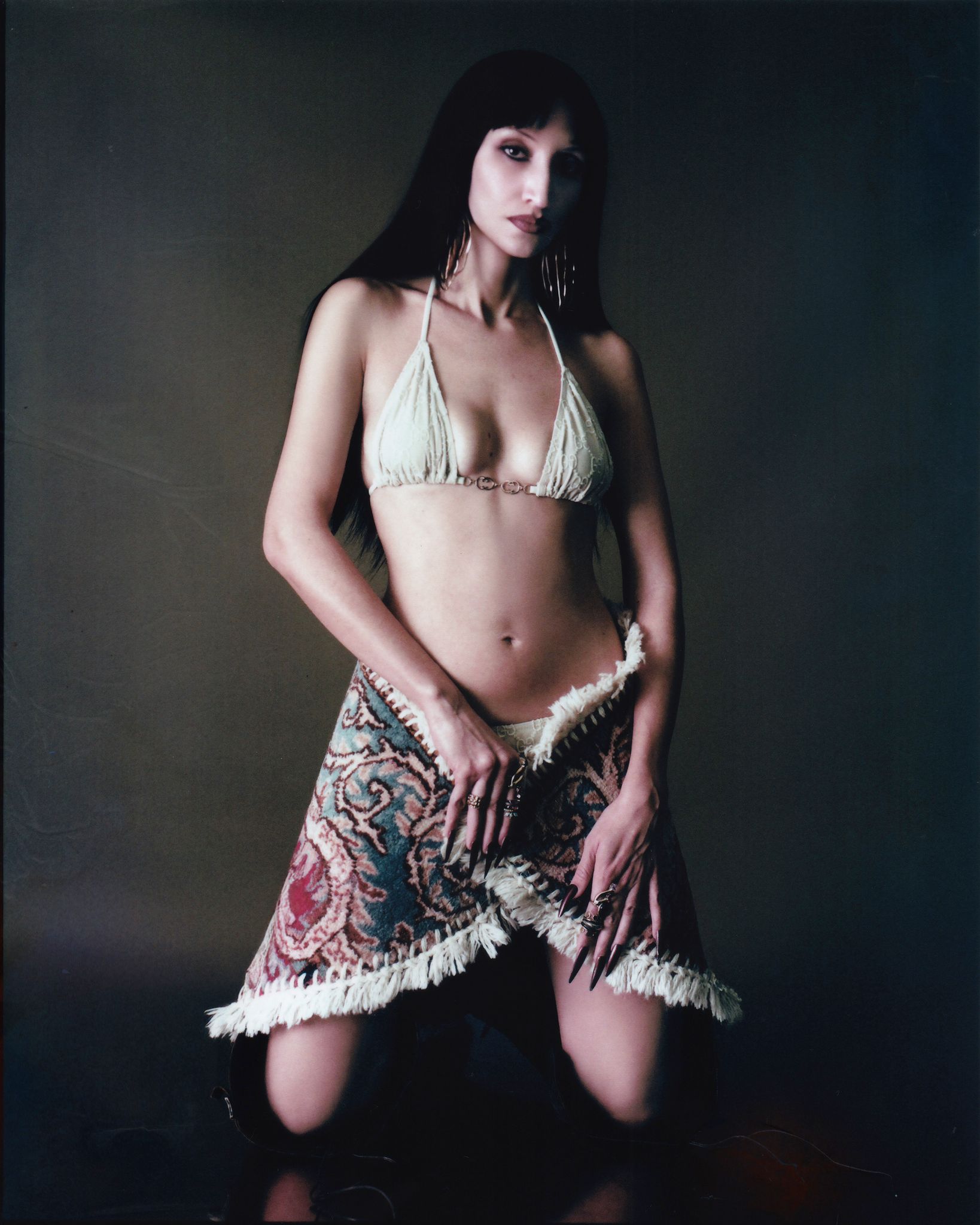
This album had a very clear vision board because I really wanted to mix the visual world and sonic story. After all, the whole concept of Gabbeh is through the nomadic Ghashgha’i tribes that live in Iran. They travel with the herd of their sheep, so they make their living through producing Gabbehs, which are these traditional Persian carpets that the women of the Ghashgha’i tribes weave. They use them as a kind of diary, because every single knot is done in a different form. Through this, they recall what they’ve been going through, what has happened. It’s like their visual journal. And that is what I wanted to do with this album, for it to be my sonic diary. I also wanted to take from the locations they visit. All these colours of the Gabbeh are from organic dyes that they find on their travels. For example, in Iran, we have this tiny island in the south called Hormuz, which has this insane red sand. I really wanted to bring that into the colour board. I feel like that’s kind of my way of giving an homage to Iran and all the 17 years that I’ve lived there. Roots go really deep, and they sometimes also break cement and concrete.
Beautiful! And can you tell me more about your visual identity? It’s such a distinct futuristic approach.
I’ve been very lucky because, as I have my musical family, I also have the visual family that has been with me for the past five years now. We started with photography with Matteo Stocchia and Marco Servina, but they also do my hair and makeup. When I go on stage, it’s a whole transformation. I turn into an alter ego.
Who is she?
I love turning into the alter ego that’s brave and courageous. It gives me hope, which is what I want to give to whoever sees me. In Iran, growing up, I didn’t really have a Persian role model. Now there’s Sevdaliza, but back in the day, we really didn’t have that kind of reference. It was a lot of Western singers who gave me confidence. I really wanted to break these barriers because I was lucky enough to come from a family that didn’t limit me and was very open-minded. As for photography, I wanted to mix analogue with digital through the 3D works of Karol Swidolski, who does all the visuals for my concerts. The photos are all analogue at the bottom, and then on top, they have done all the 3D work, which is quite insane.
So cool.
Yeah, I’ve been blessed with this team. It’s very important to find your people who understand you and are kind of as crazy as you when it comes to trying stuff and don’t really hold back. I remember for my visual EP Bloom, we were on a frozen lake with a little wooden boat that we made, like, “Let’s freaking do this.” I think those are the only people who would say yes to me.
Love that! I want to know more about the underground scene in Iran. Do you feel like there may be certain misconceptions or things that the outside world doesn’t know?
I don’t think the outside world knows that there’s a huge rap scene in Iran, especially girls, like insanely talented girl rappers that are just really blowing up the underground scene. What is really interesting lately is that a lot of people are organising these concerts that previously were in parking lots or garages. But now everybody’s — mind you, the courage of the Persians is just insane — started performing them in front of a lot of famous historical monuments secretly. It’s so cool because they mix the historical heritage that we have with what Iran is right now. We have this square in Iran that’s called Azadi Square, which means the square of freedom. And you see high school kids going there and playing their guitars, girls without their hijabs. There was this girl, Parastoo Ahmadi, who got arrested for a concert. From the outside, you really wouldn’t think that this would ever happen. But there’s a huge support system; if the police come, people try to block them. Music is a revolutionary and rebellious movement that is really keeping this going, I’d say.
And who are some of your favourite artists? Educate us!
Brenda Torosian, Atour, Tlkhoon, Dorcci should be on your radar!
Words by Evita Shrestha
Images courtesy of the artist