“Music is the only way to describe myself, to be me”
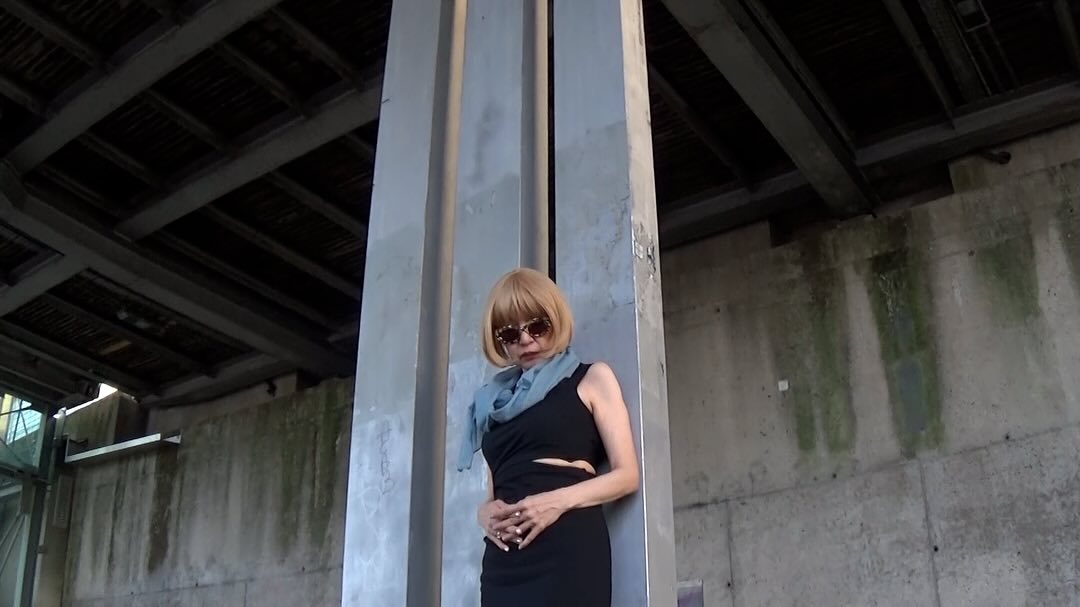
Whether we should bid thanks to the music-savvy crevices of the internet or the persistent reverence for 90s undercurrents, a treasure emerged – the longing, romantic preoccupations of the Japanese musician and DJ POiSON GiRL FRiEND saw a curious revival, resurfacing on our screens and in our local record stores. Noriko’s tender musings, overlaid with violins and synths, are as compelling today as when they first populated the small ambient music bars in Japan in the late 90s. While DJing dominated her early music career, her whispering, lurid vocals eventually found its way into her own music production under her now most well-known alias as POiSON GiRL FRiEND.
Seemingly embodying the Gen X soft club energy, her music coos to us with throbbing hearts – transporting us up to the fluorescent lights of Tokyo night cityscapes, of sitting in a smoke-filled bar, searching for the familiar face we hold dear amidst a sea of black coats. It is no surprise, then, that yearners (including her now-collaborators Sega Bodega and Eartheater) gravitated towards her universe. Her dreamy vocals wander and reminisce over electronic basslines, the down-tempo sensuality of trip-hop and symphonic splendour – all akin to a musical rendition of Wong Kar-Wai movies, if not more aching.
During our entire call, she’s holding two conversations simultaneously, answering our questions with simple honesty on one hand, and on the other, responding to the meows of her cat, with equal tenderness – and their own language. Long stretches of silence seem not to phase her, and she takes her time to choose her words carefully. Somewhat reclusive, often seated in silence and with strong proclivity for the company and communication with her cat, Noriko keeps her cards close to her chest. Her shyness makes her seem tentative, but her music lays bare a raw candour, recounting the love she has to give and the love she longs to receive – a universal experience she equates to transgenerational closeness.
Hi! How are you today?
I’m a bit sleepy. It’s past dinner time, so it’s about time.
I won’t keep you for too long! Let’s start at the beginning – what were your first memories of music, and when do you remember feeling a connection to it?
Music has always been a very natural thing for me. I’m constantly listening to music, so I didn’t view it as anything special, just my natural way of being. I always have some music in my mind and heart.
Having moved around so much, from Tokyo to Rio and London, how have these diverse cultural landscapes shaped your musical identity?
My experience in Rio de Janeiro gave me a strong sense of freedom. I was surprised when I entered a Japanese school and discovered there was a rule forbidding students from buying sweets on the way to and from school. In Brazil, I had been free to buy sweets at any time on my way – such a small thing, but it highlighted a deeper cultural difference. In London, I felt at ease because no one gave me curious looks when I walked down the street dressed a bit flamboyantly. Forty years ago in Japan, there were very few foreigners, and people would often stare at anyone who looked even slightly different. Today, with many more foreigners living in Japan, that atmosphere has shifted somewhat. That sense of being able to express myself freely – visually and culturally – has definitely influenced the way I approach music and performance.
Professionally, you started your career with DJing first. How did this foster your love for music?
One of my DJ friends suggested I try lounge DJing at a café bar, since I had listened to so many different kinds of music, including French music and bossa nova. I ended up DJing four nights a week, and I think it really trained my ear. With DJing, you have to listen deeply and select tracks with a sense of timing, which you then play repeatedly. That made me realise that when you make music, you’re not listening to music as much, because it is made of time, and time has its limits. And so, musicians focus more on playing their music, rather than listening. I made a lot of friends through DJing and was surprised to find that many of them loved music even more passionately than musicians themselves.
It’s a refreshing perspective to hear, especially from someone who is both a musician and a DJ. I feel like DJing has become so accessible that people forget that to do it well you actually need a really well-trained ear and a deep understanding of music. When you started DJing, what was the music and club scene like?
I started around the 90s, and there were lots of genres populating the scene. At the time, I really loved techno music, house, and a little new wave. I started my DJing as a lounge DJ at bars and cafes, and used to play relaxing, ambient music, not necessarily dance music. I really loved the club culture for young people at the time. You felt a sense of belonging at the club, and everyone was very friendly. I was just happy with creating and playing music for people that I loved. It felt like a team; everyone was in sync.
You often mention your deep love for London’s club culture specifically. Can you tell me more about it?
I loved the club scene in London because you could go alone, hang out, and no one would care – it felt completely natural. What really captivated me was the sense of freedom: we weren’t bound by any single rule, whether in music or fashion. One moment that left a lasting impression was when house music suddenly started playing at a New Wave party – the excitement of that unexpected moment is something I’ll never forget.
And what inspired you to make your own music?
Music is the only way to describe myself, to be me. I don’t really have any hobbies like painting or driving; it’s always been music. It’s just what I am. Making my own music was very difficult at first since I didn’t have a band or equipment, but I just had to believe in myself and my choice, as that was my form of self-expression.
What was it like to put out music in the ’90s that was so different from anything that existed before? What are some of the challenges that you faced, for example, during the creation of Melting Moment?
At the time I created the Melting Moment, I didn’t have a lover. I thought I would live all on my own, and so I was feeling very alone at the time.

I love your stage name and the distinctive typography of it. What’s the story behind this stylisation? And more broadly, what is the story behind the name itself?
I’ve always been interested in fonts and graphics. Before computers, I liked using typewriters. I’m not very good at drawing or writing, but I enjoyed putting letters together with my favourite drawings and photos. That’s why I always made my own flyers for shows. The name POiSON GiRL FRiEND comes from the title of an album by the Scottish musician Momus. The band I made in high school was called CUL DE SAC, but the members changed all the time. In the end, I was the only original member left, so I thought it was time to find a new name. At that time, all the backing members were boys, so I had an idea – maybe “nOrikO and the POISON BOY FRIENDS.” But it felt too long, so I changed it to “The POiSON GiRL FRiEND.” I think because I have a little bit of poison for everyone.
How do you view the relationship between your artist name and yourself? How has your music grown along with this dynamic?
Sometimes I pretend to be POiSON GiRL FRiEND because if I don’t step into that character, I just feel very shy. As POiSON GiRL FRiEND, I try to be more forward, but I’m not overly confident. I’m still kind of shy, and I wouldn’t say I’m that interesting in my private life. When I create music, I also want there to be some room for change. But when I create under the name of POiSON GiRL FRiEND, I feel like I can’t change too much. There are certain rules I’ve made for that music, rules I created myself.
What are some of the qualities you embody with POiSON GiRL FRiEND?
In my private life, I’m a pretty boring person. I don’t really know how to say things beautifully or charmingly. When I do speak, it sometimes comes out as something negative or not very nice, so I don’t speak much.
What negative things do you have to say?
I’m always saying things like, “Oh yeah, no, I don’t care”, that sort of thing. So I mainly talk to my cat [imitates cat sounds], which is very interesting to me.
Your sound is like that of a siren – something that is soft and very alluring. It transfixes you and pulls you closer. That’s the kind of feeling I get. How would you describe your music?
You’re too sweet. I don’t really have words to describe it. I’m very much a wordless person, and especially now, as I’m always just talking to my cat.
Where do you find words for your lyrics as a self-proclaimed wordless person?
I used to see everything in absolutes, in black or white. But now I think I’m starting to see the grey in between. Still, I can’t help it. I always go back to thinking in black and white. It’s like an obsession. So, “you love me or you hate me” type of thing.
Love is such a prevalent topic in a lot of your songs. There’s this longing in your music, but it’s also subversive. What is the meaning of love for you, from your album Love Me, to your name?
Love isn’t just about the relationships between boys or girls or just between human beings. Love has many different meanings. It’s not about love affairs, it’s about humanity. If you’re always being loved by someone, I think that in itself is a kind of reward. So I stay longing, feeling for love.
You have a few shows coming up, how do you feel about performing live now?
I’m still very shy about performing, but I’m also very happy. Lots of young people come to see me, and that’s amazing, so I’ll do my best. Until now, I’ve rarely performed live in Japan. I was very shy and didn’t want to sing or speak in front of people. I’m still shy, so I’m not really thinking about doing shows in Japan. In general, Japanese audiences expect female singers to be young and idol-like, and I’ve always felt a gap between what I want to do and what I feel is expected of me. When it comes to making music, I often judge my own ideas quite harshly. I think that’s because, deep down, I’ve always seen myself more as a DJ and a producer than a performer. I truly believe that a professional musician can bring out a more beautiful sound on an instrument than I could myself. That’s why making an album takes a lot of time for me – it’s a slow process. But I do hope to complete a new one by next year.
We hope so too! And it is true that a lot of young people are gravitating towards your music. Why do you think younger generations are feeling a connection to your work?
It happened in a way that no one expected. At first, I thought it might be part of a ’90s revival – or maybe influenced by the popularity of Japanese ’80s music in Southeast Asia, especially in Indonesia. But what I found really interesting was that my fans didn’t seem to be affected by those trends. They didn’t care where I was from, or whether I was from an older generation. That kind of openness really surprised me – in a good way. I’m just very surprised because I think I’m your parents’ age. I’m not a good mother. Maybe your mother is better than me. So please be kind to your mother. I think she needs your help. Mothers need their children’s help and warm hearts.
Do you have children yourself?
No, just a cat.
That counts. And by the looks (and sounds) of it, you’re being a great mother.
Thank you.
You’ve also collaborated with artists like Sega Bodega and Mayah Alkhateri on “So Many Ways”. How do you approach cross-generational collaborations?
I don’t think young people’s minds have changed that much across generations. I’m just a hopeless adult who grew up as a child, so I don’t really feel a gap between us. Interestingly, many of the musicians I had been listening to turned out to be fans of my music too. Around the time of COVID, I often listened to Sega Bodega’s album Salvador on Spotify – so I was surprised, as if by coincidence, when he reached out to me. It was the same with Eartheater. I met her recently in Paris, and she told me she was a fan as well. I had loved her music too. People often say I’m more of a musician’s musician – I’m not widely popular, but other musicians seem to find me.
On a final note – how do you think all of us can keep this spirit of youth and stay a child even when we grow up?
I’m not sure, but I’m always trying to be spontaneous in everything I do. That’s also just the way I am. It’s a human quality to keep changing, even though you might believe that you’re not evolving when you’re younger. So it’s good to change course sometimes, if you have the chance.
Words by Evita Shrestha and Sharon Calistus
Photography by Jacqueline de Gorter