“You don’t have to alter your personality to be serious about your art.”
A discography only proves itself when it can survive the room, moving beyond simple translation and generating a distinct atmosphere you can feel settling around you. At Rewire Festival, Purelink conjured a thick, low-hanging cloud that moved tangibly through the crowd. The hall stayed full but hushed, people standing with tree-like fixed composure or gathered on the steps like fallen flies, pacified by a shared lull. The only logical thing was to follow suit: stay still, dissolve, close my eyes and observe the colours that start to flicker beyond my visible range.
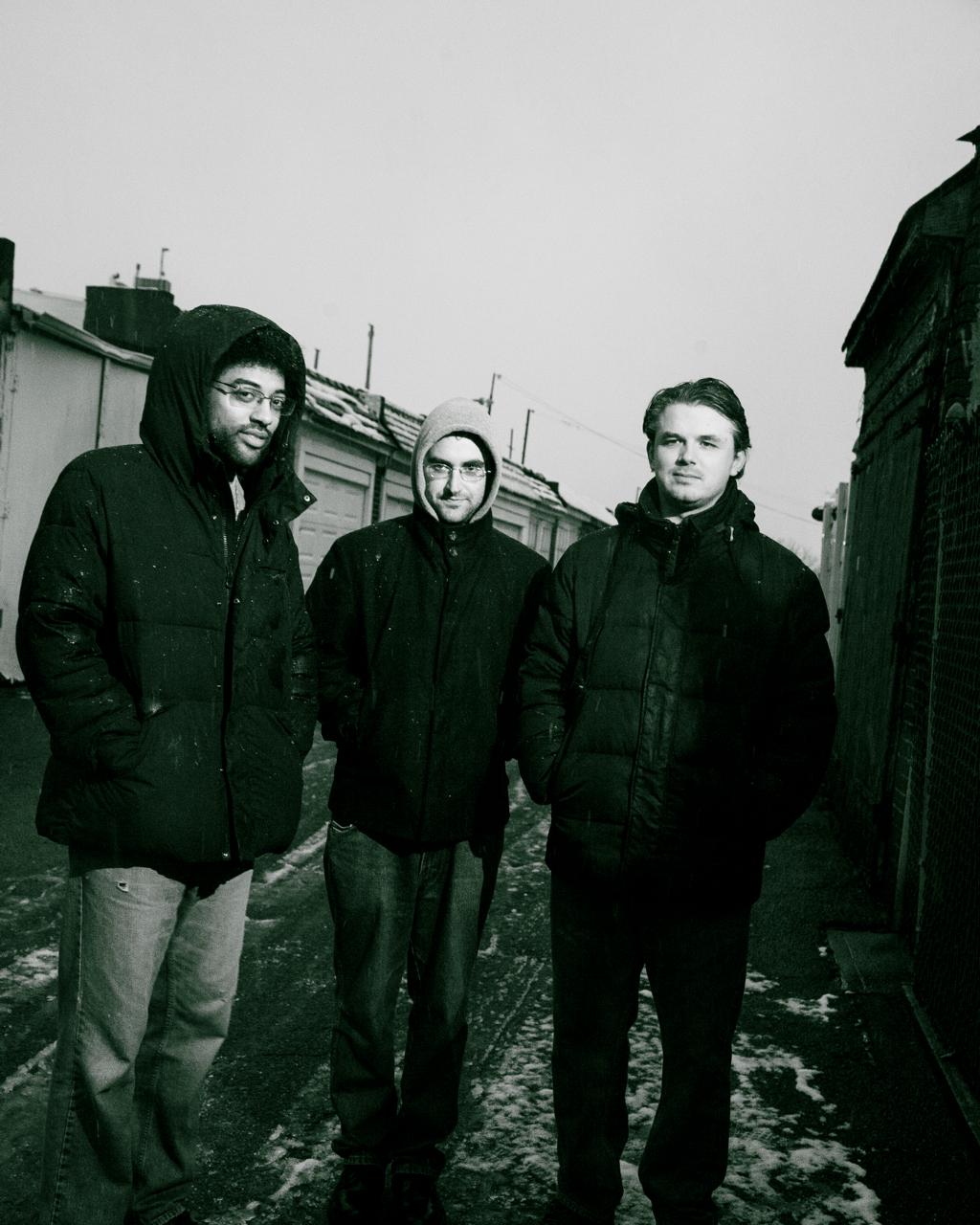
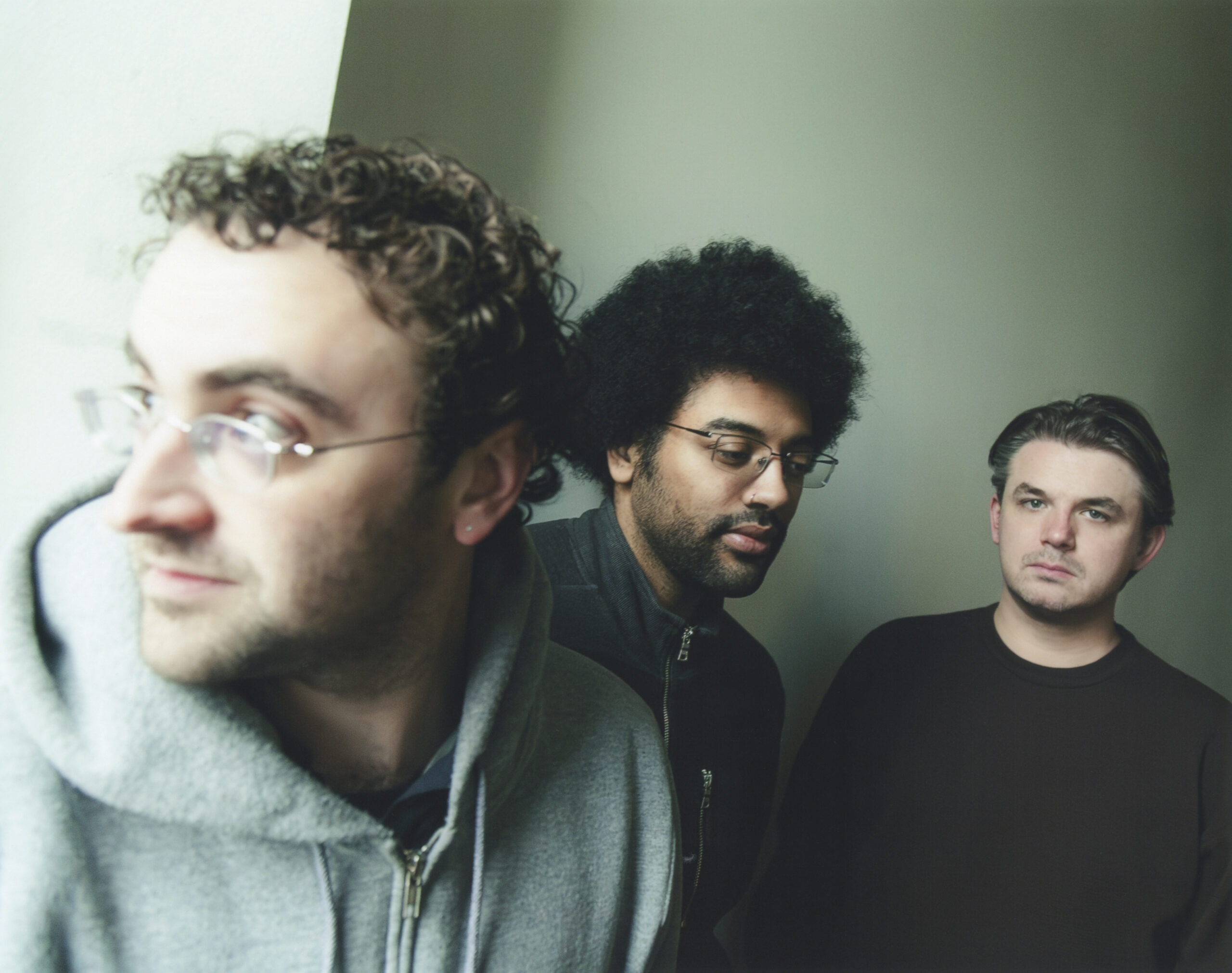
The NYC-based trio, consisting of Ben Paulson, Tommy Paslaski, and Akeem Asani, are known for a sound that spills over into different crevices of ambient, trickling into dub or IDM territories. It’s unmistakably digital, that soft haze intact, but threaded with faint, almost worn-down traces of acoustic structures. Their tracks carry an elemental density that deepens with each interaction, with details tucked away, small easter eggs embedded in titles and in the internal, almost atomic structure of their sound itself. Live, the compositions loosen and start to glow differently, dubbed-out and echoed into a neo-classical, drone-driven mist. It becomes this ambient rainforest: humid, overgrown, everything feeding into everything else. You don’t really know which sound comes from where, or who’s responsible for what.
Ultimately, at the core of Purelink is a deep friendship and trust — something that both enables and emerges from working in the same file for an inconceivable amount of hours on end (their name comes from Ableton’s feature, which syncs tempo and phase across multiple devices). In a strange way, there’s a spirit of a boy band here, but stripped of ego or attachment to an instrument. It’s three people dissolving into abstract ambient layering, bringing their unique personalities into full cooperation. And when they do pick up instruments onstage, this synergy blooms even in a more mesmerising way. Catching up the day after their show, we spend a bright, unhurried afternoon in The Hague talking about process, Midwestern roots, and a shared affection for cinema (particularly the bad kind).
Nice to meet you all! How are you feeling after the show? What’s the vibe?
Tommy: We feel really good.
Ben: Yeah, the show went really well. This is our second time performing with Mika Oki — last time was at Berlin Atonal in the fall, and that show was incredible. We anticipated this would feel the same, and it did.
Akeem: First time performing with Angelina Nonaj.
Ben: Yeah, Angelina was on our last record. We also made a new piece that we ended the set with — a newer vibe for us, with guitars and live percussion. It was really fun to try out, and we’re pretty much premiering it this week.
How does it feel to bring external people into your very well-formed dynamic?
Tommy: It feels great. Mika Oki is really easy to work with and has her craft down. After playing with her last year, we were excited to show it to more people.
Akeem: We’re in different mediums — she’s doing lights and visuals, we’re on audio — but we approach things similarly. She has a strong vision and executes it really well.
Ben: Angelina is a good friend of ours. It was fun to flesh out this new sound — it came organically, talking and working remotely over a month. It felt more live than we’re used to. This is the first set of shows where we focused on playing instruments — I was on guitar, Tommy on this electric bowed string instrument, Akeem on live percussion. It was new and exciting, and bringing in Angelina on vocals got us closer to a real band, rather than an electronic trio with computers.
Akeem: It gave us more room to improvise and go deeper in the dynamics. We’re laptop-centered at the core, so it’s nice to expand beyond that.
Ben: We use instrumentation a lot in the studio. Figuring out how to bring it into the live set has been slow, but this time we just dove in and centered it more.
Akeem: This is also our first extended tour, and we wanted to bring a fresh sound that’s fun for us to play live. Taking it to different places and seeing people’s reactions has been really nice. A lot of it is new, so we’re trying to see what works, what doesn’t — and we’ll take that back to the studio.
Ben: First time I ever sang on a few tracks, too — scary, but cool. We’re trying a bunch of different things, expanding our sound into areas we enjoy.
Tommy: We’re inspired by a lot, so we’re trying to incorporate that into the new set. It’s fun to show people what we’re into and what’s possible with our sound.
Ben: Also, there are a bunch of stems on the computers that are collaborations with friends back home, which we might explore on an upcoming release. It was exciting to share this grander idea of collaboration this time around.
Tommy: Each record has gotten more collaborative, and we’re gearing up for even more on the next one — and more live instrumentation. The progression feels natural.
Akeem: And hearing it in these rooms and on these systems, with really attentive audiences has been very nice.
What was it like incorporating live instrumentation on stage versus in the studio? It felt like an entirely different experience of your discography.
Tommy: We definitely do it in our recorded practice a lot already. We don’t fancy ourselves too much of live instrumentalists, but we’ve done it in the past, and want to get more confident in that. And each show’s gotten better on the tour, and we feel more comfortable improvising.
Akeem: I feel really good about last night’s show. We were all really locked in.
Ben: In the studio, it’s fun to try different things with live instrumentation. You can capture these little moments that fit nicely into the composition. I love really clean tones and keeping them. But then again, you can sample it in a way that still has that clean texture, but may rearrange the sound in a different manner than you physically could do on an instrument — we try to use all of that. And live, you can play the same material differently — if you’re in a big room, you can go full epic with it, or you can cater to a more relaxed, or softer, quieter vibe for different contexts. That’s been the funnest part, to be able to dynamically represent our music in the context of the space that we’re in.
Tommy: Earlier in our career, we were just sampling a lot of different stuff, like pre-recorded music from other artists. There’s a world of possibilities with that, but it’s a bit more rewarding when you’re performing yourself, or just catching sounds that you make on your own. Using that as the raw material to work with just makes it more fun and personal.
It was funny because I actually didn’t realise you were playing live until the very end. The venue was packed, I was upstairs and there was a line of people just sitting with their heads down, eyes closed. I felt a certain pressure to join and was like, “I guess I don’t need to see anything, I’m just gonna close my eyes and listen.” I looked up when Anjelina stepped on, and you all looked like some angelic apparitions.
Ben: We encourage the deep listening aspect. It’s something we find in Europe happens a lot, where people are maybe more attuned to that than in America. We feel fortunate to be able to catch that with our music, and people seem to really resonate out here with that, so it’s nice.
Akeem: The crowds in Europe are awesome. It’s nice to have attentive listeners at the shows, and people are really enthusiastic about it — not to say we don’t have that in the States, but I think it’s more common here that we have a really engaged crowd. And that’s been something that I really appreciate.
Ben: Just the fact that it’s a festival, and people pay a lot of money, and they’re like here to see the music and really engage with it, which is cool and refreshing.
Akeem: That room we played in was so big. I was like, “ they’re letting us play here, it’s crazy.”
Tommy: But honestly, if someone fell asleep during our set, I would take it as a compliment.
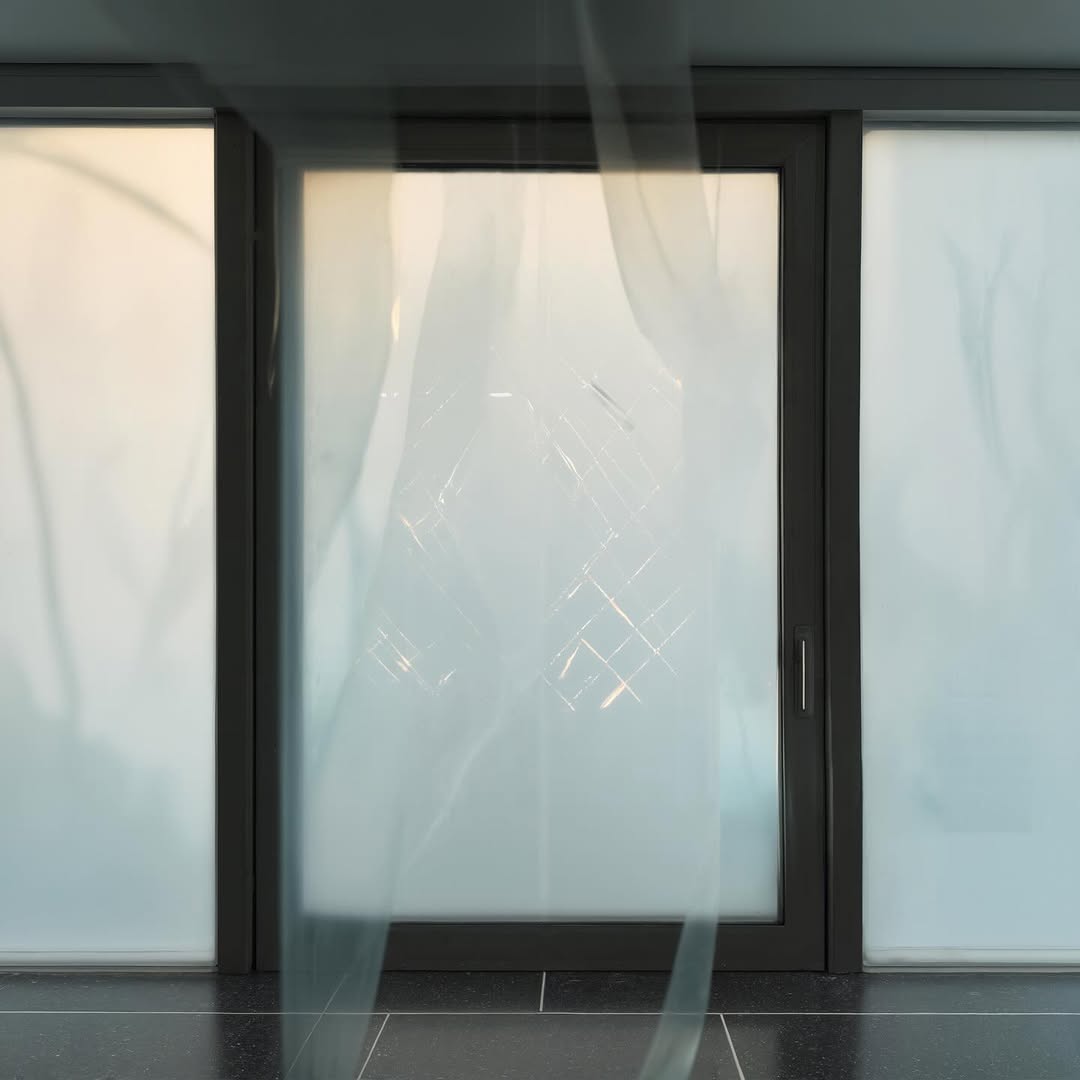
Cover art of ‘Faith’ (2025) by Ezra Miller
I feel like I hear that quite often (I love a public nap, so I fully support it). One of the most special features I’ve done was with Tilda Swinton, and she said she takes it as a compliment if someone falls asleep during her movies.
Akeem: She’s so sick!
Ben: We love Memoria! I fell asleep the first time I saw it, in the first 10 minutes. I went back and watched it again.
Tommy: Yeah, we love her. On the record, Purelink loves Tilda Swinton. Also that other Apichatpong Weerasethakul, Uncle Boonmee Who Can Recall His Past Lives.
Ben: That movie in particular, as people who enjoy ambient music…
Tommy: That jazz scene is so cool! And there is this crazy sound at the beginning when they’re in the studio.
Ben: Just such an incredible sound film.
Tommy: One of our friends in Richmond organised to have it brought to there and screen it for their community.
Ben: I’m sorry we’re just talking about this movie but it’s kind of incredible.
Akeem: Our group of friends stan them.
Tommy: I gotta re-watch it.
And do you ever create music with cinema in mind?
Tommy: Totally.
Akeem: I feel like samples sonically, like track titles, are just kind of like vibes.
Ben: We have sampled movies, a bit.
What movies?
Ben: Whatever we like. We can’t say.
Akeem: Why can’t we say?
Tommy: I feel like we’re not sampling the music from movies so much as like expositional…
Ben: I kind of like it as an easter egg.
Tommy: It’s just like a little subtle texture or something.
Akeem: Our album is called Signs. Partially references “Signs” by M. Night Shyamalan.
Ben: It has multiple meanings, but one of them is a direct reference to it.
Akeem: And there are samples from it that made it to the album.
Tommy: I also think it’s something we’ve talked about since we started making music together in 2020 — Purelink scoring a movie, it’s like a dream.
I’ll tell Tilda.
Akeem: Please, tell Tilda.
Ben: We are manifesting.
Tommy: We are available for scoring, we can start tomorrow.
Ben: I think something our music shares with cinema, at large, is the focus on emotion and the feeling you take away from it. Some of my favourite movies have musical moments that are incredibly moving, and vice versa. I feel like there’s a relationship there for sure.
Akeem: I have my “directed by Nora Ephron” cap.
Tommy: We love all types of movies. I also watch a lot of crap.
Akeem: I love a bad movie.
What’s your favourite bad movie?
Ben: I think my favourite bad movie is Ma by Octavia Spencer. It’s a movie about this woman who lets these teenagers drink in her basement, and then kind of gets diabolical about it.
Tommy: It gets kind of like Stephen King. It’s a psychological thriller beloved by the community of Ma fans.
That’s what I imagine to be an average US experience.
Ben: Yes!
Akeem: Our friend in Chicago…
Tommy: So Ma, in the movie, has like a basement cellar where all the kids drink in. And it’s like one of those you open the door to get into — like on the floor.
Ben: Our friend owns a space in Chicago.
Tommy: Yeah, his apartment has a basement.
Ben: So they did a backyard movie screening there, and I got to pick the movie — so I put on Ma. Everyone loved it, and he ended up calling his music venue Ma’s, because the basement door is the same. And Ma 2 is in development, so I’m hopeful that it will be great.
A partial reference.
Ben: Yes, a partial reference.
Tommy: I would also say one of the better spaces in Chicago these days is our friend’s basement.
Akeem: Yeah, Chicago is one of those places that has an insane overdraft of extremely talented artists doing crazy interesting, really cool work. But a lot of them are just virtually unknown artists — there isn’t the infrastructure to have their music be distributed the way some artists have, like we’ve been lucky to have. [They later list artists such as Don Lyons, Cancer House, outsidenightair, Dorothy Carlos, Kino Desk for us to dig into].
I’m actually really interested in what you were saying about the difference between the US and European crowds. Why do you think that is?
Ben: Maybe it’s the infrastructure that the European governments provide over the local ones in the States. In the States, there are clubs and certain venues that are really solid, especially in New York and Chicago. But they seem to be slightly more party-centric.
Tommy: It’s more social. People are there to hang out, which we love, too. So when we play, people start talking, which is also expected, but it’s refreshing to be overseas and have that silence.
Ben: Our music is very delicate. In the ambient space specifically, there are amazing shows and festivals in the States and in Canada where we’ve played, with everyone fully engaged. But when playing a regular venue on a Friday or Saturday night, we found out our sound requires a certain attentiveness that doesn’t always perfectly fit into the party scene.
Akeem: Not to say that doesn’t happen here. But it’s more of these big shows that we’re not so used to playing, especially in the States where there aren’t so many festivals that focus on this. Later this year, we’re going to Montreal for MUTEK with Mika, which we’re really excited about.
Tommy: Sustain Release was an amazing experience.
Ben: Some of our favourite experiences have been outside performances.
Tommy: Those are always special. I love feeling the trees. And it’s really fun to play with that too. When you’re playing outside, you can play these kinds of weird outdoorsy ambient sounds, and it will trip people out. You also mix in with birds signing and everything.
Ben: Also the show outside in LA was really cool.
Tommy: That was another show where the crowd was amazing. Definitely want to be clear— we’re not putting down US shows.
Ben: I think we’ve gotten rare opportunities in Europe that we haven’t in the States.
Tommy: We get to play Rewire, Atonal and Unsound in six months from each other. So we’re a little spoiled…
I’m curious about the dynamic between you three. Even the way you talk about movies or music — has it always been that you have the same taste in things? Do you ever fight or disagree?
Ben: Tommy and I have known each other since we were little kids. We’ve had a dialogue over our lives about certain forms of media, like TV, YouTube, and comedy stuff. Then we moved to Chicago after college. I was really trying to make the music thing happen, and Tommy was extremely engaged with it. We were going to all these shows, and we met Akeem along the way — who naturally has a very similar taste to us.
Tommy: That’s why we instantly became close friends. We’re very enthusiastic about similar stuff, although we all lean into our own territories of interest in certain ways. But generally speaking, there’s a ton of overlap of what we’re inspired by, which makes having a band and being friends really easy.
Akeem: We all make our own music too, but coming together as a group is a way to synthesise these ideas. It’s like a puzzle at the end of the day — trying to work it all in.
Tommy: The disagreements and the arm wrestling is part of the process of getting to the finals. But it’s a different level of friendship and collaboration than if we were in a traditional band, where each person has an assigned role and an area they’re fully in charge of. For us, we sit behind one laptop and work together on everything at the same time.
Ben: We all get inspired by different things at different times.
Tommy: It gets really fun when we’re all stoked on the same thing at the same time too. Lately, it’s been Talk Talk, The Blue Nile, and Prefab Sprout.
Akeem: I’ve been listening to a lot of Talk Talk.
Tommy: Ben’s had bad cell service, so he’s only listening to his direct downloads.
Ben: I only have the Mark Hollis self-titled LP, which has just been on repeat all week.
Akeem: If you got a chance to hear the live set, you might have noticed the live vocals are Mark Hollis-esque from Ben.
Ben: I wouldn’t say that at all, but thank you. I’d say the rhythms of Talk Talk are what I’m trying to incorporate more.
When reading your other interviews, I noticed there’s often this angle that you’re different from what people think of an ambient performer — in a way of being a bit more “normal” or “friendly”. How do you feel about that?
Ben: I think that we’ve found a community of like-minded people in the States that really holds this. People kind of think we’re way more serious in person than we are. As you can tell, we joke around a lot and watch whatever.
Tommy: We’re easy going. We’ve found that in a bunch of people in the States that are also making similar or different types of music. For whatever reason some people expect us to be kind of highbrow or pretentious.
Akeem: It came up the other day.
Tommy: But we’re really not like that.
Ben: We just take the music seriously. We’re interested in a wide range of sounds that are more avant-garde, experimental. Maybe traditionally some of the people with those tastes are slightly more serious. But I’ve found that it’s not always the case.
Tommy: We can be academic about our art, and take it very seriously. But at the core of it, I’d say we’re all very Midwest people. Although there are a lot of stereotypes about the Midwest.
Midwest (derogatory)?
Akeem: Midwest nice! Not derogatory at all.
Ben: That’s where we were raised. We’re just being true to ourselves.
Tommy: That’s what we really enjoy in these communities that we find ourselves in — meeting people that are true to themselves and not fronting.
Ben: It’s fun when you meet people in this ambient world who are like that, and it’s just an instant kindred connection. I feel like a lot of the people from Kansas, Chicago, and even the East Coast that are like that. And if I may name drop some: Ben Bondi, Pontiac Streator, Huerco S. — all of them are just really nice, cool people.
Tommy: Yeah, James K. People who are really cool and down to earth.
Rewriting my Midwest stereotypes right now. What did you mean earlier about something that came out a few days ago?
Tommy: We were with our friend Jack who goes by the artist name Rainy Miller, with whom we have some music coming out soon [Barrons Hotel/Yellow Bones is out now]. Some guy came up to him in Manchester and was like, “these guys are kind of high brow right?” Jack was like, “No.”
Ben: I feel like a lot of people also perceive Jack as serious. But he’s just like the chillest guy ever.
Tommy: You don’t have to alter your personality to be serious about your art.
Akeem: I’ve heard it before. We were hanging out with a friend one time. He was expecting us to be a certain way in his head. We just hung out and watched music videos on YouTube. We were just drinking beers and hanging out all night.
Ben: We are three normal, regular lads. Maybe not normal, I shouldn’t say that word. We’re very unique in our own ways. We still hang out with people from our childhood. There was this one article.
Tommy: It was this one magazine, someone really ran with that, like “they’re actually just guys you want to have a beer with.”
Ben: Like, who doesn’t want to have a beer? That’s just human.
Tommy: I think it’s just a product of who we surround ourselves with, artistically too. Everyone we collaborate and hang out with in this music world are all quite the same. I don’t think we’re anything unique, or different in that way, which is cool. It makes it fun. We were just hanging out with Loraine James in London. She’s literally the best hang out ever. We went to get fish and chips..
Ben: We met Loraine, probably like our 5th show. We played a show with her in Chicago in 2022.
Tommy: We have the same birthday. One article said that we had the same birthday to the year, which I want to correct is not true — I’m one year older than Lorraine. Just correcting it.
I’m going to correct all that’s been written about you! And cement your reputation as very chill guys.
Words by Evita Shrestha
Photography by Patrick Woodling