Your favourite artist’s favourite choreographer
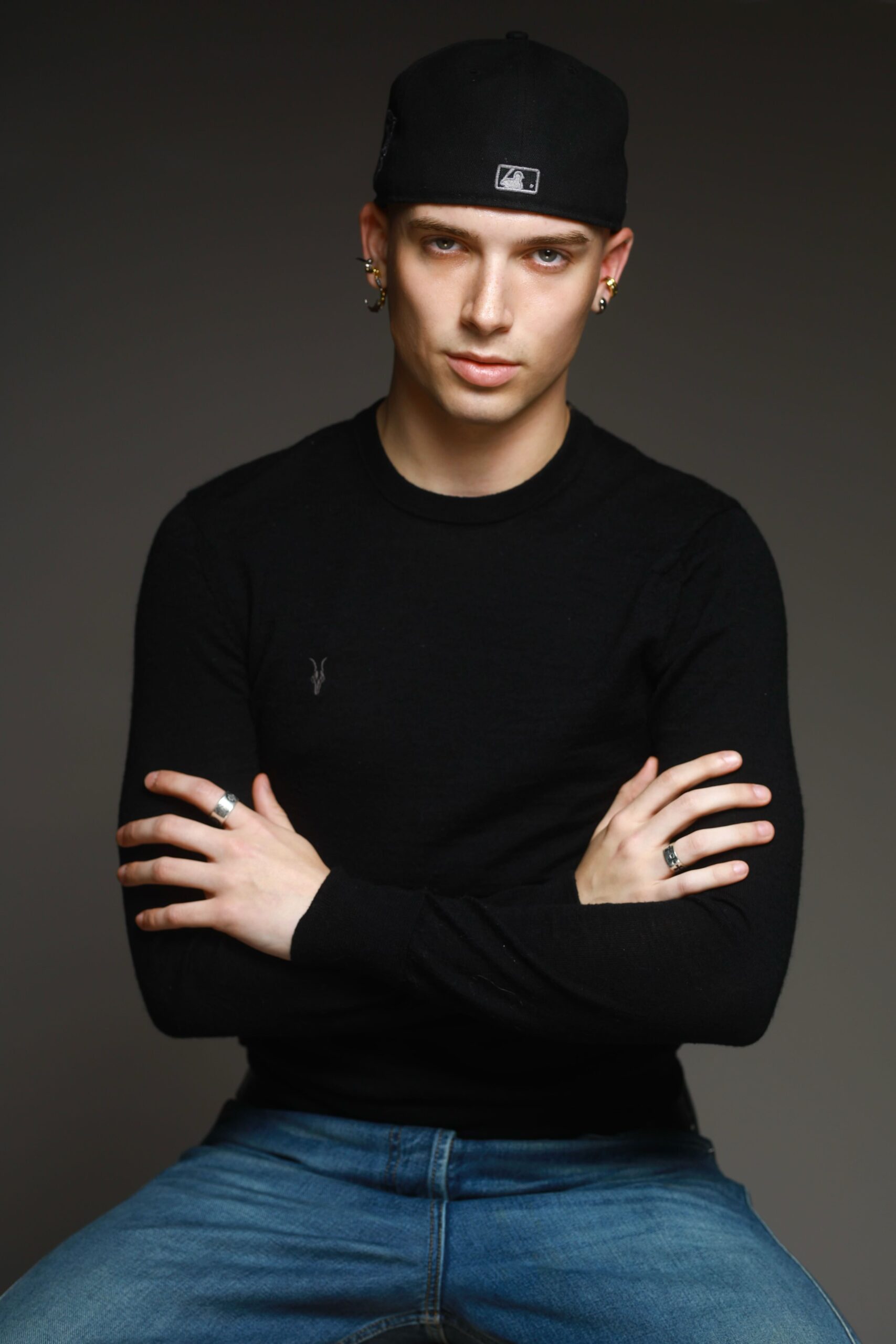
Beginning our morning call on Robbie Blue’s EMMY award nomination is definitely a way to start one’s day. Robbie Blue is your favourite artist’s favourite choreographer, and at just 26 — with a CV as thick as a bible — Robbie has crossed off much of his bucket list. Between working with Lady Gaga, Doechii, FKA Twigs, Tate McRae and Katseye (just to cite a few), the dancer turned choreographer, now also turned director, is paving his way with a gagging confidence through his distinct movement language led by ballet, contemporary, and ‘the Fosse of it all.’
Today, he’s wrapping up Adéla’s standalone tour choreo before a long-overdue break (slowing down hasn’t been part of his routine in the past few years). Drawing from the obscure limpy figures of Tim Burton, the eerie rawness of liminal spaces, a deep, deep love for Cher and Xtina’s Burlesque, and a musical awakening with Britney’s Circus record, he collects his inspirations with the most precise intention, breathing them into even the smallest gesture.
We caught up with Robbie where we discussed his childhood formative obsessions (who can compete with over 300 Wizard of Oz collectibles?), the mathematics behind dance, and finding the perfectly tacky 2016-esque wedding venue.
Hi Robbie! How are you doing this morning?
Good, we actually just got an Emmy nomination! [Nomination for ‘Outstanding Choreography’ for Tate McRae’s performance at the 2025 MTV Video Music Awards]
No way! That’s amazing, congratulations!
Yeah, it’s crazy. Oh my god.
Wow.
Wild.
What a way to wake up. Can you tell us how it all started before you got here? Where did you grow up and what were your beginnings like?
I grew up a little bit further out than the suburbs of Cincinnati, southern Ohio. There’s not much performing arts-wise there, but I was dabbling between city theatre, middle school plays, and eventually I stumbled upon these videos of this dance studio that was in the area. They were creating this crazy art that was pushing the boundary of dance; it was very graphic and it was just wild. So I kind of fell in love with this studio before I ever went there, and then I eventually convinced my parents to let me start taking dance classes there. It was pretty conservative where I grew up, so it was definitely a push for me to be able to dance. I started dancing there, the two owners are two gay women, and they were the first gay people I had ever met.
As time went on, I ended up dancing there all the way until I graduated. They became mother figures to me, but I was dancing at the studio every single day, so that just became my life. I was there probably six, seven hours a day every day, and then in the summers, I would travel around with them — I just fell in love with it. It was like a little creative bubble in the middle of nowhere. It’s crazy because they are both such artists, kind of living out in the middle of nowhere.
So you just randomly discovered their videos on YouTube?
Yeah, there were these videos of them competing at dance competitions, but the numbers that they were doing were nothing like any other dance competition number I had ever seen — they were dancing to Zombie by the Cranberries, headbanging, body shaking. It was just wild. I just had never seen anything like it, and honestly, I still haven’t seen anything like that.
It’s insane that their studio is in your town, as well. They were literally down the street.
It’s crazy, and it was kind of fate that we were able to find each other, and I was able to train under them. That’s how I became an artist, and also a great dancer.
What were some of your core obsessions growing up?
It started with my sister, who’s 11 years older than me, and she was the coolest thing in the world. Even before I went to the studio, I had found her Britney Spears Circus CD — it was gold. That’s when I started dancing alone in my room, wanting to be a pop star, to be like Britney Spears. And one day she brought home a disc of Burlesque, and that completely changed everything: I was dancing on chairs in the basement, learning the dances, and that movie just became a core thing for me. Later on, I did my research, and discovered Chicago, Cabaret, and all of these references that made that movie. I was also always obsessed with The Wizard of Oz, it was kind of obsessive-compulsive how obsessed I was with it, I had over 300 collectibles. At the time, I didn’t even realise that that’s a queer culture movie. I was enamoured with these movies, and I still am. I also had big fixations on fairy tales, anything Tim Burton-related — I consumed all that stuff constantly.
What was the shift from dancer to choreographer like for you?
So after high school I moved to LA to be a dancer. I came out here, really confident and strong, and I was able to start booking right away, and I crossed out a lot of things on my bucket list. I was loving that life. But when the pandemic hit, I had to go home, and figure out what the fuck to do with myself and all of this energy that I had. So I started creating my own stuff, because that was really the only way to dance. I started posting it online, and then I just started getting a very positive response from people. When the pandemic was over, I was, like, “Okay, I’m gonna make a film, put my choreo together, pay for it, I’m gonna do it.” And so I made that film, which was the funnest time of my entire life; we felt like the coolest people on the planet.
Then after releasing the film, I was booked by Doja Cat as a dancer for her tour, we were rehearsing, and then things just got interesting when I decided to go back home and go to rehab. So this is when this whole personal shift of my life changed, when I was like, “Okay, I have an issue, I need to go to rehab, I need to get myself straight.” I basically needed to give up this profession for an unknown amount of time to figure myself out. So that was a pivotal moment for me, because I didn’t realise yet how life would unfold after that. But once I went home, took the time for myself, went to rehab multiple times, really got myself together, Doechii sent me this film that I made from a long time ago, and she says she wants to do something like this for the Grammys, asking me if I’d choreograph it. It was just like a regular Instagram DM. And it was just crazy because I had sworn that I was not coming back to LA, that I wanted to stay in Ohio, be sober there, and live a small life there. So after Doechii sent that, I just moved back, and then this crazy train started. [Laughs]
It’s so funny how life unfolds sometimes. And I was wondering; what makes one choreography more challenging than another for a dancer?
It’s about understanding where the choreographer is pulling from. For example, I have a technical contemporary base, so when I’m doing something that’s pop, rock, or rap, it still has a ballet and contemporary influence, and if you’re not heavily trained in those, this is going to be a lot harder for you.
What about for a choreographer?
I think that choreographers, when they’re finding their voice, they’re mashing together all kinds of different styles of dance, and they’re saying what’s their style. And in order to execute something perfectly, you almost have to be trained in every single pocket of dance.
And how would you describe your movement in language?
I would say there’s ballet and contemporary influences, there’s heavy theatrics, and when it comes to the Fosse of it all, it’s very obscure and maybe even queer and a bit ugly, but it’s confident, and it’s in your face. I think the main thing is the level of confidence needed to achieve it, even before the technique. You have to be able to sell it and be confident in doing these moves — which I think takes a really brave soul to be able to be this theatrical. So I love using humour within it and being so serious about the movement. There’s lots of Fosse influence, cabaret, lots of Chicago, lots of theatre, ballet, old-school jazz funk, Brian Friedman, Britney Spears, pop, and commercial choreo.
Do you have any major non-dance-related inspirations?
When it comes to Tim Burton, that was what I was watching constantly when I was a kid, and it’s evolved into my dance style — the way that his claymation figures move, the way that they’re built. I’ve adapted these obscure body types, horrific monster and creature silhouettes into my choreography, even just subconsciously. It’s all about the way his characters move and behave: it’s dramatic. You have the hunchback, the tiny waist, the long legs.
I read you’re also very inspired by architecture, and particularly liminal spaces—How does that crystallise in your choreography?
Exactly, I’m also very inspired by liminal, raw spaces, where you can just get lost in the world. Backrooms is a perfect example of the liminal spaces that are lost in time, and they’re perfect to create something very gaggy and emotional. They just feel like the perfect juxtaposition.
I love architecture, cathedrals, the Renaissance, and when I create, I’m constantly thinking about these massive things. Also timeless paintings and the way they’re positioned, set up, their composition.
That’s so interesting; in a way you’re giving life to these sort of very epic, dramatic paintings with their many characters.
Totally.
Architecture does dictate the way in which we move our bodies — is that something you’re actively thinking about? How space comes first, and will then dictate the choreography?
When it comes to me directing my own projects, it starts with a space. And when I get brought on to other projects, they’ve already decided on the space, what it’s going to be. But for me, I have to feel like the space juxtaposes the movement. And that’s what becomes so jarring about the piece is that I’m in this, like, Walmart basement, and I’m gagging you down, and I’m so cunty and confident in this no man’s land space. That gives me life.
Can you tell where this fascination for these types of spaces comes from?
I think it’s just where I grew up, the Midwest, where everything looks like the backrooms, everything is like a strip mall in a box. And now it comes out in the spaces that I look for. But I want to change the narrative of these spaces and make them the backdrop of something really cunty and confident in a way that’s tasteful and artistic.
I was wondering how much of the space is dictated beforehand by the director? For example, with Tate’s Revolving Door and Doechii’s Anxiety music videos, where the actual architecture plays a huge role in their choreographies.
It honestly depends on the project. For some projects — like the Gap campaign — I was the first person on that before they even had a director. So the music, who it is, what they’re wearing, where they are, I had a huge hand in that. Some projects I was brought on later, like with Revolving Door, where Aerin Moreno was the director, and she had already kind of planned out this concept of the doors in the room by the time I got there. But she thought of me for this music video because of how liminal it was and how it seemed it would really fit my world. And with Anxiety, I had free rein with that outdoor dance scene. The house was prepared early on, but once we got outside to the massive dance scene, they were, like, “Do whatever you want.” And I was able to just go crazy. But recently, I’ve been much more closely tied to the creative direction as well as the choreo, because they just go so hand in hand. When it’s two separate things, it looks like two separate things.
I’d love to talk about Adéla’s KGB music video too. It creates such a distinct universe across different settings, with the wardrobe completely integrated into the choreography — like the rotating, veiled models. How much of the visual narrative is continuous for you, instead of a collection of standalone scenes?
There was a very specific reference for those veiled models—a traditional dance style where their skirts reach the ground, and it looks like they’re floating. I forget the exact name, but that was the starting point. For me, it’s about reading the treatment, looking at the spaces, and deciding what goes where and when. A lot of the set day is also determined by the quick changes. Like for Gap, that was unreal, figuring out from the top of the number who wears what colour denim because not only does it have to correlate, but we also have to make sure we’re getting every shade the same amount of screen time. We had people that would literally run off camera, change jeans, run back on camera because it was like, “Oh, there’s too much light wash all of a sudden in this shot.”
It was just like beyond — the mathematics are very real! And to the outsider, you wouldn’t think that, you know, these set days, the costumes are mathematical. It looks like we’re just having a lot of fun, but actually it’s even more logistical than it is creative. For example with KGB, we shot it literally in 12 hours.
No way. That’s crazy.
She changed like 10 times, and would be like, “Okay, she just changed, she just came out. Let’s do like, bam, bam, the ending dance break one time, and then we’re done.” And then we got to move. We got to get it on the first try.
Wow. And you’re still working together, right?
Right now, we’re working on her Lollapalooza show and her headline tour. I love working with her. She’s incredible.
And do you have a favourite project that you’ve worked on?
Well, my favourite project from last year was this video I created with Tanner Williams. It’s called Beat Bunny; it’s this crazy, sex scandalous video about this couple. That was the most fun. I haven’t created anything like that. It’s just insane. There’s the pizza boy who comes to the house and then gets involved in the threesome. It’s just like the most wild ride, and it’s all choreo. It was like the epitome of being absurd. And then another one, I loved doing this video with Spike Jonze. It was an on campaign with Zendaya where it was shot in slow motion, and it was like the most logistical thing I’ve ever done. But I love shit like that.
Wait, how do you do that?
[Robbie starts lifting his hat in slow motion] If there was a hat over there, then I would go like this, and then I would pick it up. And then I place it over there. So we were literally shooting it this slow. It’s crazy shit, and just to figure that out took weeks, and I loved it. I loved figuring out the specifics of the camera angle, and Spike is so incredible. It was mind-blowing, honestly.
I also wanted to ask, you’ve done so much, and how do you slow down? How do you take a break?
You know, that’s actually been a pressing issue for me. I think I’m getting to the point where once we finish Lollapalooza and the headline tour run with Adéla, I think I’m going to be taking a lot of time to myself just to be a human for a while. And be a normal person, go on dates, do normal people things, and have fun with my friends. I think I’ve just been a workwhore for a year and a half now, and it’s been incredible. I’ve loved it, but I’m wanting to just get re-inspired on my own terms. It really has nothing to do with the artists or the projects. It’s really more of just an internal thing of: “I feel like I didn’t know any of this was going to happen.” It’s been gag after gag where I’m like, “Oh my God, how are we going to figure this out?” I now need to go out, live my life for a bit and get inspired to create something of my own, like purely my own.
Well first, obviously, rest a little. But you’re also working on your third film, right?
Yes, directed by me, choreographed by me. I want to put my energy and time back into myself and then see where it goes from there. I’m still trying to find the perfect location for the third one, but I think we’re going to look at some really horrible wedding venues that are really tacky. I guess you could say a little like the 2016-type of Convention Centre ballroom. It has that liminal kind of backrooms feel but also some fake luxury. I’m leaning towards something like that for this next film, because it also feels like a party. It could almost feel like a reception in the sense of all of these people coming together. That’s where I’m at for that right now, but I’m very very excited about it.
Words by Lora Lolev
Photography by Lee Gumbs