“Even in individuality, there’s still something quite universal.”
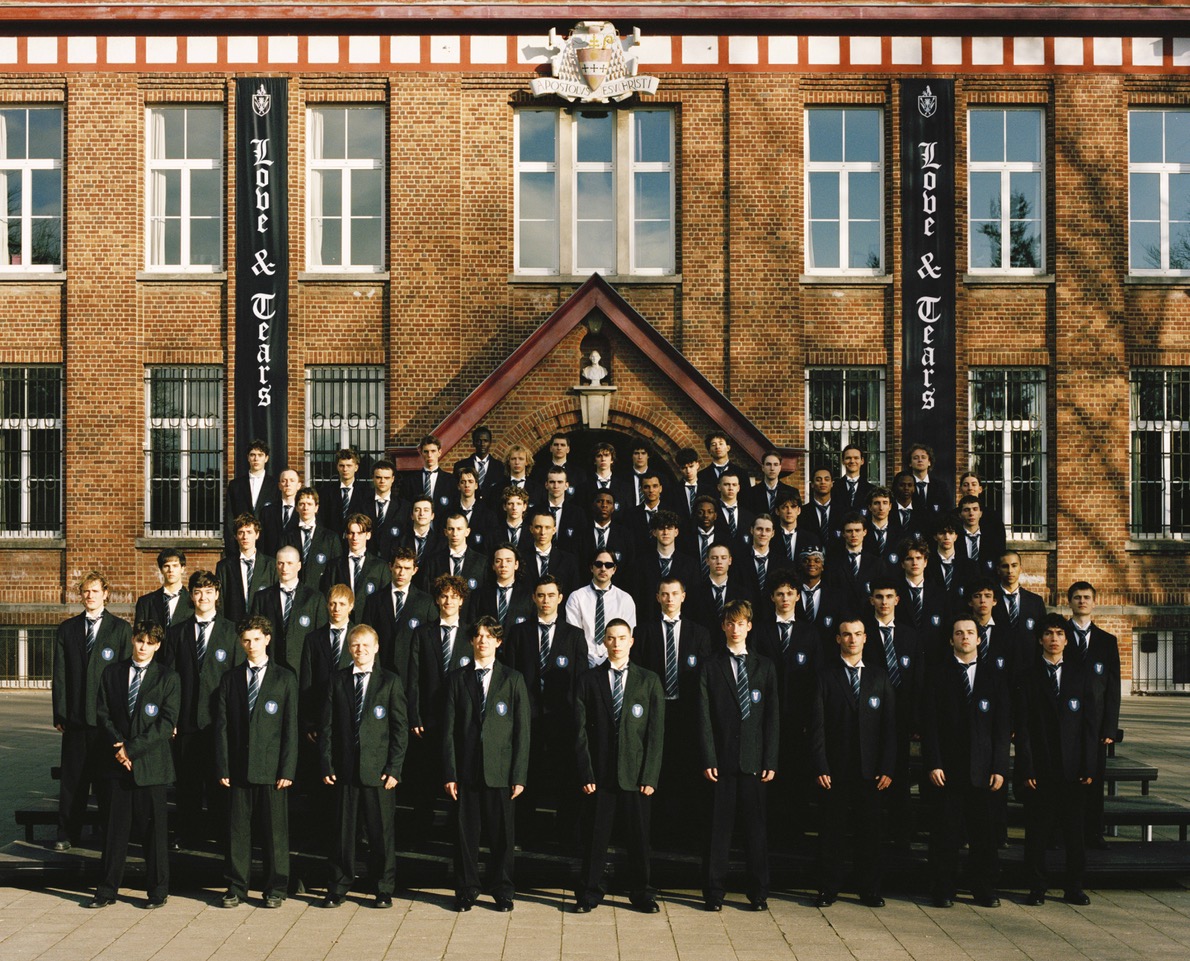
If you’ve spent any time online over the past few months, chances are you’ve stumbled across the hypnotically synchronised spectacle of Yung Lean standing among a group of schoolboys moving with uncanny precision. It’s one of those images that lodges itself somewhere in your brain. But it’s only the tip of the iceberg that is GENER8ION: the long-running collaborative universe built by producer and composer Surkin and filmmaker Romain Gavras (which is a crazy side quest considering the scale of their individual careers). The internet, ourselves included, was immediately hooked. Since then, GENER8ION have hardly slowed down. They released their debut album Love & Tears, featuring collaborators including 070 Shake and Yannis Philippakis, transformed London’s 180 Studios into an immersive exhibition, and cast Charlize Theron in a film where she spends minutes locked in a staring contest with the viewer, somehow wordlessly cycling through the entire spectrum of human emotion. Not a bad run.
Everything exists as part of the same organism. Across films, music and installations, GENER8ION build a kind of speculative mythology, hopping between Mumbai, Athens and Hangzhou to construct what they call a “reverse archaeology” of imagined futures. Their science fiction is never over-explained, remaining strange and porous enough for us to arrive at our own conclusions. Nothing entirely makes sense (but it looks stunning), and this is exactly the part that makes our mind jog in a very refreshing way. With Love & Tears out in the world, we caught up with Surkin to talk about building universes instead of albums, unintentionally going viral, and (also not really intentionally) upsetting the French right wing.
Congratulations on the release of Love & Tears! How are you feeling?
Pretty good, very happy, we launched the exhibition in London as well, called ‘Visions of 2034.’ So there’s been a lot happening at the same time.
The project has been in the works for a few years now, right?
Yeah, the thing with GENER8ION is that we’re not in a rush to finish it. With Romain, it’s something we work on when we have the time. I needed at least six months to actually finish this album, and I finally managed to find the time, so here it is. We also film pretty ambitious videos, and the scheduling is pretty intense between the artists we invite and the directors we need.
Can you tell us a bit more about the album and what inspired it? It feels like such an integrated body of work with other mediums — like the visual world and now the exhibition, that I imagine the approach to the album itself must have been slightly different.
It didn’t really start as a traditional album; it’s more like world-building, which involves, obviously, music, but also images and installations in the real world. It’s a discussion between all those things. The starting point sometimes can be the music, video, or installation — so it hasn’t been made in a very traditional way. Of course, the album format is still very important to me, and an album is something that stays for a longer period of time than an exhibition. The album is like a timeless format, and it was a challenge to make something that works in this form in 2026 because we’re in the world of playlists, TikTok, and short formats. It’s been quite a process, but it’s very interesting to work on something a bit more traditional like that.
The STORM video really worked with Instagram and TikTok though, it went so viral.
Yeah, we didn’t really expect that because we kind of broke all the rules of engagement. The video is extremely hard to put in a vertical format because it’s a classroom; by design, it’s something that’s horizontal. And even though the format of the video is in two parts, it’s pretty long, like seven minutes. At one point, we were thinking of cutting it in half, and we’re already so far from what’s supposed to work right now. Let’s push it as much as we want to, and basically bet on the fact that if you stay true to yourself, the final piece is going to work. I guess people liked it — but it wasn’t really designed for that.
I feel like people are developing this pull towards things that break at least one rule of what traditionally goes viral.
We’re in a world where everybody just tries so hard to be viral. Then, when something is not exactly trying to do that, it kinda works. I think people are just looking for a change in terms of the quality of content given to them. I think the obsession with virality has made the quality of the content go down, because people are choosing the five perfect seconds… we had that through the choreography in a way. But it wasn’t designed for that in a way.
But for instance, with your latest Charlize Theron video, you have to watch it in full and really lock in.
It’s kind of funny to direct something like this after STORM, which is extremely epic and intense. And then we released something which is basically two shots. That’s also kind of the freedom we want to take; we don’t want to be bound to anything. We also knew it wouldn’t be the same viral success as STORM. It’s also important for the scope of the project not to do one kind of thing, but to explore different ideas and formats.
How did the collaboration with Charlize even come about? So iconic.
It was kind of luck because Romain was working with her on a commercial project, and he basically asked her, like, ‘We have this idea, would you be open to doing something with us?’ And she loved it. We shot this quite a while ago, and we presented it in a museum in Greece, called the Onassis Foundation. I’m happy that more people finally get to see it. She’s a legendary actress, and it’s all about this dialogue about what AI might do in the future. But it was actually shot in person; there is no AI involved in the video or music.
Would you ever work with AI?
I’m not against AI per se, but I feel like I’m always playing with some codes and the uncanniness of seeing the little dissonances. And sometimes AI is going to bring you more to the average than to the freeing. People were complaining about synthesizers and drum machines in the 70s and 80s. I think it’s more about how you use it. And personally, what I love about music is the process of making it. So if you remove that from the equation, I’m not even sure I’d be making music.
I wanted to talk more about the symbolism behind ‘Visions of 2034’. Can we start with the choice of 2034, the number that keeps lurking throughout the project — what is the vision for this near-future?
Basically, when we chose this year, it started with something far off in the future, but not too far. It’s not a project about science fiction in a crazy spaceship way, but we wanted to have a date that is still close enough to us that we would still have some reference points. It’s about reverse archaeology. But there’s no specific meaning behind the year. It’s supposed to be an Olympic year — so that might help us in a narrative way, because the project is about something very global. Every video is situated in a different country.
In the description of the exhibition, your worlds were described as peripheral dystopias. I’m curious what that description means to you?
The world is already a little bit dystopian, to be honest. So dystopia is almost like a default state for the world. When you think about the future, it’s kind of dystopian, but the videos are not just dystopian — there’s also hope, and it’s poetic in a way. So we’re not completely hopeless about the future. But since we start from a point where everything seems a bit messy and depressing, we can still see a light at the end of the tunnel.
Do you feel like it’s also part of your work to bring hope?
When we think about GENER8ION, it’s almost like we’re doing a retrospective from the past about the year 2034. We’re kind of neutral in many ways. Of course, with the music we’re trying to bring a kind of joy, and it would have been super easy to go down a very depressing and dark path. The music is about balancing the images and bringing some romanticism back. It’s a discussion between hope and fatality.
I’d love to talk more about the STORM video specifically — by the end of watching it, it felt like observing one ecosystem, or almost like a colony of ants, because the choreography was so beautifully synced. It also reminded me of the M.I.A music video you did. What was the inspiration behind working with groups of people?
There is something about the project where we kind of have an obsession with a large group of people moving [laughs]. It’s something we’ve been trying to incorporate as much as we can. There is something universally striking about seeing a lot of people doing something together. Also, in the pure concept of GENER8ION, the name of the project itself is also a group of people. So yeah, there’s definitely this aspect of mass, of synchronicity. Even in individuality, there’s still something quite universal.
When the video had just come out, I remember reading an analysis on what attracted people so much to it, and it was a very large degree of playfulness, and the fact that it didn’t really make sense in the end. Was it something that you thought about?
We wanted people to build their own symbolism out of the videos we make, and not try to leave too much direction on how it should be read. I think that’s maybe why it attracts so many people, because we don’t have a clear conclusion. There’s actually a lot of symbolism that we didn’t even think about that people are putting together.
Do you have an example of your favourite interpretation?
Well, there’s the ‘Eye of the Storm’ thing, where it’s about not moving when in the middle of a group of dancers in movement. So people very quickly made the analogy of it being called ‘STORM,’ and so it’s the eye of the storm. I didn’t think about that, but it actually makes perfect sense.
There are a lot of interesting takes on the video — we actually had the French right wing being extremely mad at us because we had Yung Lean draw a penis on the map of France. We just thought about what kind of stupid thing a kid would do. I guess drawing a dick is kind of a universally funny thing. And we chose France just because it was kind of self-deprecating, as we are both French. So the French right wing was like, ‘They got money from the CNC [The French National Centre of Cinema], and now they’re making fun of their own country.’ And it’s not that deep; it was just a joke.
If you’re criticised by the right wing, you made it.
Yeah, you can kind of see the lack of sense of humour these people have, I guess. [Laughs]
Yes, checks out! I imagine the whole ‘goal’ of GENERATION is for the work to be digested in full with the music and visuals, but do you feel like that sometimes overshadows the music?
Everything is kind of made as one thing, so the more people get to experience the project, the better it is. There’s no priority for images or music. And the project is adapting itself to the different places it’s shown — in an exhibition, it will be in a different format compared to on Spotify or on YouTube. We’re just trying to build a world that’s strong, so people can experience it the way they want to.
And considering you already have some really insane collaborations, do you have an almost outrageous dream collaboration?
There are a lot, actually. But unfortunately, a lot of them are dead already. Actually, I’d love to do a collab with Elton John — that would be extremely cool. I’d love to do a collaboration with one of those timeless artists. Janet Jackson would be amazing.
Well, you’ve got time until 2034.
We might have to push the date a bit. [Laughs] And the project is ongoing, so it takes quite some time to finance the music videos, to shoot them. Better wait six months and do something beautiful, than just rush something out as quickly as possible. I feel like so much content is pushed every day; we’re not trying to compete in terms of quantity. Also, we’re trying to get the exhibition to travel the world, and show it in as many places.
Words by Evita Shrestha