“The push and pull of what you want and what you’re supposed to be.”

Ülkühan and Batuhan’s collaborative fashion collection Down Low enshrouds itself in the tension between one’s true desires and the public facade hypermasculinity begs to maintain. Blank Grindr profiles, lingering glances, and quiet cruising points – the prevailing norms push genuine desire to the brink of seclusion. Utilising the contradictory nature of down low culture, the designers make use of traditionally straight work attire, male archetypes, and brands like AXE and Flink as canvas for their experimentation. Browsing their collection feels like watching an acrobat balancing on a thin rope of heteronormative expectations, threading between what is known and what is hidden. In an almost theatrical display of clashing fabrics, ironic sentiment and sex appeal, Ülkühan & Batuhan amplify the opposing nature of down low.
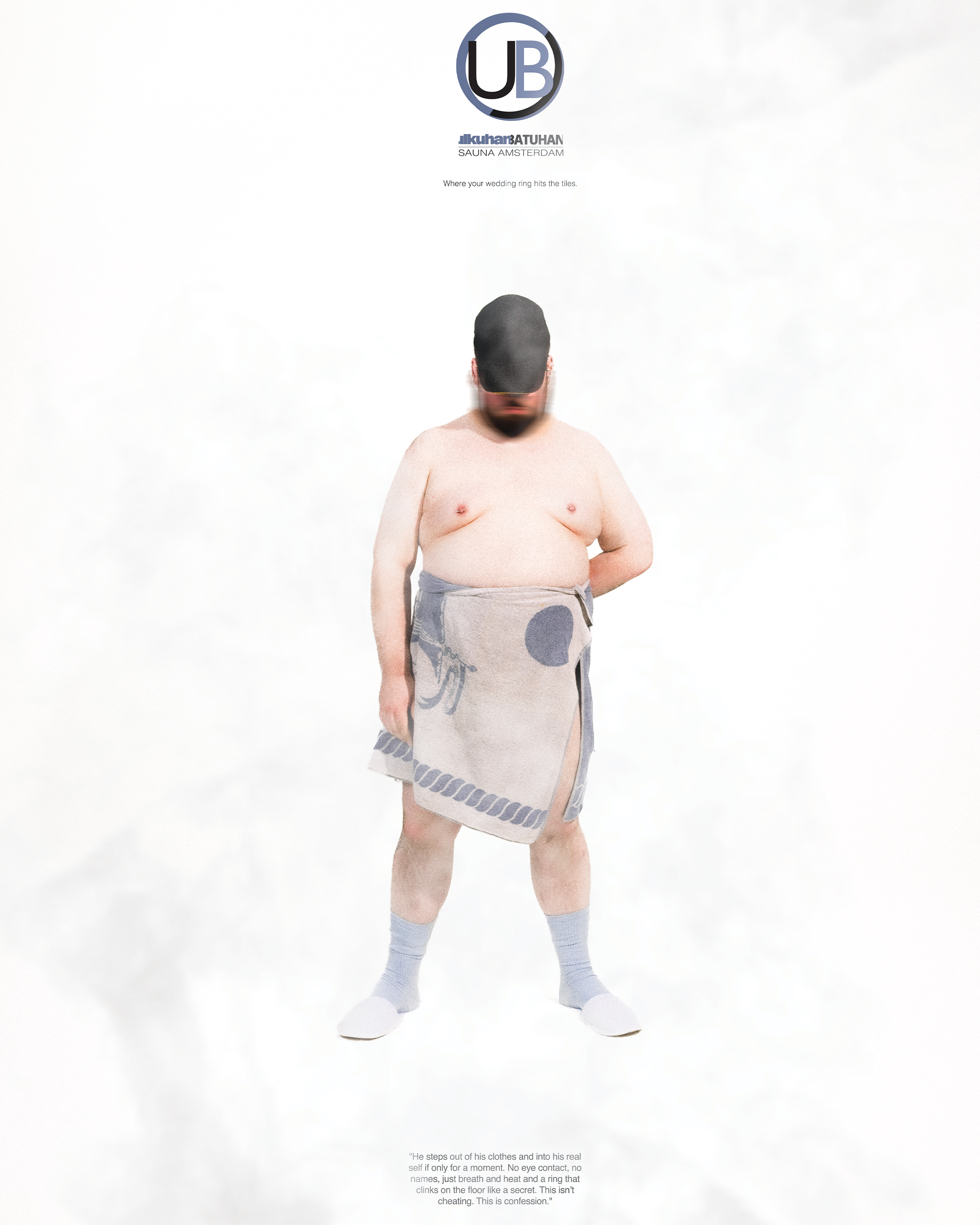
There’s an underlying discomfort that accompanies the looks, from the crouching, in-motion posture on top of pointy heels and a tight dress, to the single towel wrapped around a model facing the onlooker. Desire and shame dance in an intricate tango, entangle and threaten to become synonymous in this collection. The collection tackles hypermasculinity head-on, and taunts it with spandex, exposed thighs and thongs riding low on the hips. Vulnerability is the antidote. Non-conformity is the cure. The duo doesn’t try to provide a concise answer on how to dismantle male ideals, but rather presents the collection as a portal into a realm where slurs are reclaimed and worn as a badge of honour. Take a step into the shadow and hang your coat of shame behind you. This collection welcomes vulnerability, femininity, and queerness in its full glory.
Hey there! How are we doing today?
B: Woke up with love and gratitude.
U: It’s been a bit of a chaotic period, full of fittings, shoots and last-minute fixes. But we’re proud of what we’ve made and excited to share the work with Glamcult. And like Batuhan said, full of gratitude.
How did your collaboration begin, and what drew your individual practices together?
U: We both graduated in 2023 and were selected for Lichting that same year. That’s when we got to know each other better, and it just made sense to collaborate. We’d been following each other’s work for a while. There’s a shared interest in the body, identity, and pushing visual boundaries, but we each approach it differently. Batuhan works very intuitively, emotionally and physically, while I come from a more conceptual and structured place. That contrast creates a strong dynamic. We push and complement each other.
B: This isn’t our first time working together. Last year we also did a project for FDFA titled Jij denkt het, Geert zegt het. I reached out again to Ulkuhan, and because we enjoyed the process so much, we decided to collaborate again. We share a lot in terms of taste, energy, and our cultural backgrounds. It just feels like a natural match.
You two really complement each other! Now…I’m very curious to know – Down Low (DL) refers to men who (otherwise) identify themselves as heterosexual, but partake in sexual activity with other men, under the radar and gaze of prying eyes. It also happens to be the title of your project. What was the initial spark that piqued your interest in this phenomenon?
U: It actually started quite casually. A friend took us to a night sauna, and it felt like entering a completely different world. There were guys there who, on the outside, fit into a very straight, hypermasculine mould. And yet here, in that dark, steamy space, they were letting go of all that.
B: The secrecy, the performance of masculinity, the shame, that whole cocktail is fascinating to dissect. There’s this idea in certain cultures of what a man should be, and it’s often absurd when you look at it closely. I recognise my younger self in those coded silences. I still see it around me. And honestly, that in itself is a failure of progress.
U: That contradiction, between public identity and private desire, really struck us. DL became a way to explore that tension. Not to judge it, but to understand it and show it.
How does the collection reflect the term, and more pointedly, how does the collection play with its interpretation of the term?
B: Most queer people know the blank profiles on Grindr. The cruising spots. DL culture is a reality and a contradiction. We wanted to both critique and celebrate it. To reflect on how it exists within queer spaces and how, in many ways, it also holds us back from acceptance and openness.
U: We approached it both literally and metaphorically. Some of the garments sit very low on the hips; they cling to the body in ways that feel exposed or sensual. At the same time, there’s always a sense of discomfort, like something’s being hidden or restrained. We wanted to visually show that mix of desire and shame. The push and pull of what you want and what you’re supposed to be.
The collection tugs between the hypermasculine and the feminine, as seen with male-presenting models wearing typically female items like dresses and heels. What are some other ways you portrayed this tension in the project?
B: We explored posture, materials, archetypes, and kinks, and amplified them into something theatrical and confusing, just like the term Down Low itself. It’s a blend of opposing energies: tension, desire, suppression, and performance.
U: Nothing is quite what it seems. We like using humour, irony and visual contrast to break open ideas of what masculinity is “supposed” to be.
Speaking of the models, a quick observation! I find it so refreshing to see the spectrum of diverse models and body types draped (or pompously naked) in your garments. Gay men often fall prey to these toxic hypermasculine physique ideals, where they are pressured to present themselves a certain way physically. How does the choice of model fit into the overall story of your collection?
U: Thank you, that was deeply intentional. Queer representation in fashion still sticks to narrow standards. We wanted to go beyond that.
B: Exactly. “Masc4masc” culture has such a chokehold on gay aesthetics, and that’s toxic. We wanted to show different bodies, energies, and expressions.
U: Our models weren’t just there to wear the clothes. They brought their own presence. Mees Mulder, our photographer, really captured that. He has this incredible eye for intimacy and physicality.
B: His lens made the project feel soft and raw. That contrast is exactly what we were going for. We wanted to show that there’s no one way to be queer, sexy, or valid.
That message is so important. Let’s move to the fabric itself. What were the inspirations behind the fabrics you played with?
B: We built from straight-coded archetypes: businessman, athlete, construction worker. Their uniforms became our canvas.
U: We gravitated toward materials that suggest intimacy or friction: spandex, lycra, satin. Fabrics that hug the body reveal tension.
B: Poplin from secondhand shops, you know, those corporate guys or student association types.
U: We loved mixing that stiffness with queer textures. The contrast creates friction — visually and conceptually.
I see spandex, I see thighs, and a whole lot of thongs. Of all the “feminine” elements, why did you choose these?
B: Because it’s fantasy. It’s fetish. And because softness, for these men, is the ultimate taboo to be seen as ‘feminine’
U: A thong is direct. It doesn’t pretend. It’s not about being tasteful, it’s about being honest. And that honesty is where the discomfort lives.
Non-conformity is practically your middle name. How do you use your collection as a tool for rethinking identity?
U: We’re not trying to offer a clean definition of masculinity or queerness, quite the opposite. The project shows what happens when those fixed categories start to fall apart. We mix things that don’t usually go together: a jock wearing nail polish, or a frat look styled in a queer way.
B: I think I can speak for both of us: identity is never fixed. It’s fluid, shifting, layered. Even while working on this project, we confronted our own beliefs and biases about masculinity. Fashion becomes a mirror, sometimes warped, sometimes crystal clear, but always reflective.
U: It’s not about having the answers, but about asking better questions.
How do you get into the flow of designing your collection? Any ritual or practices in general? Do you divide tasks, or are there specific elements that are distinctively Batuhan and others more recognisably Ulkuhan?
U: It starts with hours of conversation. Sometimes uncomfortable, but always honest.
B: I tend to go for theatrical drama. Ulkuhan brings structure and clarity. We don’t split roles, we amplify each other.
U: And somehow, through all the chaos, a collection emerges.
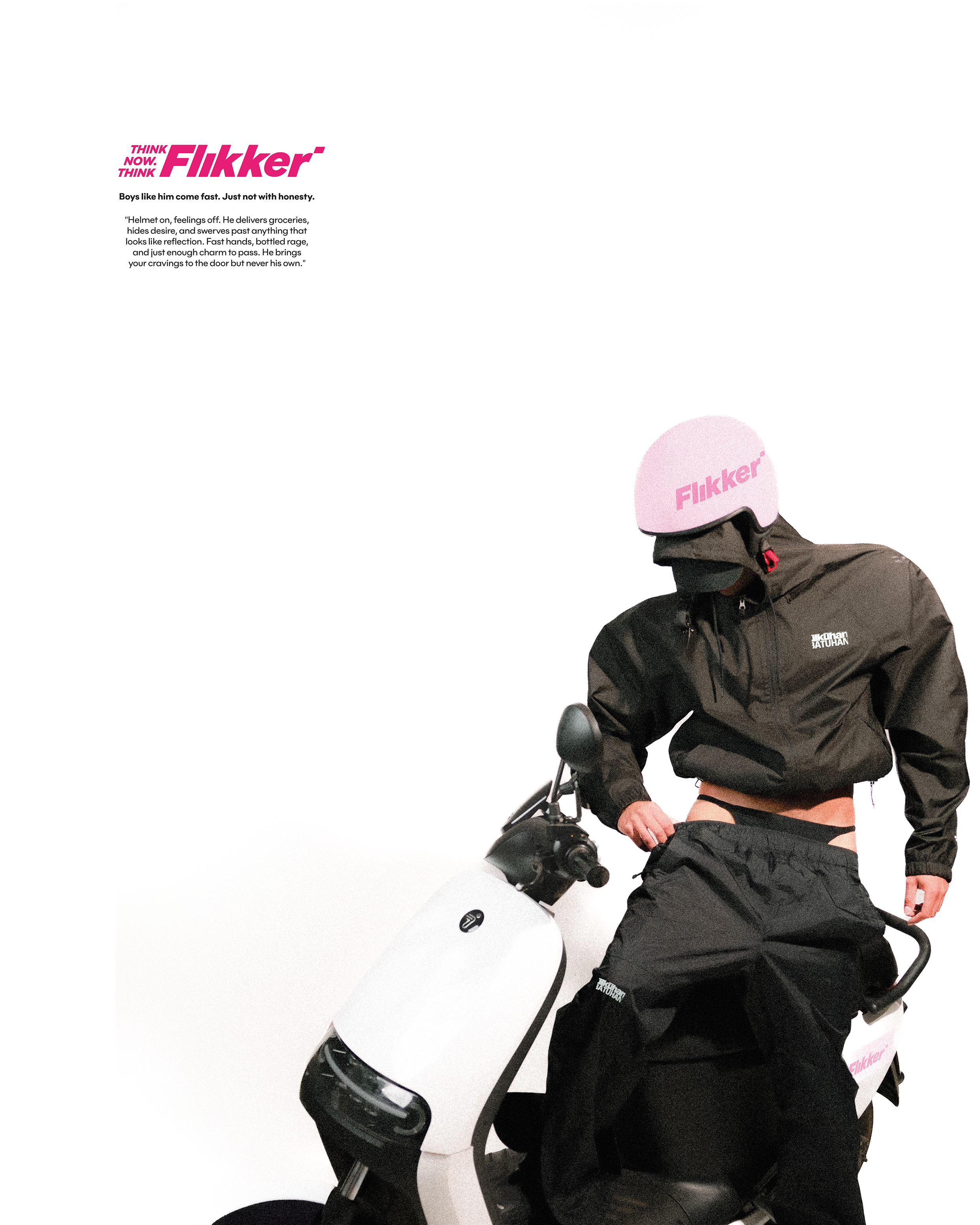
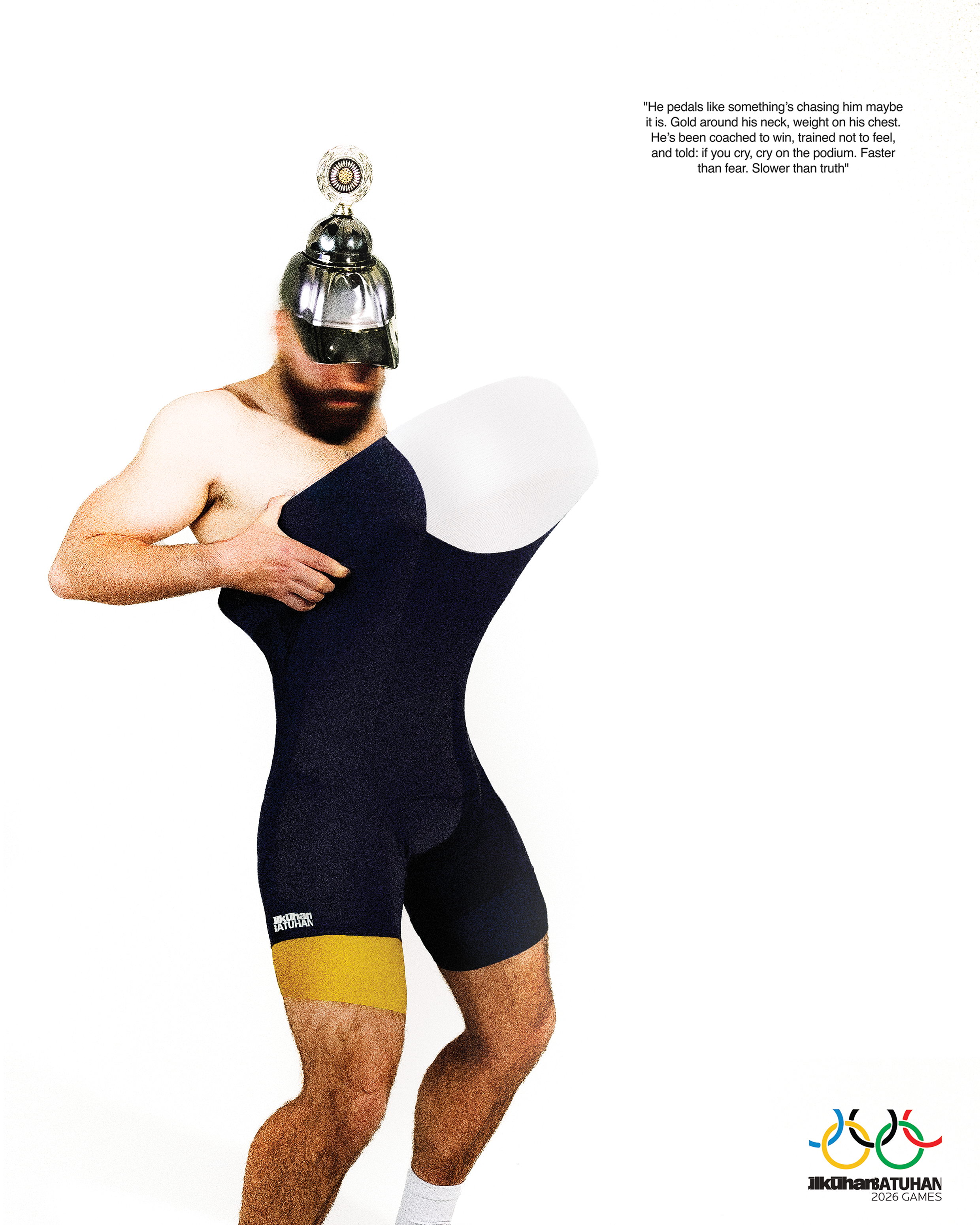
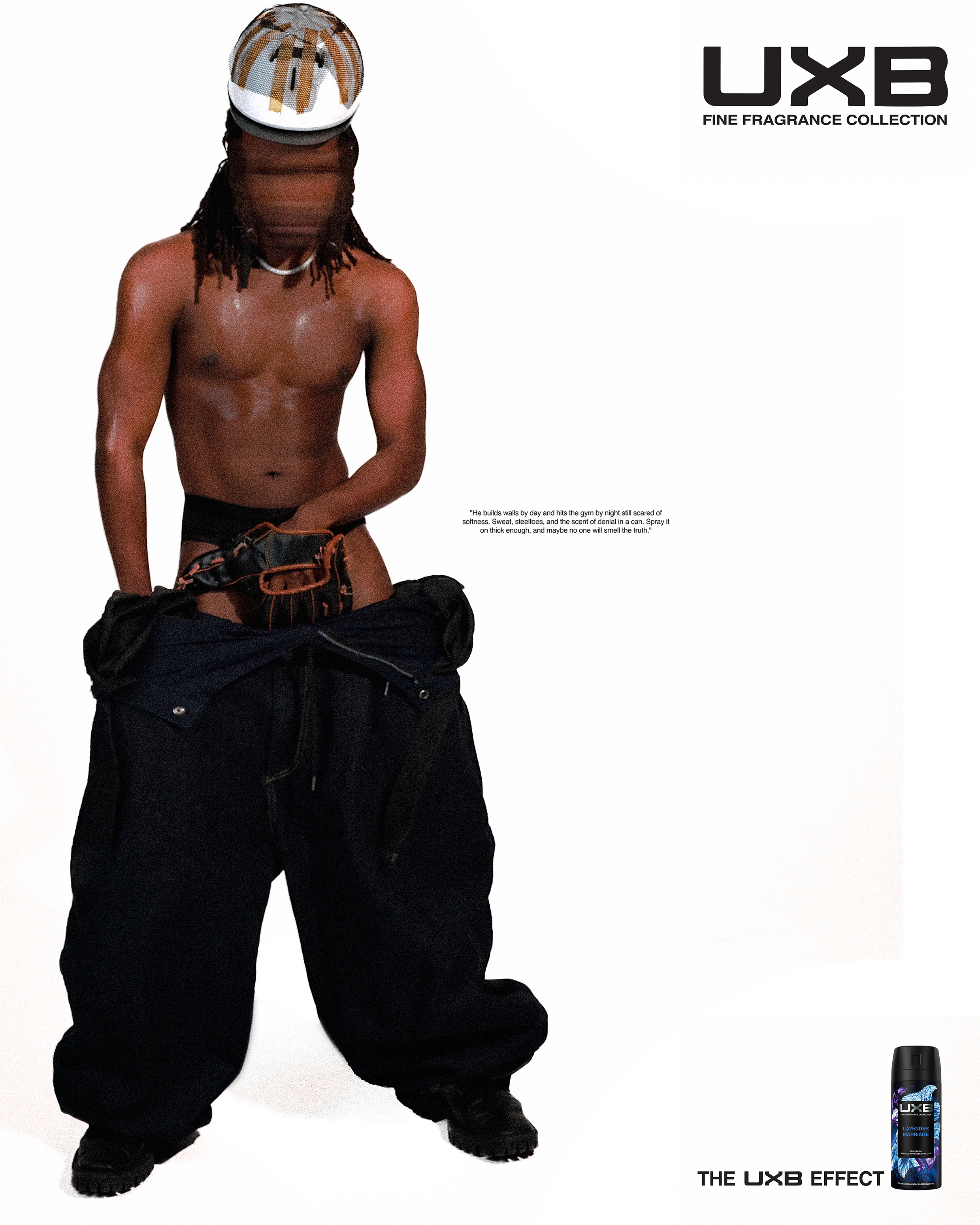
You’ve chosen very recognisable brand icons like AXE, Barbie, and Flink, and given their typography a spin with your own names and politics. Was there a specific reason for the brands that you chose? What’s the relationship between the brands and the words you chose?
B: These brands carry heavy narratives. AXE, for example, is aggressively masculine. We looked into how their branding reinforces these ‘masculine’ ideals. Barbie is hyper-feminine, and Miss Netherlands stands for a very traditional kind of beauty. We recontextualised them using our own names, politics, and queerness. In a way, they reflect how DL men might move through or fantasise about those same worlds, while staying hidden in plain sight.
U: These brands have shaped how many boys learn to perform masculinity; how to smell, how to act, what to want. By reworking their logos and blending them with different words or meanings, we challenge what they actually stand for. What if AXE symbolised longing instead of dominance?
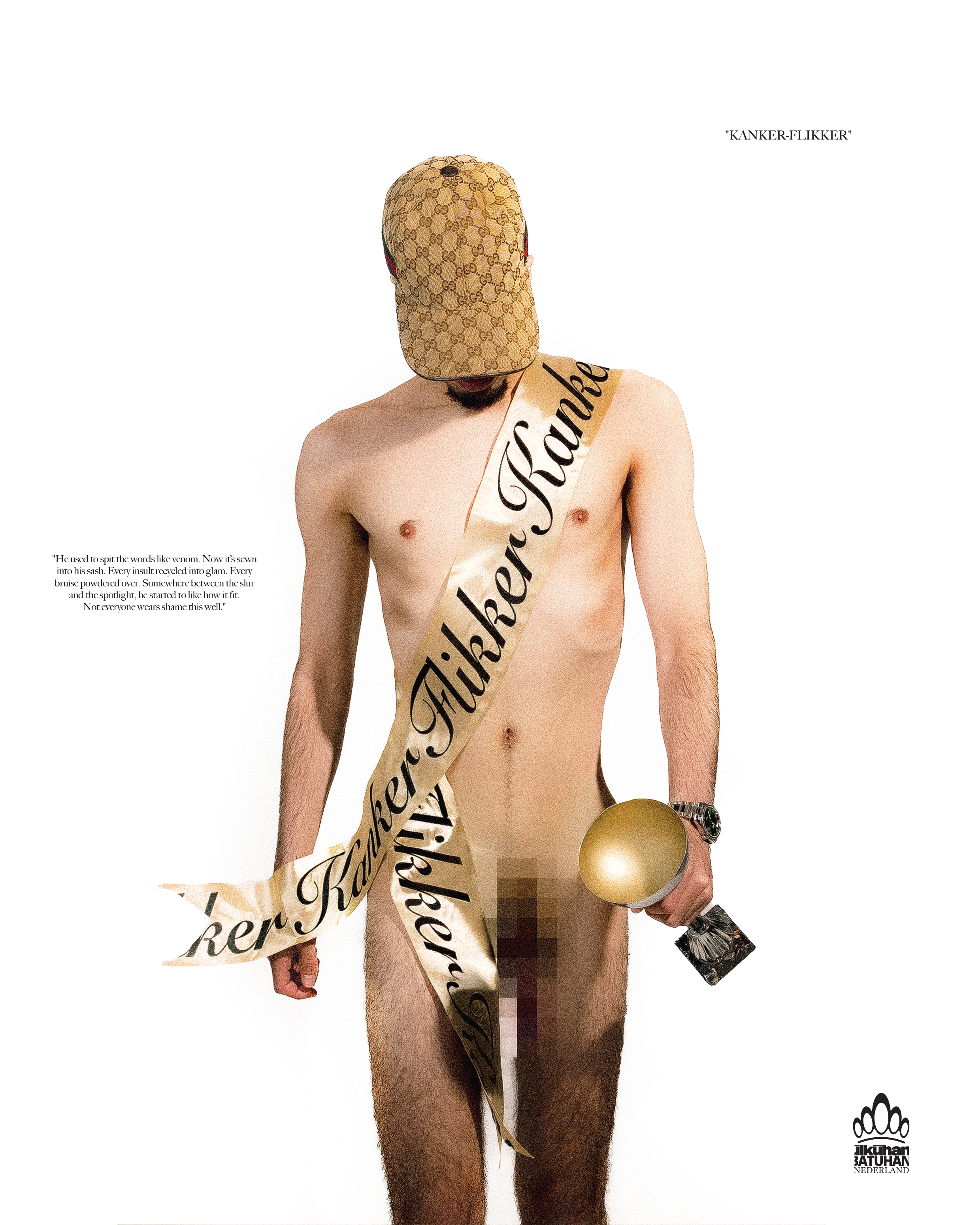
On some of your graphics, like the golden ”Kanker Flikker” band, you boldly reclaim Dutch homophobic slurs. Why is it important for you to make space for these words that are often used to stigmatise the gay community?
U: Because that word is a reality. We hear it. Pretending it’s not there doesn’t help.
B: Wrapping it around the body in gold, like a trophy, disarms it. It’s a refusal to be erased. We also wrote down: “He used to spit the word like venom. Now it’s sewn into his sash. Every insult recycled into glam. Every bruise powdered over. Somewhere between the slur and the spotlight, he started to like how it fit. Not everyone wears shame this well.”
U: It’s not about provocation for the sake of it. It’s about saying: you can’t shame what’s already been reclaimed. There’s also a wink in it, to those who know, who’ve heard it too. A nod to our fellow faggots, turning insult into inside joke, armour, even beauty.
It’s like disarming an enemy using their own weapons. Down Low also uses popular gay references like poppers, while also highlighting areas in which gay culture is more repressed or silenced, like with the student association look. What was the process like choosing which areas of gay culture to portray?
B: We had a big brainstorming session with Ulkuhan and our friend and photographer Mees Mulder. The goal was balance: showing what’s known and what’s hidden. Some references are universal in queer culture, others are hyperlocal. Some are joyful; others disturbing. That duality is the point.
U: We wanted contrast. Queer culture isn’t one thing; it’s full of opposites: pride and shame, freedom and fear. We showed spaces like the sauna alongside more conservative settings like student groups, where queerness is often hidden or denied. What you leave out is just as political as what you show.
If you could pick three words to describe your collection, what would they be?
B: Fun. Reflection. Liberation.
U: Complex. Intimate. Confrontational.
What do you wish the takeaway would be for the people who come across your project?
U: That masculinity isn’t fixed. That desire doesn’t need to make sense. And that there’s power and beauty in letting go of control.
B: Life isn’t black and white. People and identities are layered. We just hope people take a moment to reflect. To laugh. To think. To feel a little discomfort, maybe.
What future projects should we keep a lookout for?
B: I’m currently working on my debut collection and fashion film “Aren’t We All Saints?”, which will be released later this year.
U: And I’m preparing my debut collection “Ethnical Profiting” for Amsterdam Fashion Week 2025; a collection that explores identity, data, and the body.
B: “Down Low” might have started as something small, but we’re already planning something much bigger for 2026.
We’re excited to see what’s lined up next for you!
Words by Sharon Calistus
Photography by Mees Mulder