“Each song feels like a kiss after a fight scene or the fight before the kissing scene.”
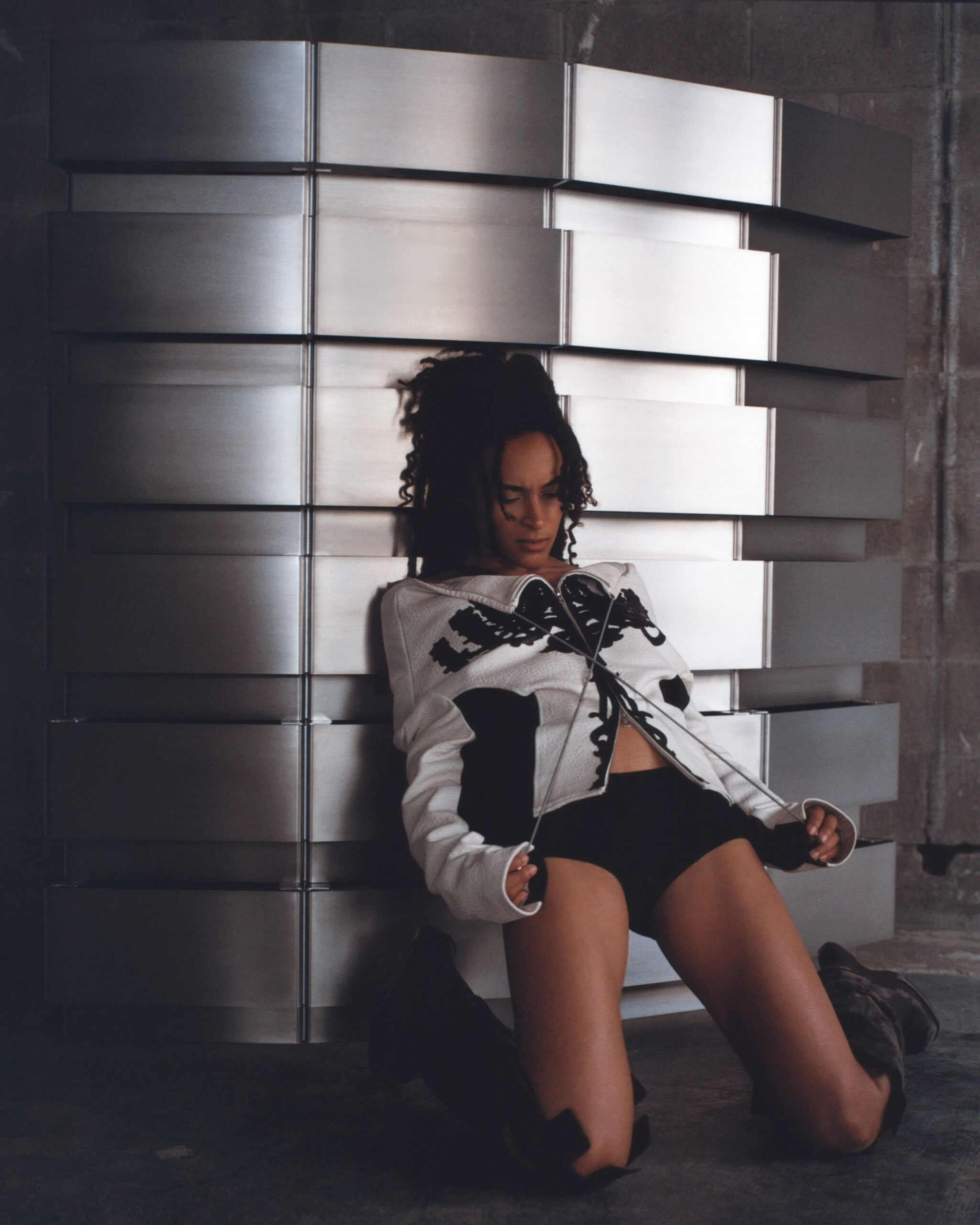
The Montreal-based producer, singer, and multi-instrumentalist Ouri approaches music a bit like a mad scientist, collecting emotional fieldnotes and obsessively rending them through sound. Classically trained on harp, cello, and piano before immersing herself in electronic music, she builds tracks like ecosystems: fragile strings brushing against synthetic pulses, whispered vocals floating through digital fog. Daisy Cutter, her latest project, continues that ever-glowing investigation. The album, which she describes as a meditation on devotion and a “slow study of love,” unfolds slowly, with a perceptual sensitivity of someone who observes their own emotions, desires, and doubts with a great deal of care and plurality.
Speaking with Ouri feels a bit like listening to her music. Thoughts arrive in spirals: layered, associative, humorous, gently drifting before snapping into unexpected clarity. One moment, she’s describing desire as a system of magnetic pulls. The next, assigning personalities to her instruments. Luckily, the world of Daisy Cutter is still expanding. Her freshly released video for Death Row pushes the project further outward — a Kubrick-esque BDSM fantasy that reimagines and rewrites the endings of her recurring nightmares.
Hi Ouri! How are you doing today?
Hi! I’m doing so good, laughed too much and my voice is almost gone but still smiling. Hope you’re good too 🙂
Daisy Cutter has been described as a meditation on devotion. When you think about devotion in your life (not just in your music), what does it feel like? Where does it show up most palpably for you?
I feel it most when I’m actively creating a world for the people I know and love. I must admit I’m addicted to the sudden burst of energy that emerges in me when I feel devotion. This unlimited and frontal flow is just so powerful. When I feel it, it means I’m at the right place, surrounded by the right people and that is so hot. It makes me want to destroy doubt in people’s minds and remind them of the surrounding beauty, it makes me want to have their favourite snack in my bag at all times and take them on adventures. But I also feel it with strangers, I love to leave them anonymous love notes in the metro.

You’ve also called the album “a slow study of love.” In the process of making it, did you notice your capacity for intimacy, towards others, or even towards yourself, change or expand in unexpected ways?
Oh yes, this whole album was a sort of magnetic experiment. I mostly view my existence from a dissociated perspective, as if I’m the subject of a scientific study. And I wanted to understand desire better so I started to expand the size of my playground. It used to be so narrow and distorted, like a close-up shot with a fish-eye lens, only able to hold one subject at a time in the composition, focusing on one magnetic pull at a time and forgetting about the rest. But I wanted to try and witness a more complex system. To understand the true nature of that magnetic pull, I had to test it more and observe the limitations. I realised that no matter how many magnetic pulls are surrounding me, it will never change their nature. And the strongest one will stay the strongest. I was able to drastically expand my capacity for intimacy for a while, and it was so graceful, discovering unsuspected parts of myself reacting to the surroundings. But there was a turn when the complexity of the system felt random, and suddenly I had to completely remove myself from the experiment to keep exploring my own complexity.
You’re a multi-instrumentalist, from piano, harp, cello, electronics, and your voice, each with its own character. If each instrument could speak a language of emotion, what would each of them transmit?
Ok, piano is the daddy, the stable ground that I can always rely on. The harp is the sexy friend that speaks freely and cries a lot, wears lace. The cello is the risk-taker that always knows the outcome before everyone else, sort of archetypal hero that would die first in the movie. The electronics would be the lab genius, in charge of the analysing forensic evidence but also testing new drugs. And my voice would be the psychic, the silent one with a smile. She has a health condition that prevents her from going outside, but she is the one in charge of the whole team, calling the shots with her eyes closed.
Congrats on the release of Death Row! How did you approach translating the sonic universe of the track into a visual output?
My nightmares are about police officers, agents with no agency, and repressive security forces. The Death Row video is an active imagination game where I rewrote the ending of my recurring nightmare. The imagery of Kubrick, the Wachowski sisters, and Hitchcock permeated my brain quite early and stayed. There is something truly indestructible in the human heart, something that can merely be asleep when you cosplay life too seriously. I’m interested in the corruption of desires and how to reclaim freedom. There is always a place where desires are kept intact. No matter how small that area shrinks, it is still there.
You also recently released Crusts EP — a body of work conceived around a cinematic frame. What was it like composing for an imagined visual narrative versus composing for the music alone? How did your internal cinema influence the sound?
This project was so special because the making of the score felt like the best scenes of the film kept secret. I usually would watch the scenes over and over again to challenge my intuition and nail the intention. I actually prepared a bunch of melodic ideas, chord progressions to support the singers during the recording. With this, we went to the studio, and the director, the choir and I played for hours. I knew I wanted to capture this untreated energy, that searching for the thing, reaching for balance. After recording the tentative stage, we proceeded to let the girls improvise and play with the ideas. We had captured the essence together, everyone in the room counted and influenced the sound and the emotion. I had never experienced this essence-grabbing as a team effort for a film. Absolute devotion moment.
Was there ever a point where your musical path felt like a tension between expectation and freedom? How did your upbringing shape that dialogue within you?
I always feel a tension between expectation and freedom in music. I think true beauty lies there, and it is an uncomfortable place, but I want to try to stand there all the time. It makes me hate external expectations, and it makes me hate freedom, too. I look at everything around me, and I know I’m only seeing a random selection of the spectrum. It’s impossible to really know where I stand. So it’s really hard for me to decide where I place the pointer on the spectrum of possibilities. I decide to rely more on instinct and let time shape things. I believe that nothing is guaranteed in this world. Growing up quite religious, I was a kid led by her faith until I looked at the absolute complexity and randomness of life. I tend to have no expectations whatsoever and marvel at true beauty when it appears for a second. I think that leads me to create music that can soothe my interior world and try to make these glimpses of beauty last a little longer.
What are you actively unlearning these days — both in how you approach your music and how you move through your relationships or your life?
I am unlearning everything! I just want to carve more space for beauty in this world, and so I’m just trying to be ready, curious, and present instead of trying to control the outcome.
You’ve spoken about creating from a place of freedom. What does freedom mean to you now, and where do you look for it when you’re feeling constrained?
Freedom feels like space to let unprocessed feelings emerge today. But when I’m constrained, it feels like securing a pocket of oxygen for later, or sharpening a tiny knife in my back. You can never totally erase someone’s freedom, and if you try, you’re probably just making your opponent stronger and smarter.
Coming back to the feeling of your music, I would describe your music as having a certain “yearner’s glow”, even in the tracks that are more danceable or club-ready. Is that feeling intentional / something you resonate with too?
Yes, I would agree. For some reason, I seem to express that over and over again.
You bring traditionally classical instruments into electronic and club contexts in a way that feels effortless yet still unexpected. What have been some of your most memorable reactions, on dance floors or in quiet listening spaces, to this hybrid conversation?
I really don’t know what to say, these timbres are part of my arsenal. I want to create a sonic space between palpable reality and imagined dimensions, and these are the sounds I use to make that happen.
Are you working on new music now? What’s shaping your current creative horizon?
Right now I’m working on new music, new collaborations. Every single song feels like a kiss after a fight scene or the fight before the kissing scene.

Images courtesy of the artist
Words by Evita Shrestha