“A still life is a representation of something that is changing, and every still life is a kind of fiction.”
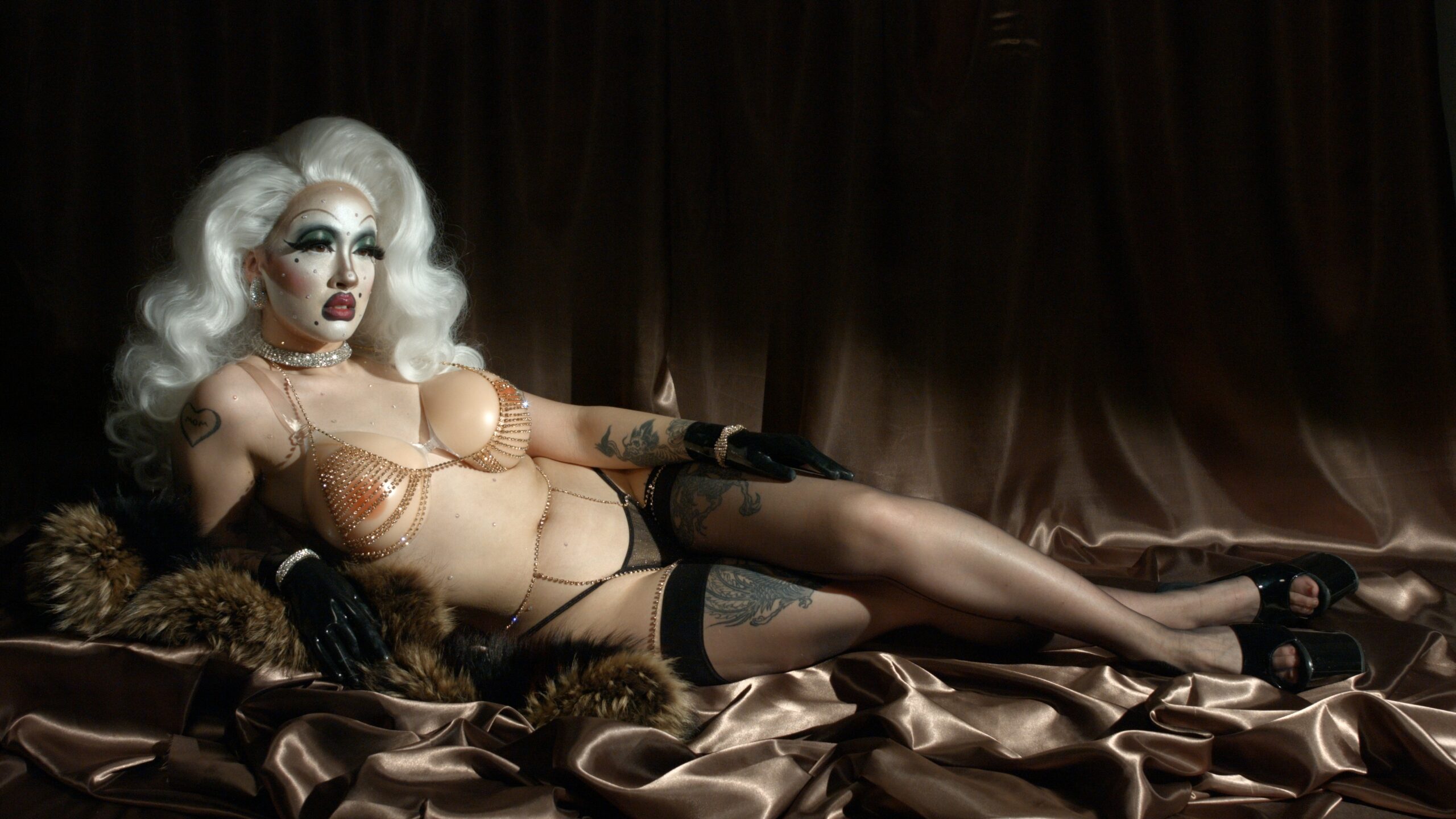
Sin Wai Kin is a storyteller first and foremost. Working across moving image, performance, drag, writing, and installation, their practice is concerned with the unattainable — slipping between identities, temporalities, and realities with seductive fluidity. As they draw equally from art history, science fiction, and popular culture, Wai Kin constructs speculative worlds that unravel fixed notions of selfhood. In their universe, identity is never singular or complete, but continuously observed and performed into being.
For their exhibition Sin Wai Kin: Still Life at the Frans Hals Museum, Wai Kin stages a dialogue between contemporary moving image and centuries-old portraiture. Canonical works — from the Mona Lisa to Caravaggio’s Narcissus and Picasso’s Guernica — are refracted through Wai Kin’s shapeshifting lens, becoming unstable, porous and newly alive. History is not discarded, but imagined and materialised beyond what we’ve been taught.
The multiplicity of Wai Kin’s references, spanning modern neuroscience, Buddhist philosophy, and queer theory, seems to proliferate the deeper you look. But in celebration of the opening, we attempted to trace some of these constellations: their fascination with the unfixity of identity, the liberatory potential of fiction, and the task of imagining futures beyond the constraints of the present.
Let’s get right to it! Can you tell me how Sin Wai Kin: Still Life came about?
Years ago, Manique Hendricks, curator of contemporary art at the Frans Hals Museum, asked me to be in an exhibition that was focusing on drag in relation to the museum’s collection, which then led to an invitation to do a solo exhibition at the museum. We thought it would be more interesting to set it in the museum collection. I have this series called Portraits — works on screens hung as paintings, which at first seem like still images, but they’re moving images of characters sitting for a portrait — which are cross-referencing famous historical artworks. It made a lot of sense with the museum collection, which has everything from classical to modern and contemporary art in it.
I spent a long time with the collection, online and in person. I had been thinking about making this work, a video portrait of my parents at their dinner table, for a long time. I think the dinner table or sharing a meal is something that is very deep in the subconscious of any Asian person. In the end, I kept on coming back to the still lives in the museum collection because of their relationship to stillness in the portrait series and because of the relationship with food and the profound in the everyday. In still life paintings, there’s an idea of trying to represent or hold still something which is ephemeral. I used this as a departure for the conversation that I wrote for my parents to have over a meal.
What was it like working with the Frans Hals Museum? It feels like such an interesting juxtaposition between your work and the more traditional oeuvre the museum is associated with.
I initially worked with the Frans Hals Museum for an exhibition called The Art of Drag. But it’s been amazing to see and to work with them. Their team is mostly women, and Manique’s curation ethos is very decolonial, very queer. Everybody there seems to be aware of the weight of art history of this extremely white, traditional, male painter narrative that exists and that dominates art history. Working together has been succinct, because my work is also about relationships to hegemonic narratives.
Would you say your work is also about rewriting dominant visual codes into a more inclusive philosophy?
The main through line of my work at the moment is storytelling. A lot of the research that I’m doing is looking at how, in theories of physics and neuroscience, we are seeing that there is not one true or objective reality. I’m thinking about how to represent this in narrative form.
I find the idea (or fact) of complete subjective reality really fascinating, how a very small proportion of our attention registers a fraction of what’s around us. Which makes it all the more important where attention is directed.
Completely. In a very real sense, people see what they want to see. In quantum physics and general relativity, we’re realising that even the lengths of space and durations of time vary depending on who’s looking. Reality happens as we agree to what it is, and things don’t have determined properties until we measure them. The representation of different narratives becomes incredibly important because they literally construct our reality.
In connection with that, I would love to know more about the characters you create. What do they represent?
I think of each character as an embodiment of some kind of knowledge or question. This is a reflection of the fact that everything that we know or that we experience happens through our bodies and experience of the senses. This also brings us back to the sciences and the idea that there is no observer-independent reality that we access. As soon as I had more than one character in my work, I also realised that the important thing was not the individual characters, but the relationships between the characters. In a way, there’s no such thing as an individual, and meaning changes when you’re in different relationships and contexts.
For example, you’ve spoken about the character of The Storyteller as one who disrupts certain narratives.
The Storyteller is one of my most recurring characters, because they’re about the fact that storytelling not only represents, but also creates reality. They’re often presented as a news reader, a sort of contemporary storytelling figure, where they’ll say one thing, and then the opposite, but present them as equally true.
And can you tell me more about the portraits exhibited at the Frans Hals Museum?
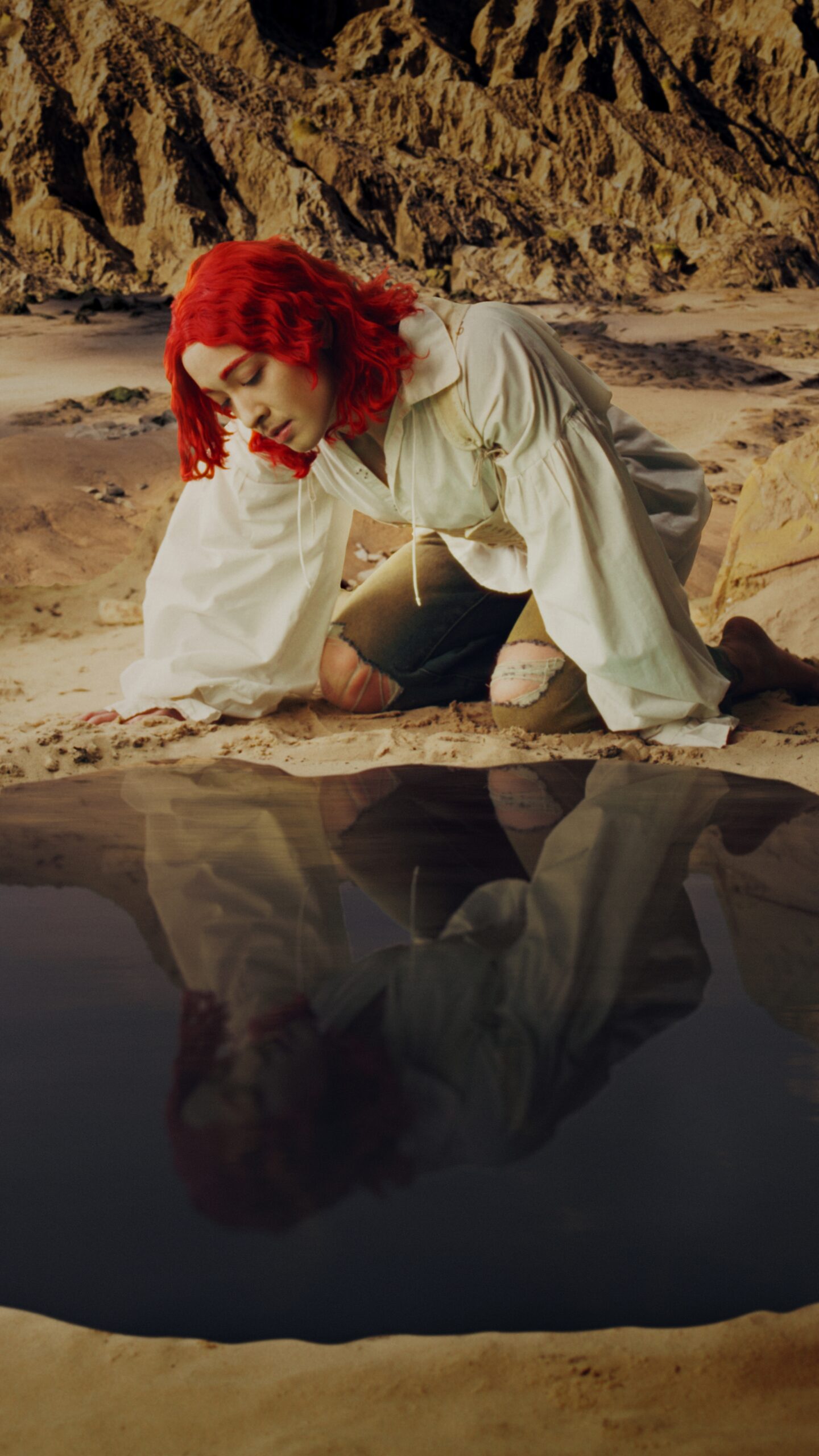
Definitely. There’s the portrait of The Storyteller posing in the style of Mona Lisa as a newsreader at their desk. The Mona Lisa is a famously ambiguous portrait, and I wanted to play into this ambiguity in the role to think about a storyteller‘s intent. We also have a portrait of Wai King, who is my drag king character, who poses as Caravaggio’s Narcissus, looking into his reflection in a desert mirage, and being trapped there.
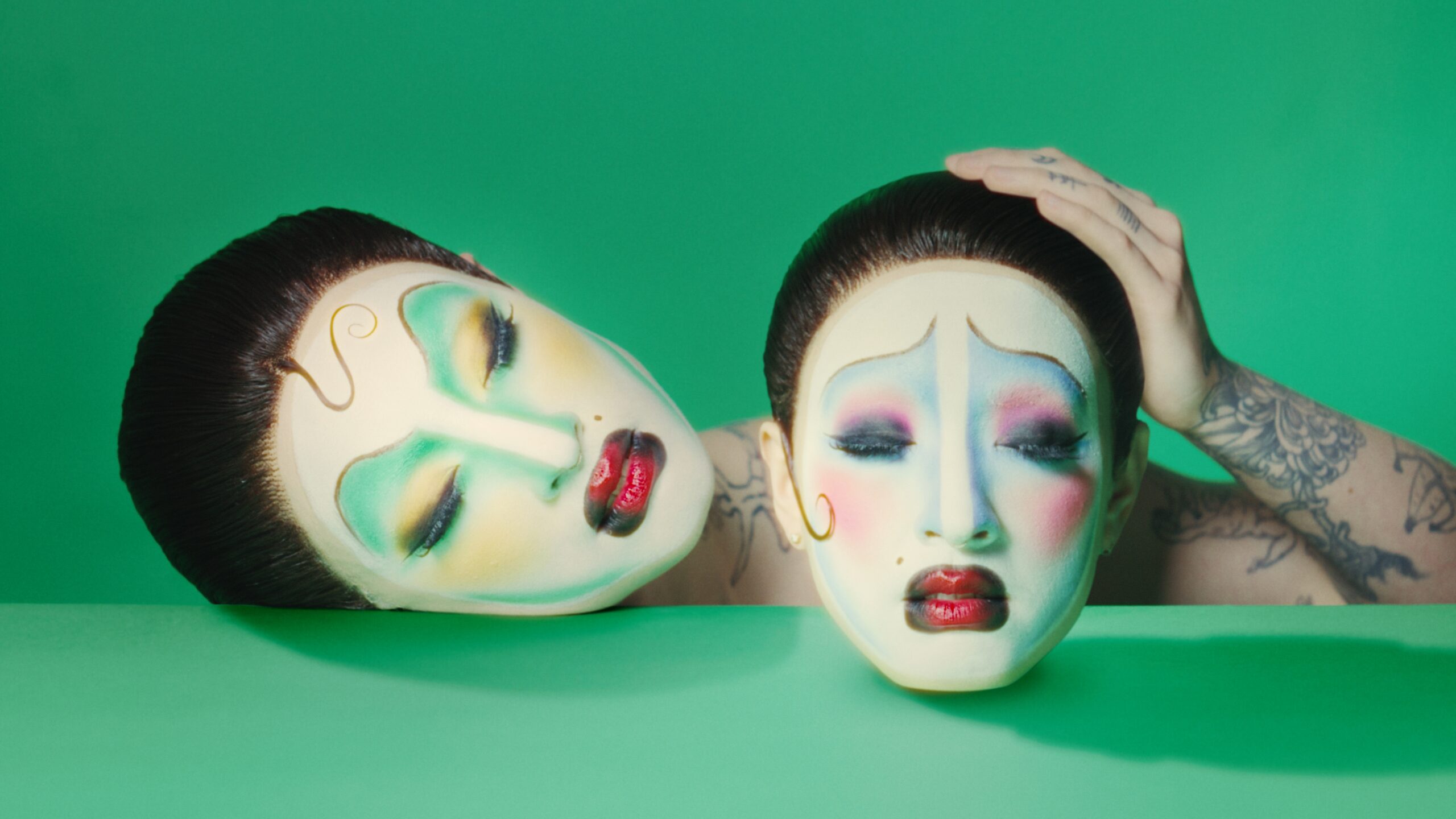
There’s a portrait of The Construct, a character that has two faces. It’s based on the Dan or the female role in Cantonese and Peking opera. And the two faces are reimaginings of that traditional makeup: one being in green and yellow paint, and the other in blue and red. In Peking opera, these colours are symbolic of opposing character traits — such as cruelty or selfishness, or loyalty and virtue. The two faces pose as Man Ray’s Kiki with African mask. This is also to bring in the conversation about the objectification of racialised femininity.
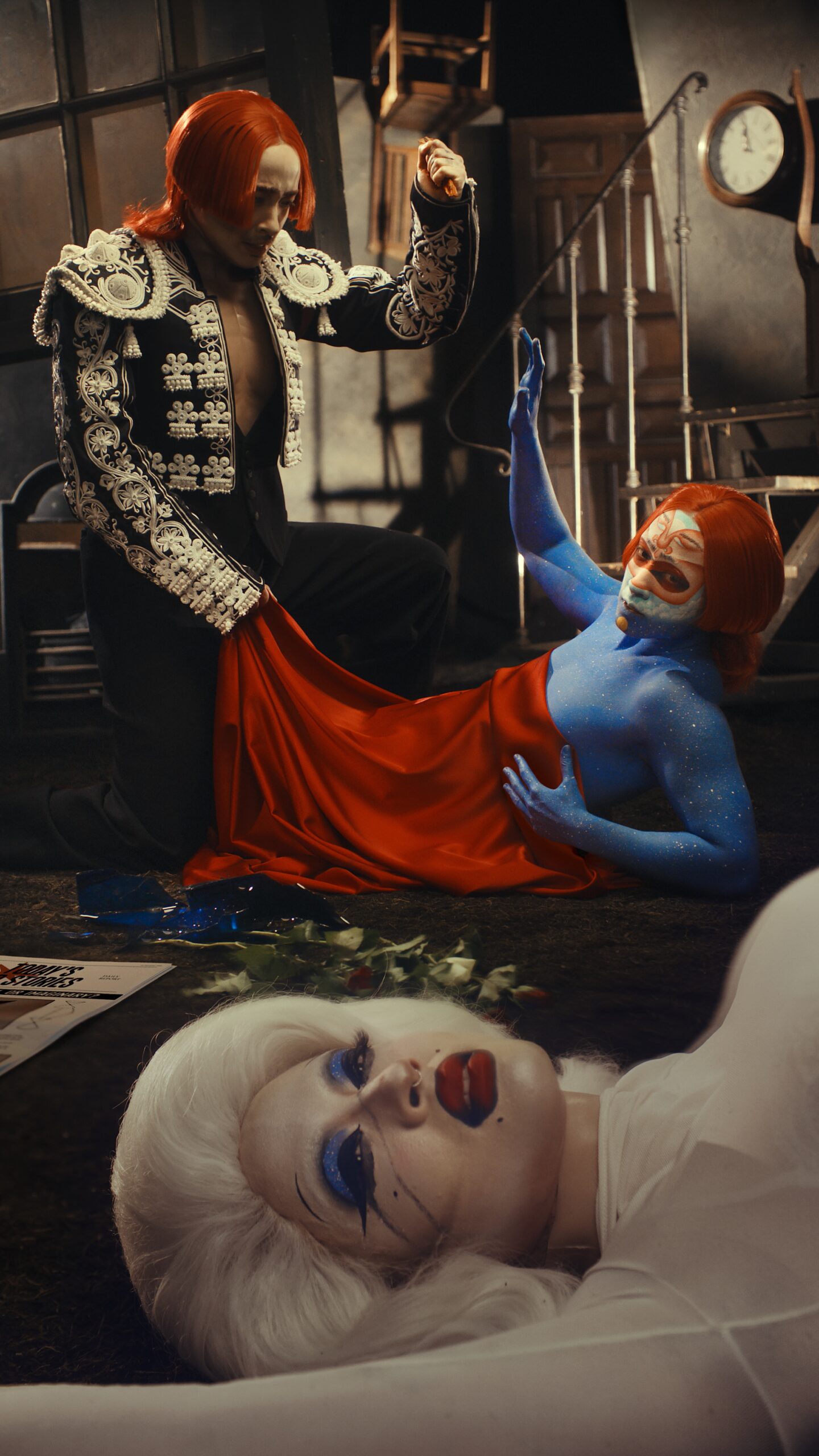
And what about your new video work, the portrait of your parents?
We’ve reconstructed my parents’ kitchen in a studio, which is painted all white: the table, the chairs, and then outside, there’s this kind of featureless, bright white. They’re sitting there, but it’s this kind of nowhere. In a very literal way, it references the Western context that they exist in. But in another more surrealist way, I’m trying to question their context, of where they are, when they are, or could be.
What was working with your parents like?
Both my parents and I approached this project as a once-in-a-lifetime opportunity to work together in this way. They were curious to see what my working process was like. It was challenging and rewarding.
How do you feel about exhibiting this very intimate part of yourself in a setting that is sometimes impersonal or very open?
I’ve always had this experience with my work, this tension that I have to deal with the personal and the universal, or the private and the public. As an artist, you can’t help but draw from your own experience to make works. And it’s scary to present sometimes. I do as much as I can to hide the personal details by abstracting them through science fiction or fantasy. I’m not sure how successful I am, but I think that’s what makes my work relatable. The portrait of my parents is a real representation of the environment that shaped me, with people who have extremely different perspectives in terms of gender, race, and culture. This nuanced representation of different perspectives meeting is something I don’t see very much in the world — and I relate to it very much. I often find the more open I’m able to be with my work, the more people relate to it.
For sure. It takes a very specific courage to show that, and people can feel it and connect with it. I wanted to talk to you about the linguistics of Still Life. To me, your work is so far from any kind of stillness, both in a literal sense of the medium, but also the un-stillness of these multiple characters and perspectives. What does ‘still life’ represent to you?
It’s definitely a little bit of an oxymoron when it comes to my work. I deeply believe that the only thing that is constant in this reality is change. But as somebody who depends so much on language and storytelling to communicate — both every day and in my work — I’m aware of the irony of using words and images, using representations. Because every word or image is something that attempts to hold something still that is constantly shifting. That is the tension that I’m trying to illustrate in this exhibition, in the idea of still life: a still life is a representation of something that is changing, and every still life is a kind of fiction.
It’s like a snapshot of something that escapes it immediately.
Exactly. And there is something a little bit sad about that, but it’s also very human.
Do you feel that sadness of trying to cling to a certain moment?
Definitely. But there’s also, within that sadness, something very beautiful and hopeful. As we come to terms with the fact that everything is changing and everything ends, it also makes space for new beginnings, for other things to happen, for new ideas, worlds, and existences. I think that a lot of harm actually comes from the fact that we’re so bad at letting go of things, and reckoning with the fact that everything is constantly shifting and changing.
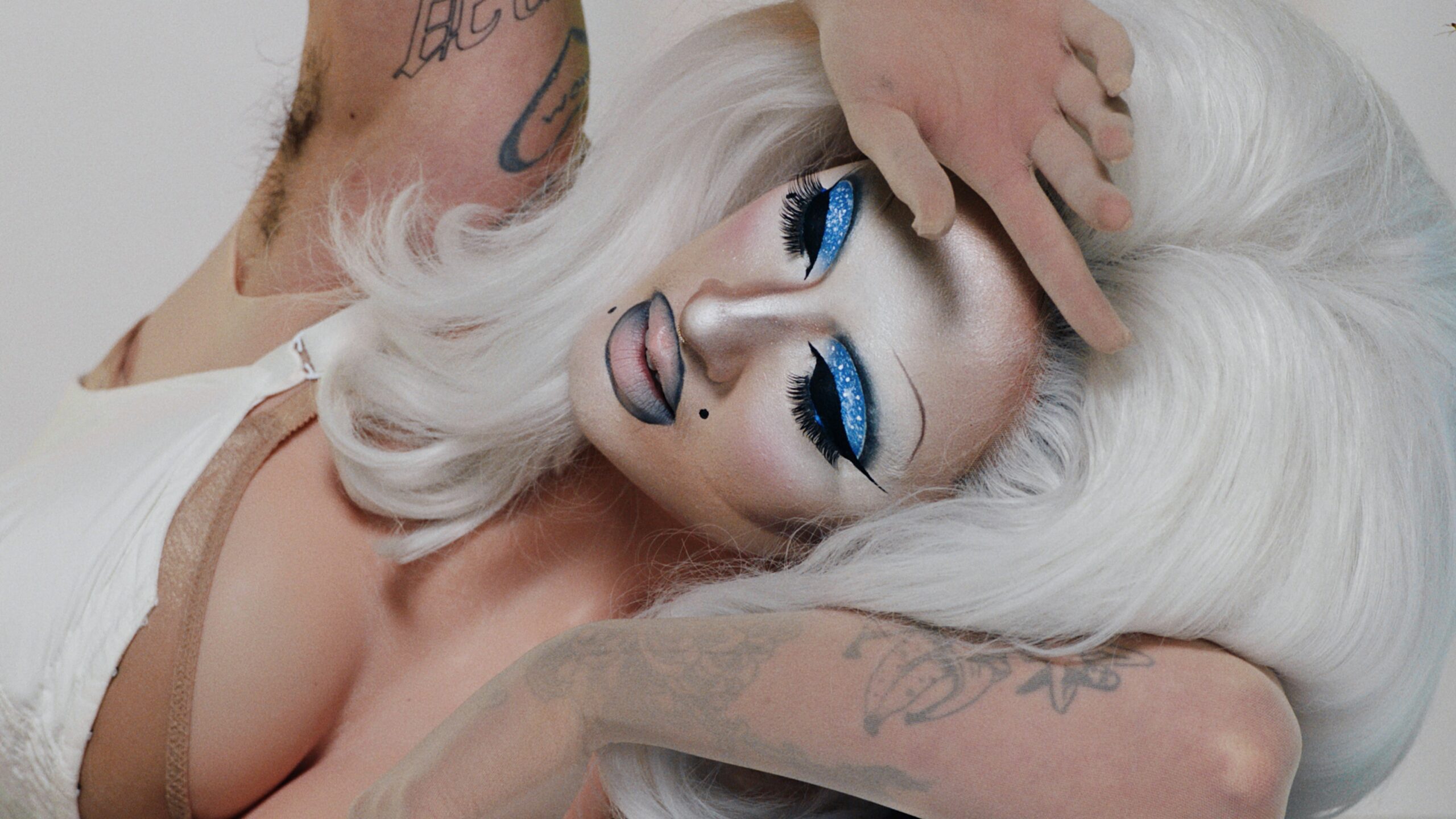
It makes me think of your approach to different characters and identities, again. I feel like I connect this to the Buddhist philosophy of the instability of the self, which can be a bit distressing. How do you reckon with the idea that the self is not fixed, and how does it manifest in the physical person I’m talking to right now?
Something that’s been very important to me as well — in the form of Buddhism and other ancient non-dualistic spiritual philosophies — is this idea of impermanence. As well as the idea that there is no self, a mind object that we cling to. This not being able to pin down a self is something that I have a lot of experience with in my life. And for anybody who exists between categories, there’s also this experience of the slippage of always looking in from outside of systems. I take great comfort in this idea that identity is something that we leap to and cling to, but is a kind of fiction.
It’s something that has been confirmed for me in research that I’ve been doing into the neuroscience of consciousness. Anil Seth talks about how our experience of reality is like a controlled hallucination, it’s projected from inside. There is no truth to the idea of a self or of a continuous existence. The idea that I am the same person now as I was 20 years ago is completely false and ridiculous to even imagine.
Would you say your characters also represent that unfixity or detachment from a different self?
I’m somebody who loves change because I think that I very easily feel trapped in something. In most of my works, the characters, when they reappear, it’s as a different gender with a different haircut, and a different personality. It shifts because the context that I put them in is not the same. I’m trying to also illustrate that your identity comes from this meeting point of how you are treated by the world and the beliefs that you have about yourself, and it’s this kind of cycle of cause and effect.
As you said, nothing exists in a vacuum in that way.
Exactly. It’s important to have in mind that identity is a relationship that the world has with us, and it’s not something that we are doing on our own. The reality that we exist within is shaped by identity, because we live in a world shaped by all of these histories of colonialism, patriarchy, and capitalism, which are enacted and proliferated by people who have specific perspectives, an identity.
How do you position your narratives within all of this?
My narratives are attempting to move beyond any kind of existing categorisation and structures by laying bare the structures that we exist within, so that we can be aware of them. It’s impossible to exist outside of those structures because we are reflections and products of the context in which we were produced. Take the English language, which has embedded within it all of these histories of colonialism, patriarchy, and capitalism, and it’s impossible not to reproduce these ideas as I speak. How do we dismantle the master’s house if the master’s tools are all we have?
It’s hard to think of how we escape those systems.
Step by step. I already believe that it can cause a certain shift in consciousness, even if it’s not a total escape. Yeah, I think we have to, we have to try to imagine what that would look like, what that could feel like, and to move towards it. Probably, it’s something that right now, we cannot even imagine. But we have to try.
I’ve also seen science fiction being referred to a lot in the context of your work. Would you say that using a certain utopian or alternative vision of the world is a catalyst for that possibility?
Definitely. I use science fiction, fantasy, and speculative fiction to try to represent realities that are experienced in a way that is both more accurate than, and not possible with the representation of the reality that we see around us. At the same time, I’m interested in this binary of reality and fiction, or objective and subjective knowledge, in relation to narratives that happen both in science and in fiction. Often science fiction depicts worlds that 20 or 30 years later become true. We’re seeing this right now. We’re living in this kind of Venn diagram of all of these ideas that were written in the eighties or even earlier. I identify more with a lot of science fiction authors who have used it to write fantasies that feel more true than nonfiction ever has for me. I often refer to revisionist, feminist, and queer scientists, such as Joan Roughgarden, who is a trans biologist whose theory goes against sexual selection. Or Karen Barad, who reads Niels Bohr through Judith Butler to think about how there is no such thing as objective reality or an observer-independent universe.
Do you have any favourite fiction works in which you’re now seeing these crazy parallels to reality?
I mean, 1984, Brave New World. And the whole Parable series by Octavia Butler. There are too many to name, but I would say those are the main ones that I keep on thinking about in terms of the relationship of the media and government and truth.
Objectivity is such an interesting concept, and you can observe how easily it crumbles within these scientific protocols.
It’s scary to think that we believe objectivity exists in these scientific narratives because then they’re put into textbooks, and then they are taught in schools as true. Which in turn shapes culture. As humans, we completely construct the environment in which our brains are shaped and grow. There’s this idea that I encountered in Buddhist philosophy, which I really love and keep on repeating to people, “once you know something, it’s in the past.”
That’s a beautiful idea. To finish off, could you tell me what you’re most looking forward to in the exhibition?
I’m really excited about presenting this new work. I feel like it is a big departure for me in a lot of ways, a door to a new way of working that I’m going to be pursuing in the future.
Visit Sin Wai Kin: Still Life at Frans Hals Museum until August 30
Words by Evita Shrestha
Images Courtesy of the Artist