Running through May 14-June 28 in Arnhem (NL), here are the ins and outs of this year’s edition
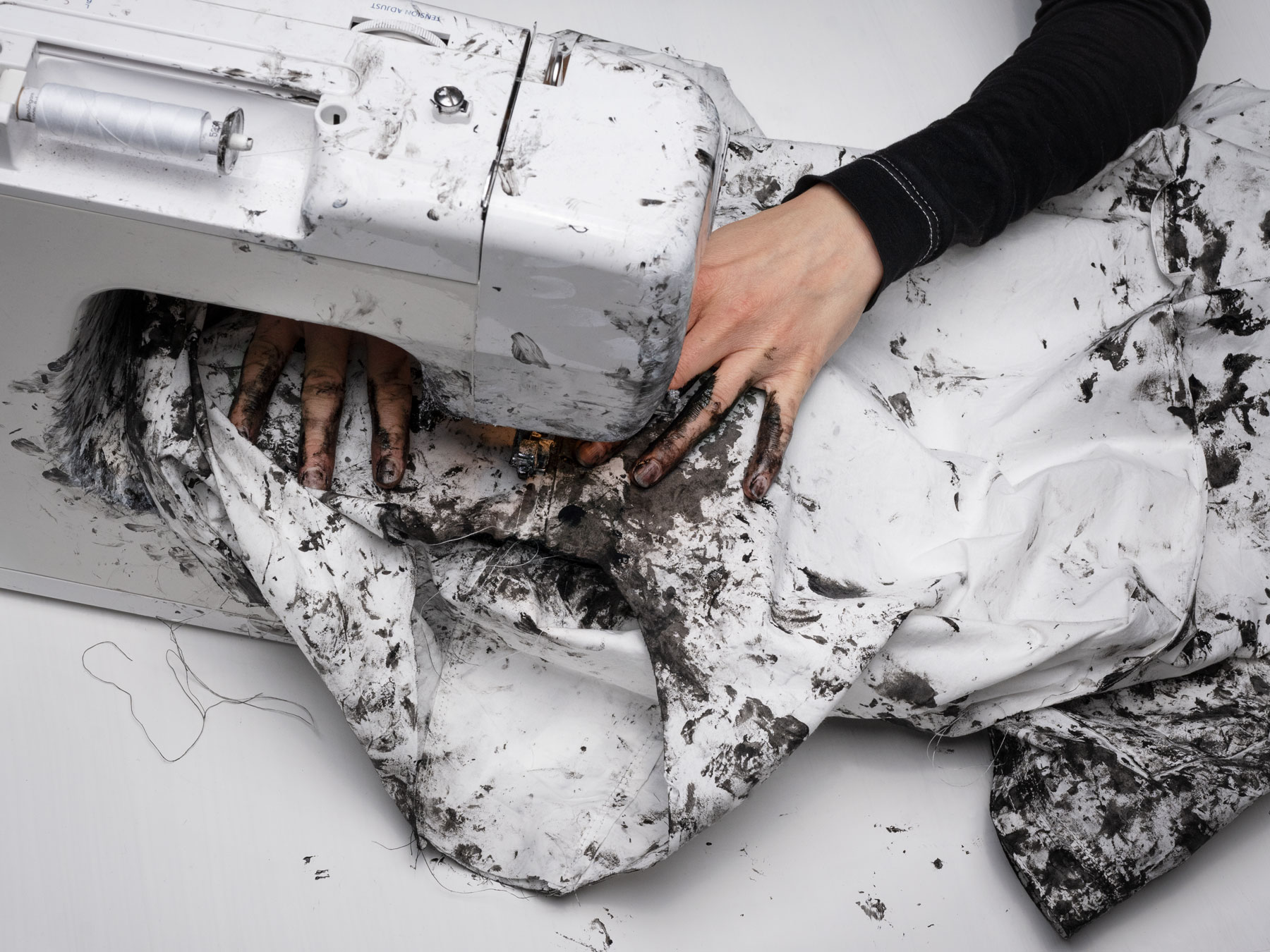
HUMAN TOUCH, paint-sewing, 2024, STUDIO MIME
Fashion is good at pretending it’s just something you look at, want, wear, and then move on from. The State of Fashion Biennale 2026 doesn’t really allow for that kind of distance. Titled Available to Promise, this year’s edition shifts the focus away from the finished image and into everything that quietly holds it up behind the scenes: systems, routes, labour, data, desire, the parts you don’t usually see, but shape the entire world around it anyway.
This edition sheds light on the tension between what is seen and what remains hidden by moving through five pillars: Develop, Distribute, Hype, Experience, and Transform. Installations like a live flax field experience, film and documentaries, video games (you can cosplay as Julia Fox in one of them), exhibited garments, workshops, and talks all come together to make up the rich program. It’s also through multiple meticulous collaborations, such as ONsite research residencies in China, Ghana, and Sri Lanka, and the International Library of Fashion Research in Oslo, that ground the whole thing in something real and tangible.
Ahead of the Biennale’s opening on May 14, we spoke to the curators — Anouchka van Driel, Anne Zhou, and Shanu Walpita — about what happens when fashion is approached not as an object, but as a system you’re already part of, whether you want to be or not. And it’s through careful weaving we move through each pillar, unraveling the ins and outs of the themes, decrypting what hype means today, and how transformation is made tangible.
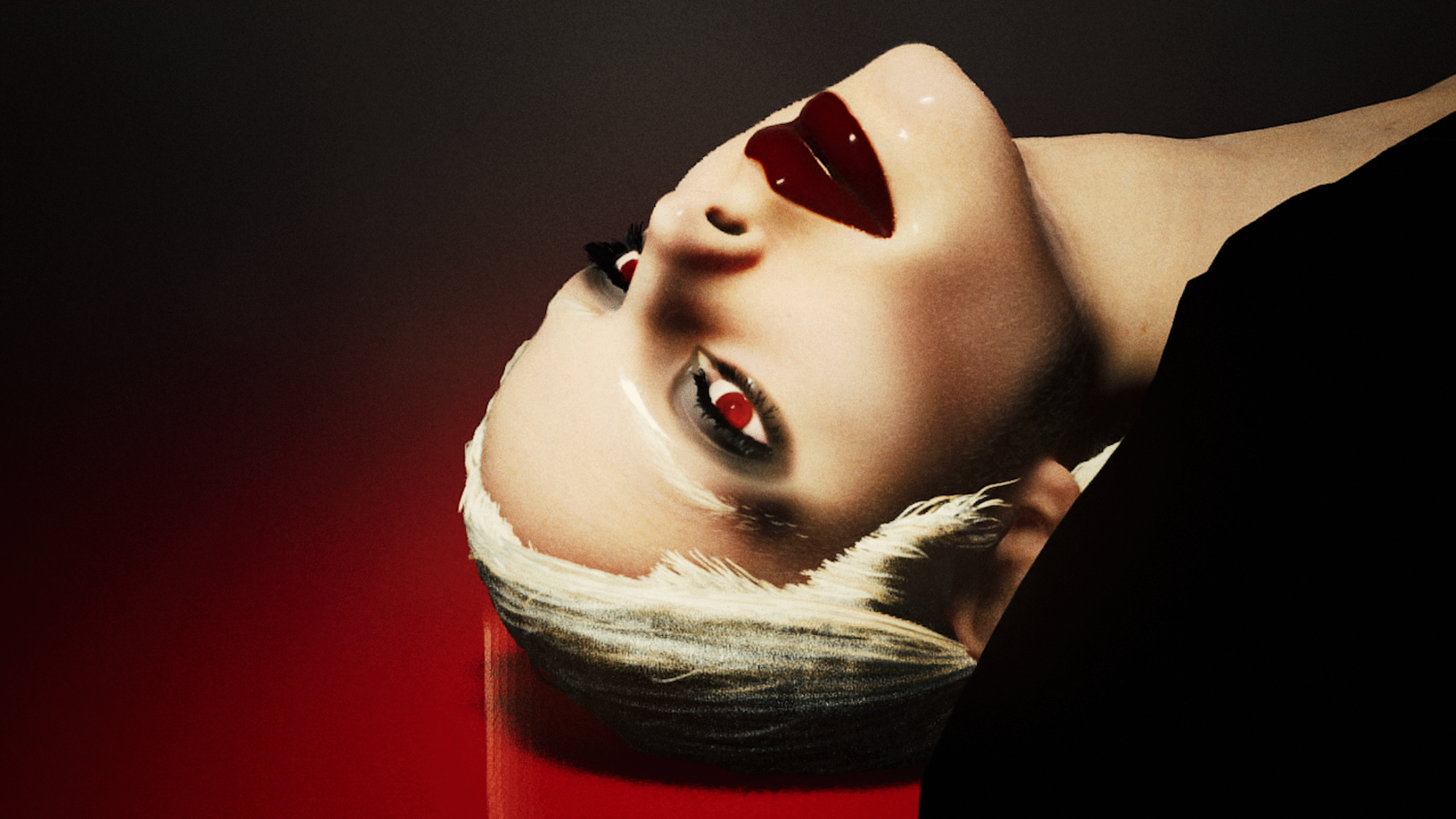
Daniel Felstead & Jenn Leung, Jankspace: Residues of The Stack, 2026
For someone who’s never been to the State of Fashion Biennale, tell us what it’s all about!
Well first, you don’t need to be a fashion-insider to explore the 2026 State of Fashion Biennale. We welcome everyone—no matter your background, interest or level of fashion knowledge.
State of Fashion has evolved over time. It began in 2005 as the Mode Biennale — initiated by ArtEZ — and was reintroduced in 2018 as the State of Fashion Biennale. This edition continues that movement, but turns its attention more explicitly toward what sits behind the image. And the spotlight turns away from garments, and onto fashion’s complex systems, such as its network of materials, technologies, labour, infrastructures, and cultural narratives. Simply put—it’s a fashion exhibition unveiling what is unseen.
And what’s the particularity of this year’s edition?
The exhibition unfolds through five interconnected pillars: Develop, Distribute, Hype, Experience, and Transform, alongside ONsite research residencies in China, Ghana, and Sri Lanka, developed with local interlocutors and makers. Together, they trace fashion’s hidden infrastructures through multidisciplinary works that bring together a plurality of geographies, voices, and lived realities.
Visitors will have the opportunity to view films and documentaries, engage with livestreaming AI avatars, play as Julia Fox in a custom video game, and explore various installations and experiential activations. Some garments will still be featured too though, with pieces from some of our favourite established and emerging designers.
We’re also doing a partnership with the International Library of Fashion Research, where we’ll host a library displaying rare magazines, ephemera, and exclusive fashion invites. And during your visit, you’re invited to contribute to their archive.
Can you tell us more about your curatorial approach?
For this edition, our curatorial approach explores and focuses on the tensions between what is seen and what remains hidden. We are as invested in our participants’ ideas, processes, and storytelling as we are in their final projects and garments. And to reflect this, our spatial partners, OMA, have created a dual-layered exhibition design. The first layer is dedicated to the artifacts, and the second one to the ‘behind-the-scenes’ process. This separation allows visitors to engage with the work as standalone pieces, or deep-dive into the development and inner workings of each participant’s project.
The title Available to Promise comes from logistics language. What drew you to that phrase?
In thinking about a theme, we wanted to look at the larger implications of fashion, the systems in place behind it, how things are interconnected. And ultimately, there is a whole chain of events, things, objects, people, time, capital, politics and so on, which are all connected to one single garment.
At the same time, we were looking for an evocative, but also poetic title to capture all of that. So we decided to jump into the jargon — literally — and dug through lengthy lists of supply chain terminology, and there in those lists it stared back at us: ‘Available to Promise.’ It was vague enough, poetic yet strange enough, while also compelling. Of course, it carries an openness in having the word ‘Available’, and then there is the very loaded word that is ‘Promise’. This loadedness is something that we liked, but at the same time, it’s also not what we wanted to single out — the emphasis is on the whole phrase, and how it sits together and allows people to have their own interpretation.
Who do you think fashion is currently failing to keep its promises to?
We operate in a world where promise is in surplus. Fashion has a tendency to promise us newness and status — a new look, a new trend, a new me and/or us. But these promises come at a cost. Are the promises brands make to produce clothes failing the labourers in factories? Are promises putting a strain on our planet’s resources? Who are we making promises to, and to what end? At its most basic level, the biennale queries whether ‘ to promise’ is an extractive act. And alternatively, it also presents ‘promise’ as a vehicle for transformation and speculation: a promise for betterment.
We’re careful not to isolate or overemphasize the word on its own, but rather to consider it as part of a larger constellation, much like in ‘Available to Promise,’ where meaning emerges through the full phrase and the systems it gestures toward.
Now let’s get into the pillars that define the festival. You start at ‘Develop’: the making part of fashion. What will ‘Develop’ actually look like in the exhibition?
The Develop pillar tracks fashion as it emerges through acts of imagining and making, such as spinning, weaving, dyeing, and forming. It’s the starting point which can be at different levels, like the seed of a flax plant, an idea or concept in the mind of a designer, a computer code or bodies and hands that make and form things together.
For example, you’ll encounter a live flax field, the linen garments worn for the cultivation of flax by The Linen Project, a documentary about Chinese factory workers by renowned film-maker Wang Bing, paint-sewn garments by HUMAN TOUCH, and a multimedia installation by Olena Newkryta. We will debut our first ONsite project by Fibershed Sri Lanka and designer Shasha Mahanama, who spent months working closely with an artisan community to learn generational weaving techniques. Each project in this pillar captures traces of place, knowledge, and care — revealing the creative potential and entanglements of extraction, trade and transformation.
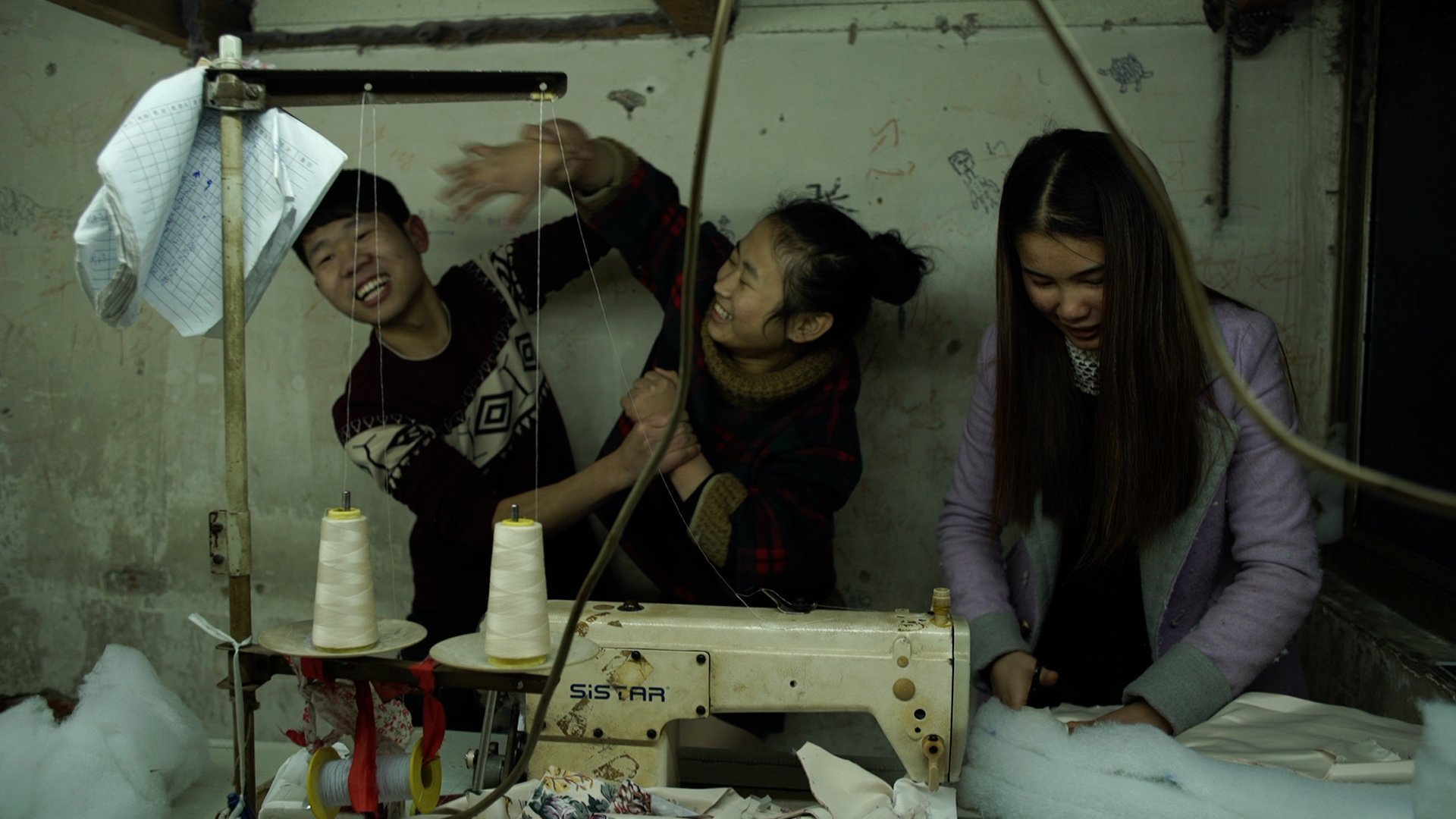
WANG Bing, Youth (Spring), nine-channel video installation, represented by Wil Productions, Courtesy of the artist, 2025
How do you want to change the way we think about where clothes come from?
Well, we hope people will come to understand that clothes don’t exist in a vacuum. A t-shirt has crossed borders, and hands to eventually end up in a wardrobe. Fashion isn’t just about the clothes we wear, it’s about how each garment holds stories, cultures, histories, political perspectives, and skills. And, it’s a shame that we’ve been programmed to see them as items to discard, rather than cherish.
We’re interested in making all these trajectories more legible — not as a moral instruction — but as a way of complicating authorship and value. A garment is never singular. It’s the result of negotiations between infrastructures, labour conditions, logistics, materials, and time. By foregrounding these entanglements, we hope to shift attention away from the idea of origin as a fixed point, and toward a more distributed understanding of making where responsibility and agency are also shared, unevenly, across that chain.
Let’s continue with the pillars. ‘Distribution’ is usually an invisible world to most consumers. How will you be turning fashion’s routes, systems, and logistics into something visitors can actually see or feel?
Behind every shipment lies a story of labour and loss, of efficiency and inequity. The biennale traces these routes to see how movement itself structures the global imagination of fashion. Ports, warehouses, data servers, factories and hands become focal points.
We felt that MSCHF’s Global Supply Chain Telephone exemplified the distribution pillar. True to MSCHFs playful USP, the project follows a handbag as it moves through a sequence of factories across Peru, Portugal, India, and China. What appears as a single product is the result of fragmented authorship and geographically dispersed production. A different take on the pillar is Sky High Farm Goods, who will debut their collection with Levi’s. They’ve utilised transitional cotton to tell a deeper story of farmers shifting from conventional to organic practices.
What kinds of encounters or moments can visitors expect at the ‘Experience’ pillar? This is where things get closer to the body. The Experience pillar focuses on fashion as something lived rather than observed. And it’s through installations, film, and interactive works, that visitors move through environments that focus on perception. We ask how clothing shapes the way we see, feel and relate to others, and how garments act as carriers of stories, meaning, culture and history. In doing so, they invite visitors to navigate, respond and become aware of their own presence within the space.
For example in When the Body Arrives by CAULFIELD–SRIKLAD, that tension comes into focus, as garments wait for the body to enter, while the film tracks the intimate gestures of dressing and undressing — layering, anticipating and lingering. This is echoed differently in Yoshita 1967, where a selection from the Temple Road collection draws on Kenyan-Indian heritage, embedding histories, inherited memories and the trace of the hand within each garment through meticulous craft.
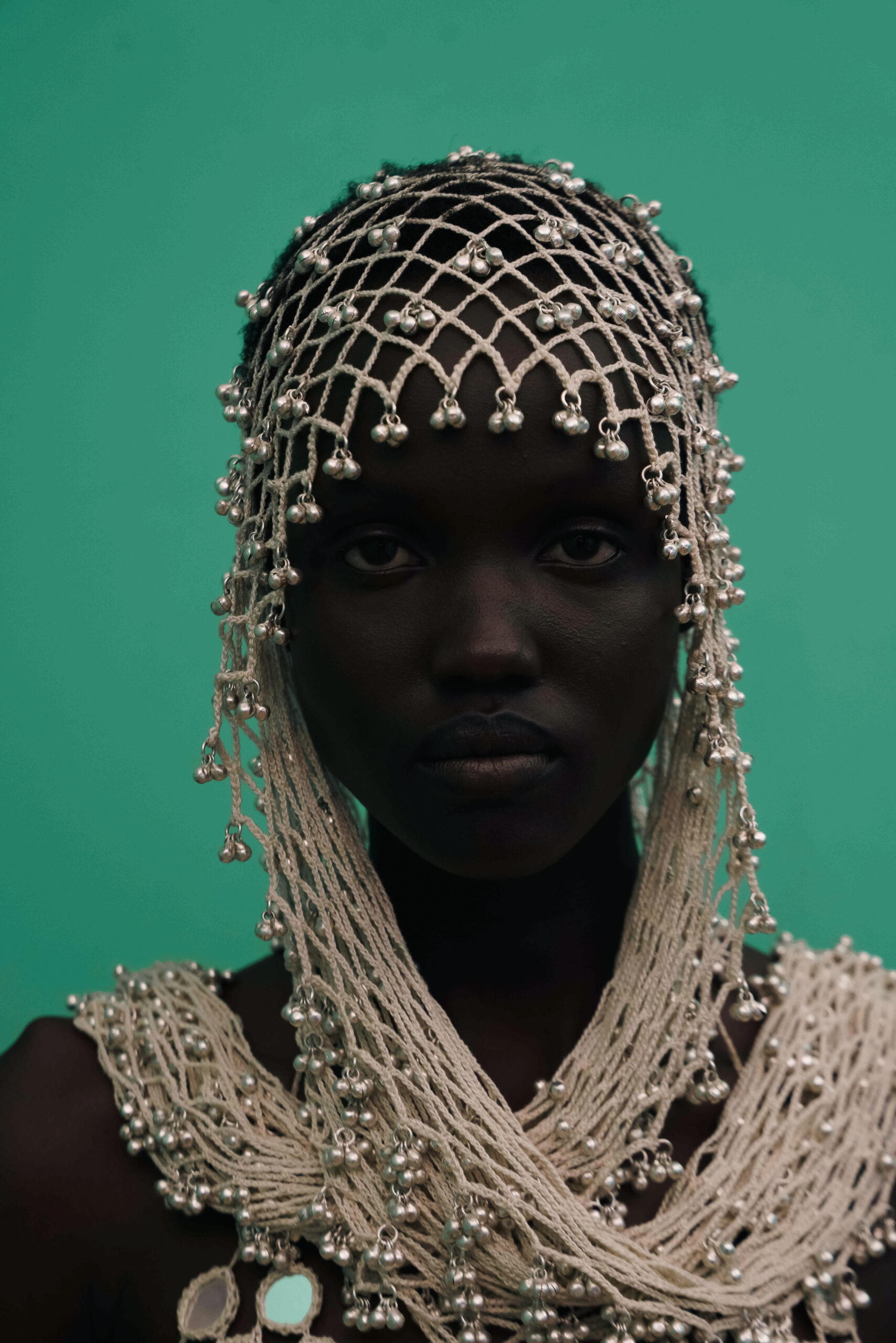
Yoshita 1967, Temple Road Collection, 2025, photo by Fred Odede
Then, the ‘Hype’ pillar feels very relevant now: algorithms, attention, constant scrolling. In what ways can we control what we want, or is desire designed for us?
Desire today rarely emerges in isolation. It is shaped, nudged and continuously recalibrated through the systems we move within, from recommendation engines to trend cycles that accelerate faster than we can process them. What we encounter, and how often we encounter it, begins to structure what feels familiar, desirable, and even necessary. In that sense, desire is not entirely our own, but co-produced by infrastructures that are largely invisible yet highly effective.
At the same time, we wouldn’t reduce it to pure determinism. There are still many moments of friction, hesitation, refusal, where desire can shift, misalign or be redirected. The question is less whether we fully control what we want. But more how aware we are of the conditions under which wanting takes shape, and whether we can create enough distance to relate to it differently. So, the ‘Hype’ pillar tries to open up that space, not to step outside of these systems entirely, but to recognise how they operate and where there might still be room to intervene.
Is hype something we should resist, or is there a way it can be playful, even empowering?
Fashion relies heavily on virality, desire and attention. With the biennale, it presents alternative ways of framing hype as a site for agency, critique, and play. Hype speaks into the algorithms, the cores, the aggregation of noise and cultural currency — as exemplified by our participants Martine Rose, International Magic, LiFE DESiGN, Charlotte-Maeva Perret, and He Jing. And so is it even possible to resist hype? We’re not sure. Instead, hype can be seen as a necessary tool for community-building and storytelling.
Yeah, and transformation can be a big, abstract idea. How can something restless, in transition, become more tangible while on the ground, at the biennale?
Transformation often risks remaining at the level of language, something we gesture toward without fully grounding it. And with the Transform pillar, we wanted to bring it closer to material processes, to things that are already shifting, mutating or being reconfigured in real time. This includes practices working with bio-based materials, engaging the more-than-human world, or exploring AI and digital environments, but also very direct acts of transformation, where existing garments are reworked into new forms, new uses and new economies.
What matters here is that transformation is not presented as a distant future scenario, but as something unfolding through concrete practices, techniques and collaborations. It can be slow, fragile, even contradictory. By placing these different approaches side by side, the biennale makes transformation tangible as a set of ongoing negotiations between materials, technologies, ecologies and livelihoods.
‘Transform’ suggests change, but also uncertainty. Do you feel optimistic about the future of fashion systems, or more cautious?
Perhaps we are optimistically cautious? Or cautiously optimistic?
It’s difficult to see past the doomcore, slop, political fissures and ecological collapse. We didn’t want to negate or flatten these issues, so when we conceptualised Available to Promise, we knew we wanted the biennale to critically examine the fashion system, but also propose alternatives. We were asking ourselves questions such as, ‘What can we do differently?,’ ‘What needs to change?’
We feel optimistic about the fact that there are people actioning change. Such as Rosie Broadhead, who has developed material that has the potential to support immune function, stimulate cell renewal, and provide antioxidant and anti-inflammatory effects for wearers. We’ve also obsessed with our Ghana ONsite partner The Revival — a community-driven, sustainable fashion initiative that addresses textile waste through upcycling education and job creation.
If visitors leave with just one new habit or awareness, what would you want it to be?
We’d wish them to leave with an awareness of connection, and of what is made available to us. And that what we wear isn’t just personal, or accidental. It’s shaped by systems, people, and places that extend far beyond the moment of purchase, determining not only how things are made, but what reaches us in the first place. Every garment holds a chain of decisions — how it was grown, made, moved, marketed. Who touched it, who profited from it, what it cost to bring it into being, and how all of that is distilled into something that still asks to be desired, to be worn, to feel beautiful.
And finally: what do you hope people are still thinking about on the train ride home?
We hope that the conversation doesn’t stop when they leave. That they continue to carry it with them onto the train, into dinner, into conversations with friends, with family, with their grandparents. Because the questions the biennale raises sit inside everyday life.
CAULFIELD–SRIKLAD, When The Body Arrives, 2026, photo by Ieva Blaževičiūtė