Fashion, AI, and the new luxury of the real
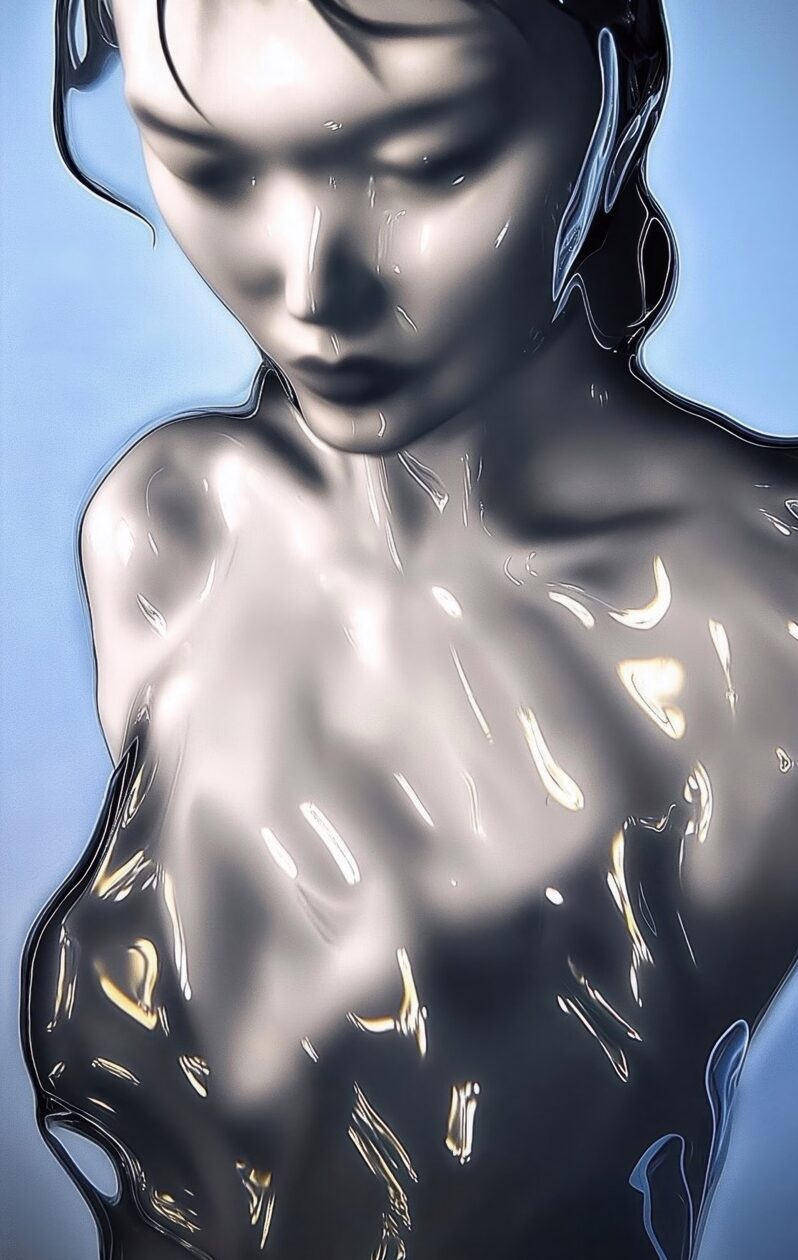
Hindi Sousan, Overdose 4, 2025
Anyone with a remote digital pulse has been swept into the avalanche of AI — its content, its critiques, and its critiques written by AI itself. While the internet foams at the mouth (in worship or in rage), Glamcult set out on our own mission to ground ourselves, cutting through the inescapable discourse affecting every node of the creative industry that is already hanging by one flimsy, morally questionable thread.
For this feature, we were graced by the words of Luna Sferdianu who has her fingers in many pies: model, who has to contend with ethically dubious beauty standards and a potential digital replication of her every cell; writer, whose word-moulding linguistic talent is at risk of being buried under ChatGPT’s incessant em dashes; critic, whose academically-substantiated, dialectically-analysed hot takes pierce through lukewarm ambivalence and the rise of anti-intellectualism; and, importantly, a meme-page owner, who has equal insights into gen-Z’s infamously cynical and cheekily affront humour, as well as the mysterious workings of the algorithm.
In conversation with collaborators Hind Sousan, the artist expanding makeup through AI, and Michiel van Maaren, the casting director behind some of Glamcult’s fav editorials, Luna meditates on beauty, simulation, and the amorphous yet undeniable figure of the “human factor.” Across these pages, she takes us by the hand into an era we cannot escape — but must learn to carry without losing our spine.
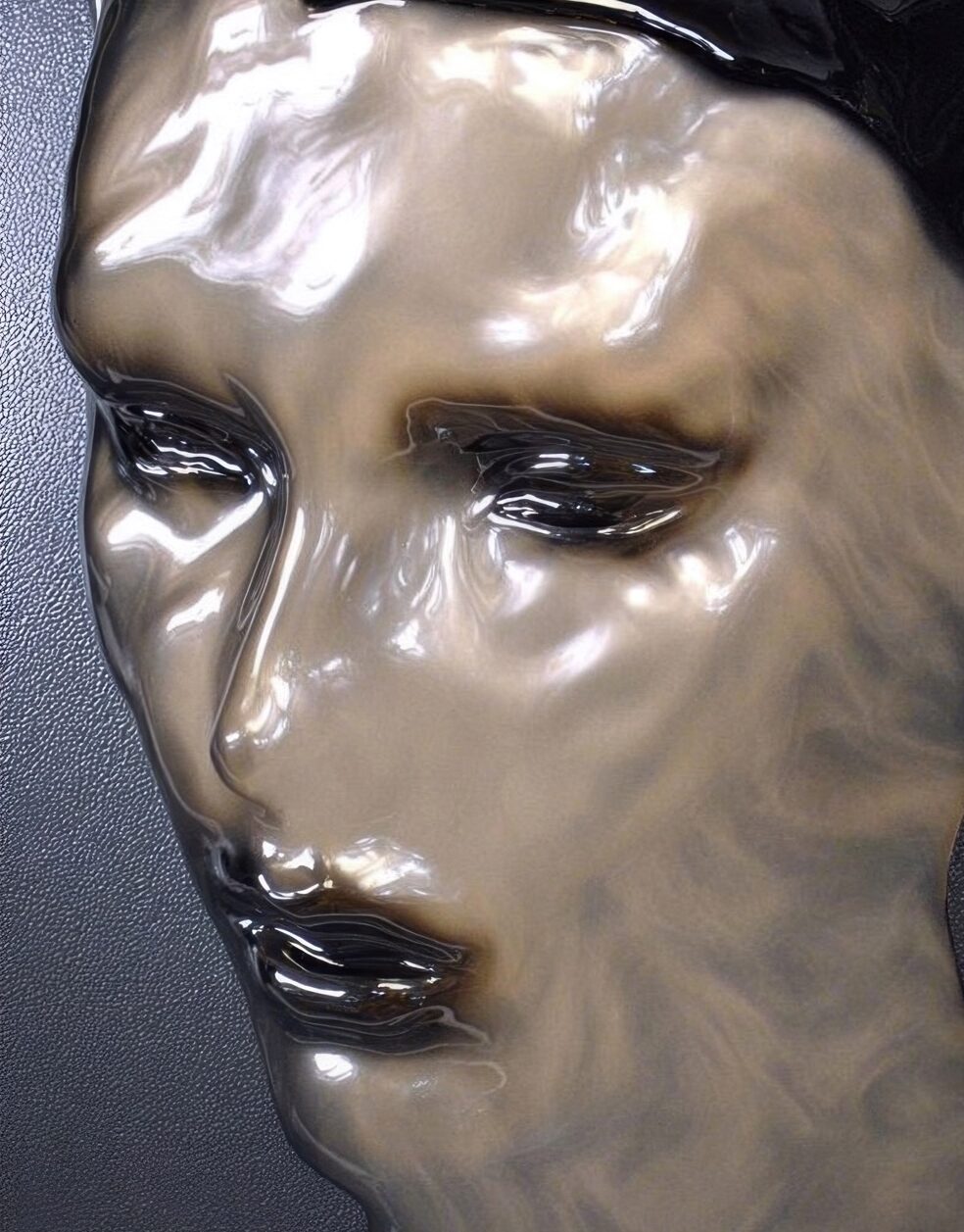
Hindi Sousan, Overdose 1, 2025
“I believe in the future. I think you need to imagine a future and live in it. I believe in unfathomable quantities of nourishment. We are but humble carrier craft of the program. Shortly, like obsolete updates, we shall be gone.”
— Olga Ravn, The Employees
In the unlikely case you haven’t felt it yourself (or haven’t read about it in an endless stream of media scuffing it around for entertainment or some sort of legibility), I’m going to point it out myself — there’s a garbled tide washing over our world today. The cynics would point out the unarguable: the political scape feels like a circus, job opportunities dwindle in a downward spiral (hope you already started curating your 2008 recession-core Pinterest board), people’s views steer ever-so-slightly rightward on the political compass, while our freedom to criticise it all gets ever-so-slightly more penalised. Of course, fashion does not escape from the clasps of this mysterious conjuncture we’re facing.
The rise of artificial intelligence (as the complementary catalyst of the discourse) topples it all in a way that may not be hot news anymore, and whose mention may come off as superfluous. Whatever personal beliefs may come in our way of grappling with the zeitgeist, it is defined by its assimilation of machine learning models and their derivatives; their effects are ever-pervasive, percolating every faction of our consumption behaviours, algorithmic preferences, and, as of lately, self-perception. AI carved its own reigning spot into our volatile paradigm and, with no presumptuousness, is here to stay — whether as an active craft, or latently, as part of inconclusive discussions with your AI-afficionado dad, your nail lady, or your employer. It feels like no matter anyone’s stance on it, AI imposes itself onto us like a persistent, looming force. In that sense, it feels similar in its qualities to the building in John Smith’s 1987 short The Black Tower, where a man is perennially haunted by an obscure, hard-to-identify, pitch-black monolith (if you haven’t watched it, I highly recommend, at least as visual support for this piece).
It’s hard to contend with the facts in a manner that’s not alarmist by nature or compliant with this ambiguous new order of organising art and content. It is equally difficult to assume an earnest position that can redeem you outside of the rituals of lamentation or veneration of generative AI. We’re not here, however, to feed you either more cynicism or AI-apology on a spoon. As people who are integrated in the microcosm of fashion, i.e., a space incredibly prone to subsumption into the AI discourse, how do you explore it detachedly, since its escaping proves to be far from ever being a possibility? Both as a fashion journalist and a model, I can see, without meaning to sound hyperbolic, how the concepts of beauty and fashionability are changing by the minute. Traditionally, unrealistic beauty is already packaged as a commodity and sold for a price unafforded by most, even by the ones who claim to possess and further perpetuate it. What happens if the fashion market toils into a rightful technocracy? In an industry where both models and the direct consumers of fashion already face demonic voices when it comes to their own bodily image, what happens when the nefarious beauty standards switch from the traditional hurdles of humanness into a competition against the algorithm itself?
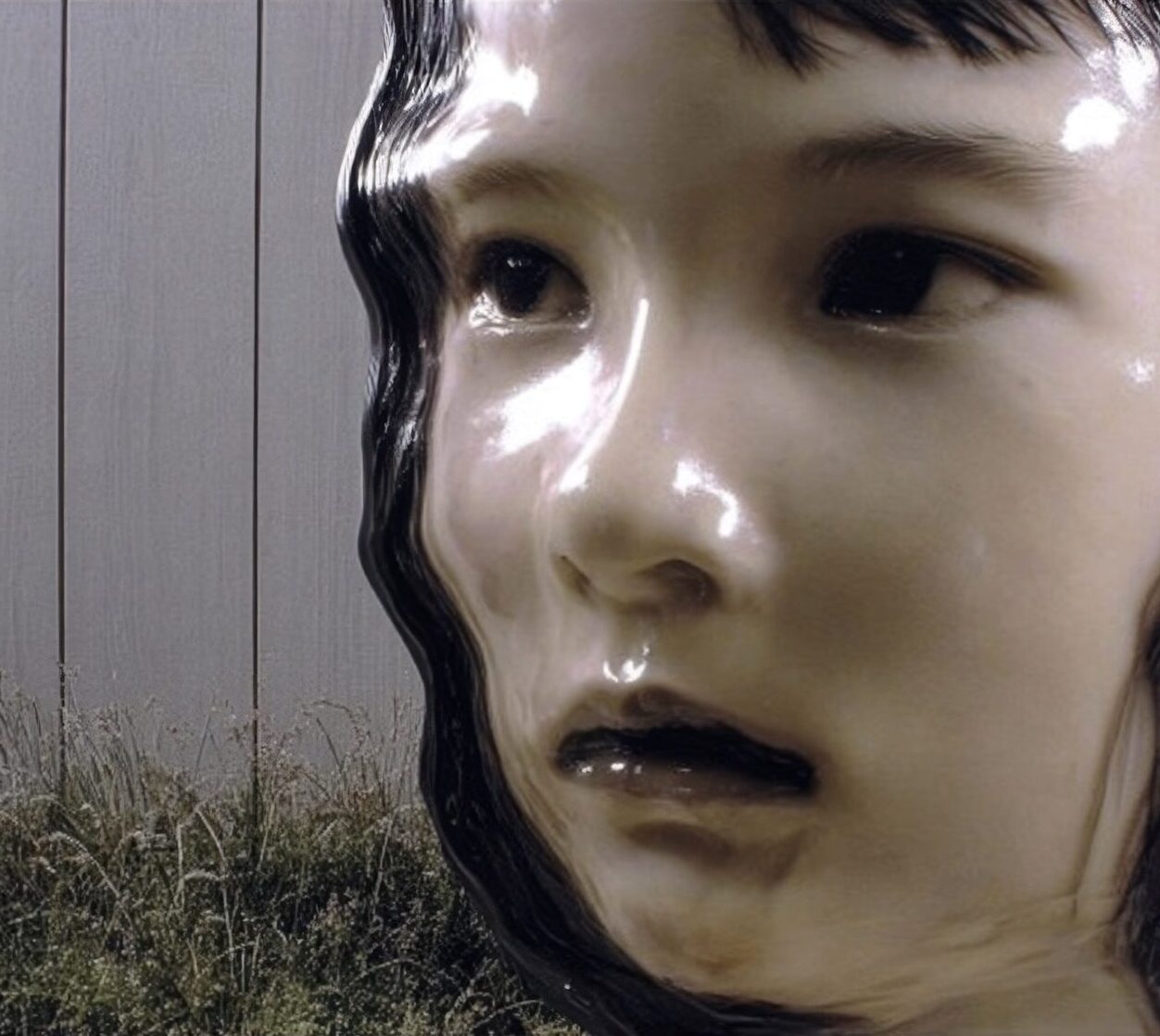
Hindi Sousan, Overdose 3, 2025
Hind Sousan — an AI-make-up artist I previously interviewed this year as I was enticed by her praxis, posits the emergent technologies as carrying emancipation for the domain of beauty, in contrast to the gloom-mongering tone of the dialogue unfurling around them. As a forefront combatant in her field, she is firm in her stance of AI’s posthumanist qualities — she sees them as heralding a new cultural epoch, where bodies become sites of exploration without being limited by any previously presumed biological essentialism.
“AI touches directly on self-image, and self-image is intimate, almost sacred. This tension between desire and fear is part of the process — it fuels it. […] AI opens breaches. It allows you to see yourself differently, to inhabit several faces, to escape the prison of a single reflection. It offers an aesthetic and identity freedom that goes beyond rigid standards. It makes it possible to explore imperfections and singularities, not as flaws to erase, but as materials to sublimate.”
For artists like Sousan, whose ethos stands for commenting on our human constraints, binding them to AI’s supposed transcendental capacities comes as a natural immersion into the current climate. In the way she speaks about it, it is revealed as a mere assessment of intentionality — “It’s not about a frontier between “real” and “virtual,” between “true” and “false.” It’s a question of intention: do we use AI to conform, or to reinvent ourselves? The distinction is between submission and experimentation, between standardization and freedom.”
Intention is, indeed, one of the defining stakes of the discourse — but as I am writing this, Vivian Wilson’s Instagram story from about two weeks ago pops into my mind, where she was complaining about the vast and uncanny AI facsimiles of herself freely circulating on the internet. Obviously, without her consent, and frighteningly analogous to her mannerisms, her voice, her facial movements. While 10 years back we were amused by AI’s completely fallible replication capacity, deepfakes taken straight out of an Alex Garland movie are invading our public consciousness and private physicalities. Their development supersedes our capacity to legislate them, while their real danger keeps expanding its degrees of freedom exponentially.
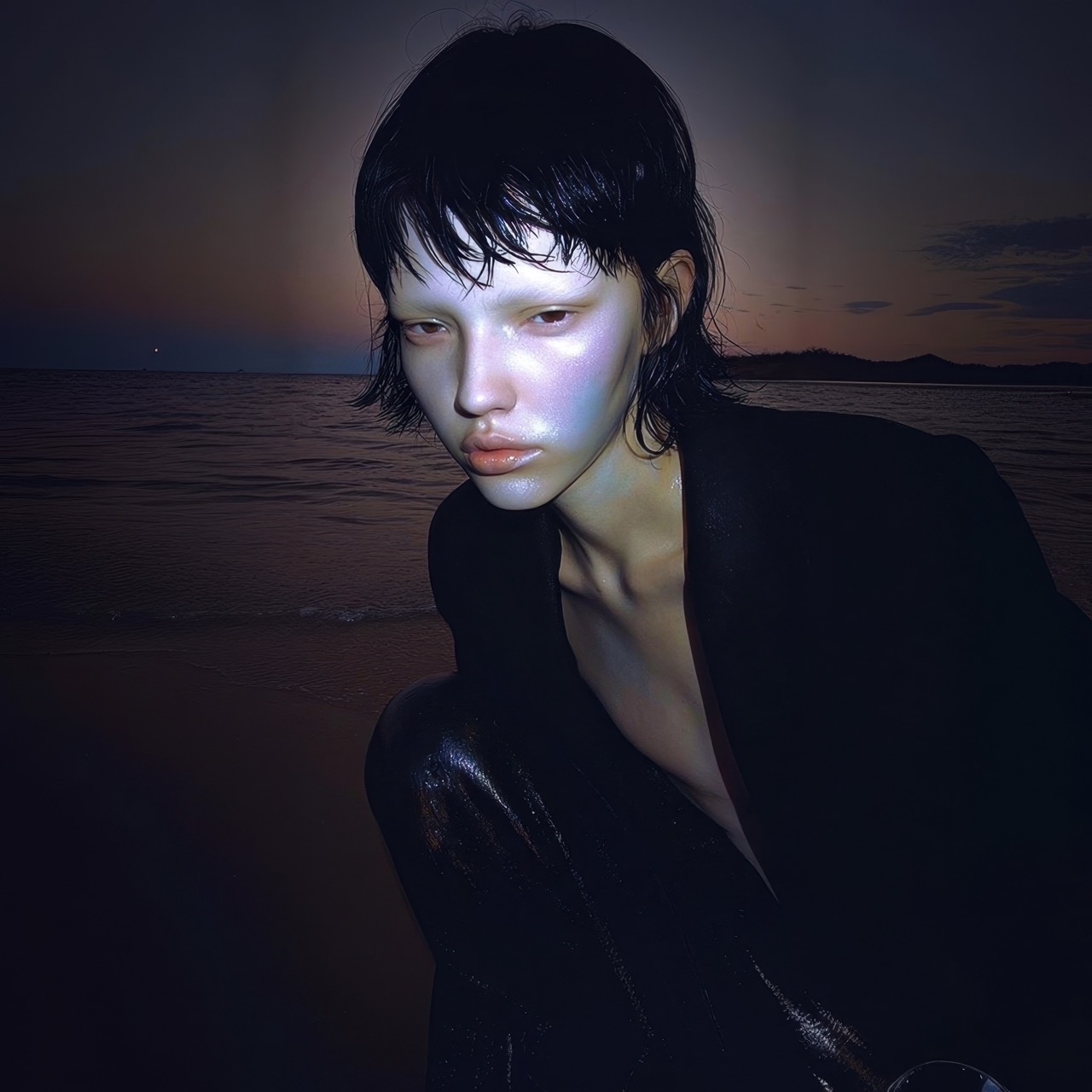
Hindi Sousan, Overdose 5, 2025
“The risk is when this freedom turns into a new norm. When AI is used to polish, homogenise, and over-perfect. If it becomes a tool of conformity rather than a tool of rebellion, then it imprisons instead of liberates. That’s where the danger lies.”
How can we guarantee a new line of creators treating AI with the amount of mindfulness and care evoked by Sousan’s praxis, when the flipside of the coin is just as readily available, and even easier to access in its malicious, countersocial reasoning? What happens when AI ultimately reconvenes with the lot it has been conscripted into today’s societies — labour automation (which includes the more fun part of labour too: fashion editorials, beauty, modelling), easing task performances, and extended surveillance? Leaving the dystopian factor aside — what happens if, by turning a blind eye to its infiltration, we further normalise slop as art, and art as content? Will art continue to speak to us, or will it simply function as attention-grabbing material, its sole purpose being revenue growth by leveraging generative AI instead of human creativity? Our critical thinking is already risking erosion due to normalising a Gemini or Grokk consultation prior to reacting to content intuitively. But what about this very “content” itself?
There’s still so many questions left unanswered — the kind of questions that require our collective, human thinking efforts, which ChatGPT cannot elucidate on its own beyond inane tautologies.
Talking to casting director (and friend) Michiel van Maaren, I expressed some of these concerns to him. I was very happy with his optimism, which did not reside in compliance nor ignorance (this dichotomy usually being the solution spectrum within this topic). We talked about the Zara stand-in AI models, the Adidas AI marketing scheme, the AI-generated models in Vogue, and of the fake-Luigi Mangione ad for Shein, which absurdly summarises the broad dialogue. One thing that Michiel insisted on, which evaded me in the mental gymnastics of my own process with generative AI (despite being super intuitive), was that all this seemingly “AI-ed” imagery has one thing in common — the presence of a real person behind its synthetic alteration. The human factor can never be superseded (at least not creatively), since that is the base on which all creative mechanisms of LLMs and image generating systems work upon — however uncanny, however devoid, or however much of a facsimile, AI is scaffolded around creativity endemic to humanness. Even the term “generative” feels euphemistic in ways, since there is no real generation most of the time — it is mere regurgitation.
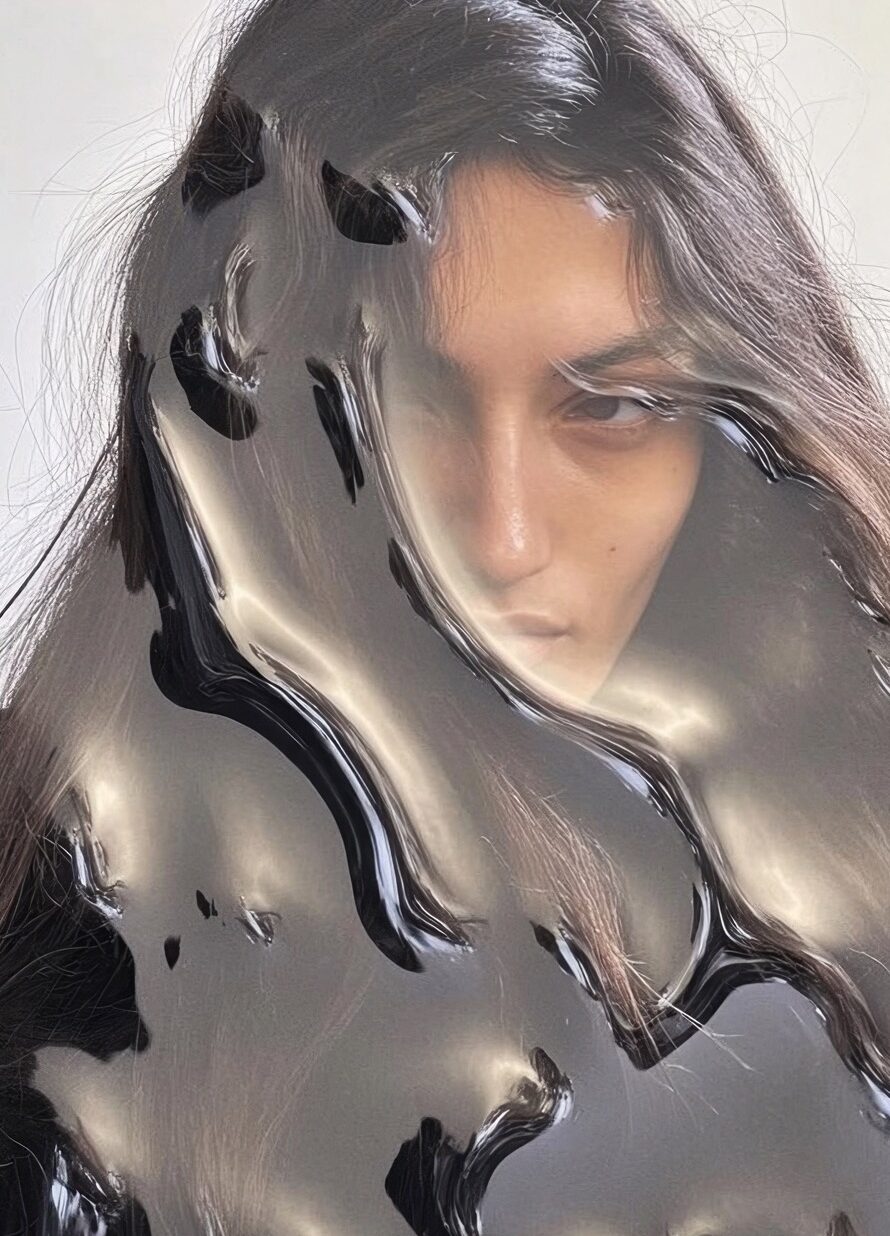
Hindi Sousan, Overdose 2, 2025
Having closely worked with models his entire career, he understands both the excitement that comes with the possibility of image enhancement, and the dread of being replaced by a deepfake that has potentially clearer skin or a smaller waist than you. But a universal truth of what fashion does and how it operates is by capitalising off of, reproducing and further selling fantasies. As long as the consumer force of the industry finds itself in the human realm, its selling points have to be (at least tangentially!) evoking human form. The unattainability of the fantasy might have to stop at invite-only shows, a perfect silhouette by an Ibiza pool, wearing an Ephemeral Dyadic scent, Fendi mink coats in Manhattan winter, or other scarcely defined ideas of success and abundance. By extension, a futuristic, subtle transformation of one’s face, á la Hind Sousan — applied on a person in demand for it, consensually at that. But once the implausibility of the reverie exceeds the bounds of actual flesh-and-bones prospect, it loses its enigmatic allure.
“Criticism often mentions authenticity, the fear of losing a soul, or the threat to the makeup profession. But every image is already a fiction, a construction. AI only makes visible what photography and makeup have always done: transform reality. My work doesn’t replace makeup, it extends it. If it disturbs, it’s precisely because AI puts our relationship to truth into crisis. And I think it’s a necessary crisis” — Hind Sousan.

Hindi Sousan, Overdose 3, 2025
In this sense, one of the real problems of AI in fashion is that reality is becoming the new luxury. But as an art, fashion has been perpetually defined by reaction, its undefeatable nature owing to the very mechanisms it uses to keep itself alive. Its cogwheels rotate incessantly as a result of its reactive capabilities, of making political climates, social unrest, and overall present-illegibility somewhat more communicable and lucid. If the claim of reality becomes the new battlefield of fashion in its self-defence, then so be it. There will permanently exist undying forces used as retaliation against fashion’s undermining — even if that means real, flesh-and-bones photographers, real models and real sets become the new fantasy. Michiel, when I asked him to conclude his take on it, urged me (and you) in a profoundly gen-Z rhetoric — go touch some grass! Beauty will forever reside in the outside, in the amalgamation of lives constituted by our awkward, friction-y ways of cohabiting this earth. Its immense power will never be perfectable by AI or any mechanism that will succeed it. Sit in the metro, turn off your phone, and start looking around — however cliché, however non-innovative and analogue, that’s where beauty lies, the spring from which it will be eternally sourced. And that will never cease to be the primordial fantasy.
Introduction by Evita Shrestha
Words by Luna Sferdianu
Images courtesy of Hind Sousan